“One is not born a woman. One becomes one.”
Simone de Beauvoir
Each of us is enculturated. This is a lifelong process in which our identities are formed. Through enculturation we learn many things. Not least, perhaps, we learn gendered identities of what it is to be a man or a woman, and we learn those behaviours that, broadly speaking, society encourages, sanctions, or condemns. It is through language that a great deal of enculturation occurs. Language works to reflect social life, but it also exists as a social fact to construct it. This is not, of course, to suggest that enculturation wholly determines individual identity, or to deny the possibility of cultural change.
In the advertising world, images of men and women are used to promote products of all kinds. You arguably might expect images of the female body to be used in advertisements for, say, beauty products or cosmetics. But the bodies of women are used to sell a far wider range of items, from alcohol, to cars, to household appliances! The same goes for men in the media. In a seminal report after an investigation into the media, (Tough Guise: Violence, Media and the Crisis in Masculinity), Jackson Katz and Jeremy Earp argue that the media provide an important perspective on social attitudes – and that while the media are not the cause of violent behaviour in men and boys, they do portray male violence as a normal expression of masculinity.
In this section we are going to focus on the way adverts create representations of women, and see how the repetition of these images can shape cultural values and expectations about what it means to be a man or a woman, and shape our unrealistic perceptions of beauty and sex too. Begin by choosing a couple of items from the reading lists below to get a crash course in issues of representation for men and women:
WoMan
- Beauty (IB textbook extract)
- How Media Portrayal Affects Women (article from the Geena Davis institute)
- Mad Men and Invisible Women (Guardian article)
- How Today’s Toys May Be Harming Your Daughter (National Geographic article)
- You’ve Come a Long Way, Baby (The Atlantic article)
- AI Winding Back the Clock on Beauty and Self-Esteem (Campaign article)
man
- Masculinity (IB textbook extract)
- It’s About Money and Muscles (Guardian article)
- From Lad to 4D Man (Guardian article)
- How Men Get Penalised for Straying from Norms (article by David Mayer)
- How the Media Defines Masculinity (handout)
- Masculinity is Changing For Better or Worse? (article at Daily Targum)
- The Many Ways Society Makes a Man (National Geographic article)
Reading Challenge
This is a longer and more challenging text, but spending time on this piece, and discussing it with your teacher, will help you master this topic:
Area of Exploration Guiding Conceptual Question
All varieties of writing, whether they are fiction or non-fiction, ads, news reports, poems or whatever can be seen as a product of the environment in which they were produced. Writing can be affected by the political climate, major events, trends within society or what is considered acceptable or aesthetic during the writing process.
With a focus on the changing representation of women on the cover of Cosmopolitan magazine as a response to a societal shift in the way women are depicted in the magazines they read, this resource will guide you through the conceptual question:
Discussion Points
After you’ve got your head around the material in this section, pair up, pick a question, spend five minutes thinking and noting down your thoughts – then discuss your ideas with a friend and report back to the class:
- The label ‘toxic masculinity’ has gained a lot of traction in the media recently. What do you understand this label to mean? What kind of behaviours are ‘toxic’? Are there any examples of ‘toxic masculine’ behaviour in the media at the moment? How widespread is this phenomenon? Do you think this label is being thrown around a little too much or is it about time men got called to account for their behaviour?
- Does it ever benefit women and girls to subscribe to the ideal beauty images in advertising and chase after the female beauty ideal? When might it be beneficial to do so – and when might it be self-destructive?
- Do you feel that cultures and societies are opening up to embrace women and girls who go against the ideals of feminine beauty? If so, in what ways? Are there still aspects of beauty that are excluded in even the most willing cultures?
1. The Commodification of Women’s Bodies
“The image isn’t real: it’s artificial, it’s constructed, it’s impossible.”
Jean Kilbourne, Killing Us Softly (abbreviated)
‘Sex sells” is an oft-heard adage in the advertising world, where nudity, suggestion and unrealistic models are used to promote products of all kinds. In this section you will learn how women’s bodies are repeatedly objectified, trivialized, dismembered and sexualized for mass consumption. Given that the stereotypes surrounding gender in advertising are fairly well known, and often criticized, you might think that advertisers would work towards representing men and women in less stereotyped ways. And it is true that, in many cases, advertisers make a conscious effort to represent people in ways that do not rely on stereotyping. However, in other cases, the same stereotypes appear again and again in advertising. Or older stereotypes simply give way to newer ones. Watch Kilbourne’s impactful and engaging talk, making sure you learn the ways women’s bodies are packaged for consumption in adverts and the wider mass media.
Activity: Unpacking Stereotypes
At one point in her talk, Jean Kilbourne says, ‘In some ways we’ve come a long way…’. and this activity might shed some light on what she means. Spanning roughly from the post-World War II era through to the 1970s, the Golden Age of Advertising was a transformative period for consumer culture – and a defining moment for gender representation in media. During this time, advertising agencies embraced mass media, particularly magazines and television, to shape ideals of femininity and domestic life. Unfortunately, these campaigns often reinforced narrow, prescriptive roles for women, embedding stereotypes that persisted for decades and are still noticeable in today’s cultural conversations about women in society.
Use the resources below to find out more about these stereotypes, and how they can be unpacked. Consider displaying the images in a gallery walk to give yourselves a taste of how all-pervasive advertising can be, and how being surrounded by certain values can normalise even the most insidious of messages.
2. Money, Muscles, and Masculinity
“The media is not to blame for the troubling status of boys today… but [it] does indeed reinforce society’s notions about manliness and masculinity.”
Boys to Men, 1999 Children Now report.
In 1999, Children Now, a California-based organization that examines the impact of media on children and youth, released a report entitled Boys to Men: Media Messages About Masculinity (see Wider Reading below for the full article). The report argues that the media’s portrayal of men tends to reinforce men’s social dominance. The report observes that: the majority of male characters in media are heterosexual; male characters are more often associated with the public sphere of work, rather than the private sphere of the home; non-white male characters are more likely to experience personal problems and are more likely to use physical aggression or violence to solve those problems. Use the images in this PPT, taken from advertising, to uncover coded messages about what it means to be a man in the media:
Activity: Modern Masculinity
In 2021, Guardian journalist Iman Amrani created a series of short video interviews with men across the UK about the issues affecting men and boys today. Her aim was to answer the question: Is modern masculinity in crisis? Links to different films in this series are posted here. Divide the videos amongst people in your class. Watch a single film, make brief notes about the issues and representations of masculinity you learn about, and report your findings back to the class. To bring this activity to life, after watching some of these short films you could hold a debate in your class using the motion: This house believes there is a crisis of masculinity among young men in the world today.
3. Alternative Representation
“Normativity: The process by which some groups of people, forms of expression and types of behaviour are classified according to a perceived standard of what is ‘normal’, ‘natural’, desirable and permissible in society.”
From July – August 2020, the Barbican in London showcased an exhibition of film and photography called Liberation Through Photography exploring how masculinity has been coded, performed, and socially constructed from the 1960s to the present day. The images collected in this exhibition touch on themes such as patriarchy, queer identity, female perceptions of men, hyper-masculine stereotypes, black masculinity and masculine tenderness. You can browse through the images from this exhibition that have been collected here to discover new ways of representing masculinity in photographs and images.
Activity: Authentic Representation
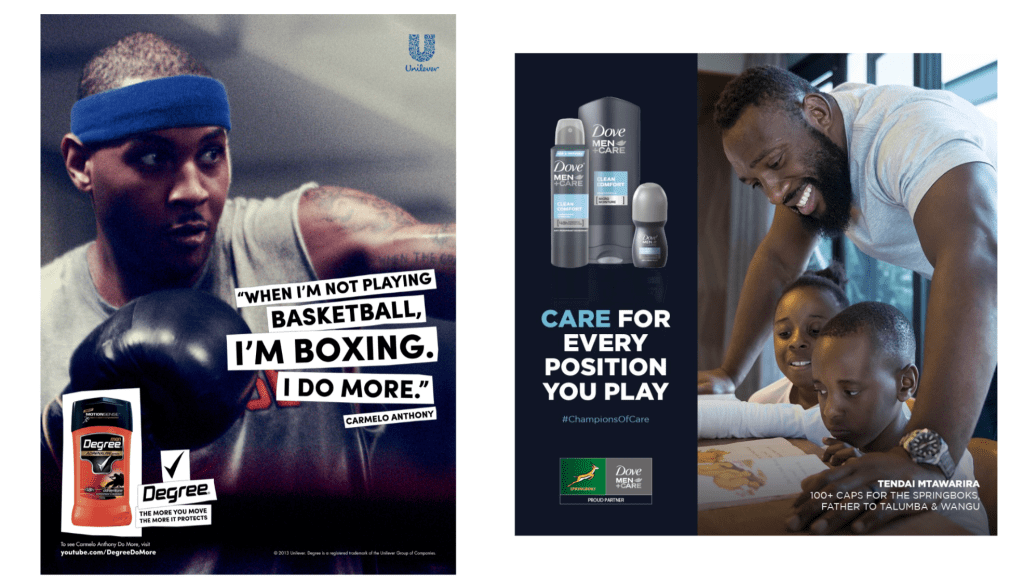
Research how images of men are developing and changing in advertising by exploring one of the following campaigns (or find a campaign you would prefer to investigate). Choose a single image or advert and present it alongside an older, more stereotyped image of masculinity/femininity. Explain how the representation of men or women has altered between your two ads, and evaluate to what extent the media images are presenting an alternative vision of masculinity/femininity, or if the media is sending mixed messages about what it means to be a man or a woman today:
Men
- Lynx Find Your Magic
- Fight the Stigma (Unmute)
- Dove Men + Care
Women
- Dove Real Women
- Holland & Barret Me. No. Pause.
- Victoria’s Secret Undefinable
- Nike Dream Crazier
Alternatively, there are plenty of opportunities to investigate alternative representations of men and women through Body of Works beyond advertising. For example, you might consider attempting this exercise using Come to Selfhood. In this exhibition, photographer Joshua Rashaad McFadden combines portraits of young African American men alongside handwritten texts and photos of their fathers or father figures as a response to society’s stereotypes of and misconceptions about black masculinity.
Learner Portfolio: How X Teaches Masculinity/Femininity
“What are guys learning? Are they absorbing the lesson that it’s the male’s job to defeat the villain?”
Watch this TedTalk by Colin Stokes, in which he compares and contrasts two popular movies and considers the hidden messages they contain about gender identity.
Afterwards, choose a text you are familiar with. This could be an advert, music video, song, literary work, magazine, TV show, computer game, or any other text you know that might be suitable for this exercise. Remind yourself of this text, then create a piece of work called ‘How X Teaches Gender Identity’, where X is substituted for the name of your text. Think about what format of work you might like to undertake: you could create a presentation, a mind-map or other visual guide, write an article, or even create your own TedTalk! Share your work with your class, then add it to your Learner Portfolio.
Body of Work: James Bond Film Posters
An icon of masculinity for almost seven decades, James Bond is the quintessential man’s man. ‘Bond, James Bond,’ ‘shaken not stirred’ and ‘license to kill’ have entered the popular lexicon – whoever you are and wherever you come from, chances are you’ll recognise the moniker Bond and images of this suave spy will leap into your mind. Making his first appearance in 1953 spy novel Casino Royale by Ian Fleming, in 1962 he made the jump to the big screen in his first movie outing, Dr. No, and hasn’t looked back since.
Why is Bond such an enduring character? In many ways, he is the idealised version of masculine stereotypes: tough, patriotic, effective, stoic. He’s a slick operator, rarely being ruffled by the sort of danger that would send most of us into a screaming panic. He’s magnetically attracted to women; yes, he’s a womaniser, but he frequently demonstrates a genuine emotional attachment to certain women along the way. He’s a suave and sophisticated gentleman, so women bring out his chivalrous side, need to protect, and sometimes even to love.
You can study this idealised image of manhood in the posters that market his films, which are collected together here to form a Body of Work. The movies, and therefore the posters, respond to cultural shifts in the expectations surrounding manhood, and can be analysed as a record of such changes. The question can be asked: does Bond represent stereotypes about men, or does he transcend them?
Towards Assessment: Individual Oral
Supported by an extract from one non-literary text and one from a literary work, students will offer a prepared response of 10 minutes, followed by 5 minutes of questions by the teacher, to the following prompt: Examine the ways in which the global issue of your choice is presented through the content and form of two of the texts that you have studied. (40 marks)
If you want to, you can discuss the images presented here as a non-literary Body of Work in your Individual Oral exercise. All 25 Bond films have been produced by Eon and the Metro-Goldwyn Mayer Studios, so this can be your named author. In terms of Global Issues, this Body of Work is a rich source of information for the Hollywood representation of men (and women), but you can explore other avenues such as the glamorisation of violence in the media or even the aesthetic qualities of advertising: these posters are iconic and many have become collectors’ items. As always, follow your own ideas and class discussions when creating your assessment tasks:
- Field of Inquiry: Culture, Community and Identity
- Global Issue: how men relate to women in toxic or harmful ways
- Rationale:
This poster collection lends itself well to any issue in the study of masculinity, and in particular how men relate to women, who are a feature of most of these posters. What roles do the posters allow women? How are they positioned in ways that imply a relationship with Bond? Famously, James Bond is an inveterate womaniser and you could speak about how that is conveyed through the imagery and text of these film ads. Any number of literary texts may relate to this global issue; an example might be The Merchant of Venice by William Shakespeare, specifically the lesser-studied interactions between Jessica and Lorenzo, which are fraught with tension. Alternately, closely examining the way Yeong-hye is treated by male characters in The Vegetarian by Han Kang would make an interesting pairing.
- Field of Inquiry: Beliefs, Values and Education
- Global Issue: the association of masculinity with violence
- Rationale:
It’s hard to ignore the most conspicuous symbol of these posters: the gun. A straightforward symbol of violence, it’s also a phallic symbol, coding violence as a natural expression of male behaviour. To what extent these posters glamourise or normalise violence would be a great question to ask and answer in your oral assessment. You’ll want to pair this Body of Work with a literary text that also makes the link between violence and masculinity. Sadly, that shouldn’t be too hard. Death and the Maiden by Ariel Dorfman is a straightforward pairing in which the symbolism of the gun is prominent. You might also consider Night Sky With Exit Wounds by Ocean Vuong, for a similar match up.
Towards Assessment: Higher Level Essay
Students submit an essay on one non-literary text or a collection of non-literary texts by one same author, or a literary text or work studied during the course. The essay must be 1,200-1,500 words in length. (20 marks).
If you are an HL student who must write your Higher Level Essay, you could consider using this body of work. Analysing the rhetorical and aesthetic qualities of images is suitable language and literature work, and choosing a small selection of the images in this collection would make for a purposeful study. Here are one or two examples of lines of inquiry suitable for this text – but remember to follow your own interests and the direction of your own class discussion to generate your own line of inquiry. It is not appropriate for students to submit responses to an essay question that has been assigned:
- How do images of men and women in posters from the James Bond marketing campaign reflect shifts in relationships between men and women over time?
- How does the iconography and imagery used in the James Bond poster collection create a certain expectation of masculinity for the audience?
Paper 1 Text Type Focus: feature articles
At the end of your course you will be asked to analyse unseen texts (1 at Standard Level and 2 at Higher Level) in an examination. You will be given a guiding question that will focus your attention on formal or stylistic elements of the text(s), and help you decode the text(s)’ purpose(s). Below are resources and articles taken from magazines. Use these practice texts to familiarise yourself with the different features of magazines articles, then add them to your Learner Portfolio; you will want to revise text types thoroughly before your Paper 1 exam. You can find more information – including text type features and sample Paper 1 analysis – by visiting 20/20. Read through one or two of the exemplars, then choose a new paper and have a go at writing your own Paper 1 analysis response:
Key features of feature articles
- Headline: bold text that reveals the topic of the article and should provide a hook for the reader.
- Images: photographs of people and places are common features of magazine articles. They are almost always posed, not natural, and are often as prominent as the copy.
- Layout: look out for box-outs, bullet points, ears and other kinds of layout features.
- Entertainment: although they might be topical and current, most magazine articles are designed to entertain. Information may be displayed in an appealing way, using pull quotes and subheadings.
- Buzzwords: being up-to-date, relevant and current means some articles make use of buzzwords and words that are popular at the time of publication.
- Interactive Features: increasingly, articles that would traditionally have been printed in magazines are being published online. In this case, look out for interactive features such as embedded videos, hyperlinks and tabs.
- Embedded interviews: experts on or participants in the topic at hand are often interviewed and quotations are used throughout the article. In the case of celebrity articles, the whole piece could be the write-up of an interview.
Further Reading
- Media Portrayal of Girls and Women – Mediasmarts website
- Miss Representation – documentary film by Jennifer Newsom
- The Autocomplete Truth – a series of ads uses genuine Google searches to reveal the widespread prevalence of sexism and discrimination against women (useful as an alternative body of work)
- The Mask You Live In – documentary film by Jennifer Newsom
- Boys to Men – the seminal 1999 Children’s Now report
- What Even Is Masculinity? (According to Cinema) – a coldcrashpictures video essay
- A Man’s World: How Music and Masculinity Got a Makeover – an article at Elephant
- Men’s FashionThroughout History (Transcript Mag article)
- How Gendered Packaging Reinforces Gender Stereotypes – a brilliant blogpost by Giorgia Lombardo available at Medium
 IB Language and Literature 3.0