“[Edward] Bernays… showed corporations how they could make people want things they didn’t need by linking mass produced goods to their unconscious desires.”
The Century of the Self – Part 1: Happiness Machines
Five thousand years ago, the Babylonians hung symbols over their shop doors depicting what kind of trade went on inside and, voila, the first advertisements were born (this practice still exists today; you might have noticed the white and red twisted poles outside some barber shops, for example). From ancient Egyptian engravings on the walls of desert canyons, to the traditional medieval European town-crier, to the pop-up ads that appear every time you log on to your computer, people have always found ways to attract other people’s attention to a product or service for sale. Advertising may have become more prevalent over the years, but wherever communities and commerce exit, so too does advertising.
In this section, you’ll learn a short history of one of the most pervasive forms of language: the advert. The industrial revolution and the increased prevalence of available goods woke manufacturers up to their ability to make people want particular products or services; increased competition intensified the need for professional advertisers; the proliferation of radio and television expanded their reach; the explosion of the American economy after world war two cemented advertising’s ‘Golden Years’; the advent of the digital age cheapened the production of ads and speeded their dissemination to a wider and wider market. To flesh out this story somewhat, and to begin your study of advertising texts, read one or two of the following articles and report back what you’ve found out:
- The History and Evolution of Advertising (by Antonio Gallegos writing for Tint)
- Advertising (interactive timeline by History of Information)
- The Entire History of Advertising (Softcube blog)
- Medieval Spam: The Oldest Advertisements for Books
- 10 Classic Images from the Golden Age of Advertising (article by WebUrbanist)
- The 1960s: The Golden Age of Advertising
Reading Challenge
This is a longer and more challenging text, but spending time on this piece, and discussing it with your teacher, will help you master this topic:
Discussion Points
After you’ve got your head around the material in this section, pair up, pick a question, spend five minutes thinking and noting down your thoughts – then discuss your ideas with a friend and report back to the class.
- What is ‘success’? How is success depicted in advertising? Who gets to be successful in advertising? Does advertising offer an alternative vision of success to the mass media, or does it replicate messages you see elsewhere? What other definitions of success might there be that you do not see in advertising?
- How many adverts do you think you see in a day? Do you think there are too many adverts in today’s world? Does being surrounded by advertising affect people in negative ways? Do you think the number of adverts people are exposed to should be regulated more strictly?
- What does it mean to be a citizen, a consumer and a conscious consumer? How does advertising encourage or discourage you to be one or more of these things? How does advertising create or erode a sense of community?
Area of Exploration Conceptual Guiding Question
No text is read or written in a vacuum and that is as true for advertisements as it is for major literary works. Both the historical time and the geographical or cultural space a text is written in has an enormous influence on its content and delivery. Similarly, no text is interpreted outside of these factors either. In this section, you will learn about the contexts of production and reception. This resource begins and ends with a consideration of advertising texts, how advertising conventions have changed over time, and how the same text might be read and interpreted differently by different readers.
1. Five Thousand Years Ago…
“Tell the truth, but make the truth fascinating.”
David Ogilvy, Confessions of an Advertising Man, 1963
Advertising has been shaping human communication for millennia. Its roots stretch back to ancient Egypt, where merchants carved sales messages on papyrus and stone. In Ancient Rome, graffiti on walls promoted gladiator games and local businesses – and prostitution! – while in China, engraved iron plates were used to print advertisements as early as the 10th century. These early efforts laid the foundation for a practice that evolved as commerce slowly enveloped the globe. The Industrial Revolution in the 18th and 19th centuries transformed advertising into an industry. Mass production created the need for mass persuasion, and newspapers became the primary vehicle for ads. By the early 20th century, advertising embraced psychology and branding, turning products into lifestyle status symbols. Figures like Albert Lasker and Claude Hopkins pioneered persuasive copywriting, while the mid-century Golden Age of Advertising introduced creativity and storytelling through print and television.
The late 20th century saw the rise of global brands, celebrity endorsements, and emotional campaigns that defined modern marketing. Today, advertising thrives in the digital age, powered by data analytics, social media, and AI-driven personalisation. From papyrus scrolls to programmatic ads, the journey of advertising reflects humanity’s enduring quest to connect, persuade, and influence one another. You can find out all about the history of advertising, with summaries of major milestones, in this one-stop presentation resource:
Activity: Selling More Than Stuff
Up until 1929, it had been illegal for women to smoke in public. One man changed that: Edward Bernays, the ‘father of public relations.’ He organised a ‘Torches of Freedom’ march on Easter Day in New York. On cue , his secretary and all her friends lit cigarettes and smoked them – right in front of gathered photographers and reporters positioned in advance by Bernays to catch the moment. Lucky Strike – the tobacco company that had hired Bernays as public relations consultant – saw their potential market double overnight! From this moment, Bernays ran adverts with pictures of women holding cigarettes and women began to feel confident about smoking in public. A legendary ad campaign was born.
Edward Bernays was the first to link ads to people’s subconscious desires; modern advertising has embraced this philosophy wholesale. Put adverts to the test with this simple word-association activity. You will see a range of adverts that sell products and services – but also sell ideas, attitudes, beliefs, feelings and desires. Note down your responses and discuss how other people in your class responded too:
2. The Golden Age of Advertising
“Advertising is salesmanship in print.”
Albert Lasker
Referring to a period roughly spanning 1950 – the 1970s, The Golden Age of Advertising is romantically named because of the glamour, creativity, and influence of the industry. This period marked a turning point in how brands communicated with consumers. Fueled by the explosive rise of television, which became the dominant medium for reaching mass audiences, advertisers embraced the power of moving images and sound, creating memorable jingles, slogans, and characters that became household names.
At the heart of this period was a shift in advertising strategy. Instead of relying on hard-sell tactics, ads began to use humour, storytelling, and emotional appeal. Campaigns such as Volkswagen’s ‘Think Small’ and Coca-Cola’s ‘It’s the Real Thing’ didn’t just promote products: they also sold ideas, lifestyles, and aspirations. Advertising evolved into an art form, incorporating psychology alongside creativity to shape consumer desires. Golden Age influences still resonate even now, as many principles of storytelling and branding trace back to this iconic era.
Activity: The Context of Production
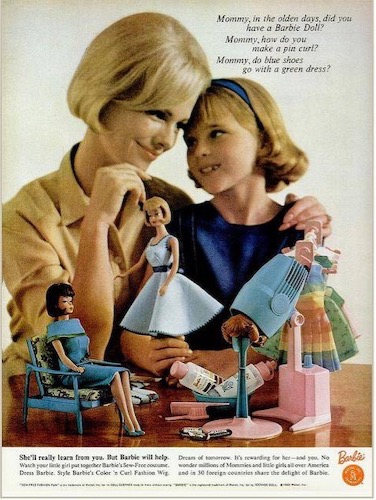
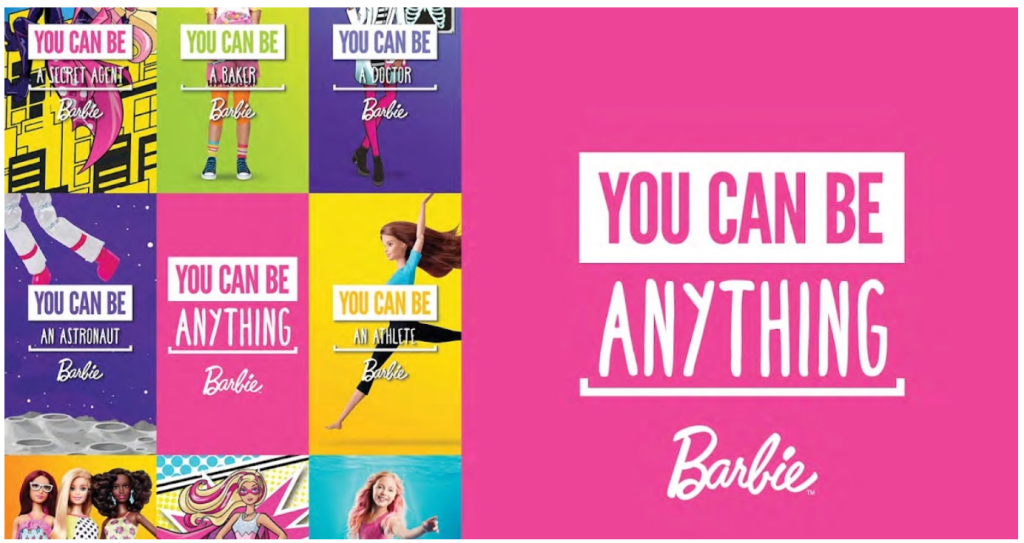
Research a product or brand from the ‘Golden Age of Advertising’. Find an advert from this time period and present it side-by-side with a modern day advert for the same product. Annotate the two images with your ideas and explainers about what has changed in advertising style, composition, methods of reaching an audience, or the messages and values adverts send. Present your ideas to your class, or write a comparison of the two ads.
Learner Portfolio: Back to the Golden Age
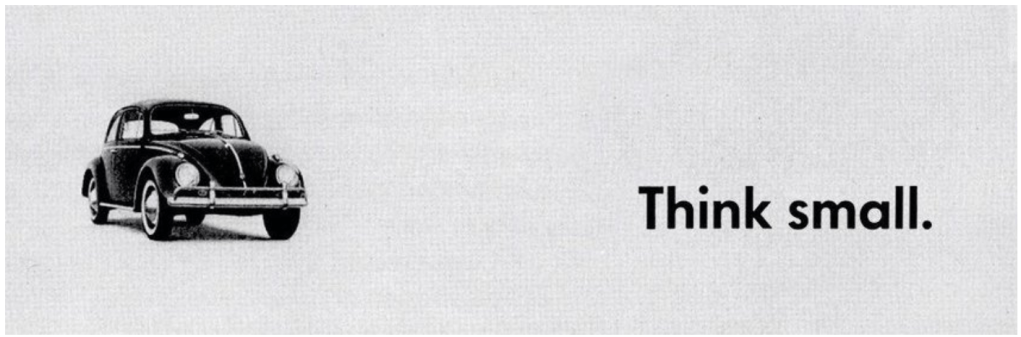
Step into the world of the 1960s Chicago Mad Men and experience advertising’s most creative era! In this activity, channel the spirit of the Golden Age by taking an everyday product and transforming it into a status symbol. Your mission: design a poster that radiates aspiration and success. Think sleek visuals, clever copy, and a message that makes ordinary feel extraordinary. You might invent a catchy slogan, create a memorable character or figure, or try out a mind-bending concept makes your product impossible to resist. This challenge isn’t just about selling; it’s about storytelling, persuasion, and capturing the essence of an era when advertising shaped culture. When you’ve finished your design, present it to your classmates, enter it into your Learner Portfolio – or even make it for real using design software and display it in your classroom!
Body of Work: Lucky Strike Print Ads
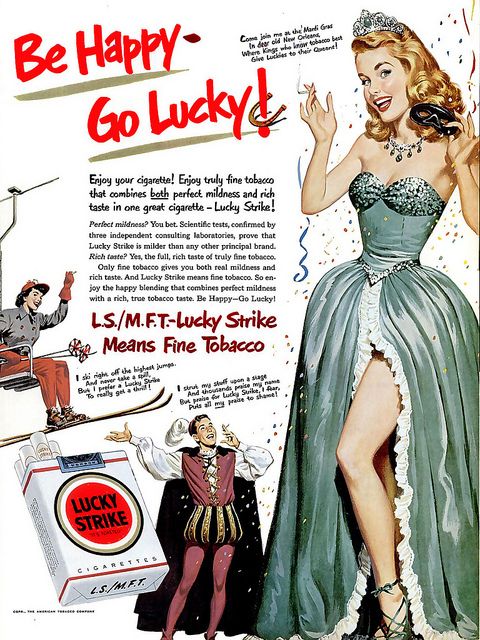
You’ve already met Edward Bernays, the pioneer who first linked advertising to the subconscious desires of consumers. Now it’s time to see how one brand ran with that idea and reshaped its identity over decades. In this Body of Work, you’ll dive into the fascinating history of Lucky Strike, a campaign that mirrored cultural shifts from the 1910s through the 1950s. Explore how early ads suggested cigarettes could even be good for your health (!), then trace the move toward glamour and sophistication as smoking became associated with celebrity allure. Watch how patriotism entered the picture during World War II, turning Lucky Strike into a symbol of American pride. Each era tells a story about changing values, aspirations, and the persuasive power of advertising.
Analyse the ads that have been collected here into a single Body of Work for ease of study. Decode the strategies behind them, and uncover how Lucky Strike evolved from a simple tobacco brand into a cultural icon. This investigation will reveal how advertising doesn’t just sell… it shapes identity, status, and even national sentiment.
Towards Assessment: Individual Oral
Supported by an extract from one non-literary text and one from a literary work, students will offer a prepared response of 10 minutes, followed by 5 minutes of questions by the teacher, to the following prompt: Examine the ways in which the global issue of your choice is presented through the content and form of two of the texts that you have studied. (40 marks)
Here are a couple of ideas about how you might develop a study of one of these Body of Works into a proposal for your IO, or how you might productively link a Body of Work with some different Literary Works. However, you should always be mindful of your own ideas and class discussions and follow the direction of your own thoughts, discussions and programme of study when devising your assessment tasks.
- Field of Inquiry: Art, Creativity and Imagination
- Global Issue: The Need for Escapism
- Rationale:
Whether a student grinding away through mountains of homework, someone working 9-to-5 just to pay the bills, or a person who gives up everything for their career, the need to step outside our own lives, retreat into our imaginations and dream dreams is a universal part of living and working in the world. Yet, in terms of the Lucky Strike campaign, you might like to consider how canny advertisers exploit the boundaries between healthy escapism and a more cynical distortion of reality. If you’re searching for a literary work to pair with one of these campaigns, look no further than a poetry collection such as John Keats’ ode sequence or Ocean Vuong’s Night Sky With Exit Wounds, both of which depict imagination as the key to resolving the existential crises of the writers.
- Field of Inquiry: Beliefs, Values and Education
- Global Issue: The manipulation of language for dishonest means
- Rationale:
Advertisers are experts at using language to lead and mislead. From the early adverts where Lucky Strike try to convince you that smoking is good for your health, to later ads that associated the brand with patriotism and American efforts in World War Two, these adverts showcase all kinds of rhetorical methods, both verbal and visual, that are used to manipulate the reader. An example of a literary work in which characters try to manipulate each other is Glengarry Glen Ross by David Mamet, featuring a cast of salesmen expert at twisting language around in order to sell worthless real estate to unlucky clients.
Here is a recording of the first ten minutes of an individual oral discussing Lucky Strike adverts for you to listen to. You can discuss the strengths and weaknesses of this talk as a way of improving your own oral presentations. Be mindful of academic honesty when constructing your own oral talk. To avoid plagiarism you can: talk about a different global issue; pair your adverts with a different literary work; select different passages to bring into your talk; develop an original thesis.
Towards Assessment: Higher Level Essay
Students submit an essay on one non-literary text or a collection of non-literary texts by one same author, or a literary text or work studied during the course. The essay must be 1,200-1,500 words in length. (20 marks).
The adverts in this collection would make a perfect case study for an extended written task. Beginning in the early 1900s and continuing through to the 1950s, these campaigns demonstrate how a text changes in response to social and historical developments. Whatever topic you choose to investigate, you should develop a line of inquiry and include a range of advertisement texts, with a focus on exemplar adverts. Here are one or two examples of lines of inquiry suitable for this text – but remember to follow your own interests and the direction of your own class discussion to generate your own line of inquiry. It is not appropriate for students to submit responses to an essay question that has been assigned:
- How do images of men and women reinforce existing gender roles and expectations in society in early 20th century Lucky Strike advertisements?
Paper 1 Text Type Focus: historical adverts
Advertising is a wide and varied genre, ranging from print ads that you might find in a magazine to huge billboards overlooking a busy road, to posters on the sides of buildings, to webpages… and more. While ‘historical adverts’ is not necessarily a text type, conventions of advertising have changed over time, and you might want to practice with texts that are not necessarily modern or familiar. Therefore, the adverts in this section have been deliberately chosen because they are old-fashioned in style. Use these practice texts to familiarise yourself with these less-commonly-seen advertisements and add them to your Learner Portfolio; you will want to revise text types thoroughly before your Paper 1 exam. You can find more information – including text type features and sample Paper 1 analysis – by visiting 20/20. Read through one or two of the exemplars, then choose a new paper and have a go at writing your own Paper 1 analysis response:
 IB Language and Literature 3.0