“The basic definition of news as factual information that its viewers need in order to participate in society is only half the story.”
Robert Fiske, British Journalist (1946 – 2020)
Many people assume that the news offers a clear and accurate account of events as they happen. But if we pause and consider the practical realities of news production, this assumption quickly falls apart. News organizations operate under significant limits: television broadcasts are squeezed into 30- or 60-minute slots, newspapers have limited column space, and even 24-hour news channels and websites cannot cover everything. They must make choices of what to include, what to omit, and how to present things. However, these choices are influenced by more than simple time and space constraints. Commercial pressures play a major role: news outlets compete for audiences, advertising revenue, and ratings. Stories are often selected and framed to attract attention during prime viewing hours or to fit the interests of a target demographic. Cultural and societal norms also shape coverage, as news organisations tend to reflect the values and priorities of the communities they serve. As a result, the news does not present reality in its entirety, it offers a curated version of reality: reality slimline, reality-lite.
This section will help you explore and understand why and how this happens. We’ll look at some underlying assumptions that are so common, we’ve forgotten that they’re actually biases! Next, we’ll learn about subtle techniques (such as loaded language, slanted sourcing, and lack of context) that can influence your opinion without overly distorting facts. Then we’ll consider multiple challenges to journalistic integrity, including political pressure, the race to break stories first, and find out what the Overton window is and how it affects news reporting. Finally, we’ll look at modern media challenges, such as the rise of fake news, misinformation, and the growing role of artificial intelligence in deciding what we read and watch. By the end of this section, you’ll understand that news is not a neutral mirror of reality but a constructed narrative shaped by practical, economic, and cultural forces. Begin your study into some of the underlying issues in news reporting by choosing one or two of these articles and reporting back what you find out:
- Media Bias (extract from IB Textbook)
- How to Detect Bias in the News (a media literacy guide by FAIR)
- Evaluating News Bias (a Libguide)
- Media Bias (extract from Introduction to Media Studies by Pressbooks)
- How do you tell when the news is biased? (Nieman Lab article)
- When Truth Became “Liberal”: How the Overton Window Shifted (by Aldo Grech at LinkedIn)
- The Construction of Reality in Television News (essay by Mark Pease)
- AI Intensifying a Collapse of Trust Online (NBC News report)
- How the Media Industry Keeps Losing the Future (at The New York Times)
- Can We Think Critically Anymore? (Bigthink article)
- The Cult of the Amateur (New York Times)
- The Rise of the Fact (History Today)
- Facebook, Fake News and the Meaning of Truth (BBC article)
Reading Challenge
This is a longer and more challenging text, but spending time on this piece, and discussing it with your teacher, will help you master this topic:
Discussion Points
After you’ve got your head around the material in this section, pair up, pick a question, spend five minutes thinking and noting down your thoughts – then discuss your ideas with a friend and report back to the class:
- Is the news really a source of factual information? What does it mean that the news presents a ‘curated’ version of reality, rather than reality itself?
- How can you tell when the news is biased? Is it always possible to detect? What are the biggest give-aways that what you’re seeing is not the whole truth?
- Is the internet dumbing us down and making us lazier than ever? Or is it empowering people by giving easy access to information?
1. Inherent News Values
“The basic definition of news as factual information that its viewers need in order to participate in society is only half the story.”
Robert Fiske, British Journalist (1946 – 2020)
Sociologist Herbert Gans, in his landmark book Deciding What’s News (1979), revealed that news is not just a mirror of reality. Instead cultural norms and assumptions (such as ethnocentrism, altruistic democracy, responsible capitalism, and individualism) that influence what stories are told and how they’re framed. In all, Gans identified a pattern of eight inherent news values that underlie news media narratives. Understanding these values will help you see how political coverage champions certain ideals or how economic reporting praises entrepreneurship over greed. Gans’ insights pave the way to an understanding of bias, thinking about who sets the tone for the news, and lets us appreciate how subtle forces act on public opinion.
Activity: Gans’ Values In Today’s News
Grab yourself a copy of today’s newspaper (you can use Pressreader) or visit an aggregate website like Front Pages at Freedom Forum or Front Pages Today that give you the main headlines from around the world. If you have a single paper, look at the stories on the front page and those inside the newspaper. What values can you identify through the headlines and framing of the stories? If you are looking at an aggregate website, choose four or five front-page stories from different sources. For each story, say which of Gans’ inherent values are present in the headlines and framing. Then, consider if one or more of the values are dominant across different news media. Make notes on what you find and where, then submit or report back your findings.
2. Subtle Forms of Bias
“Choice of sources can shield extreme bias behind a façade of objectivity.”
Noam Chomsky
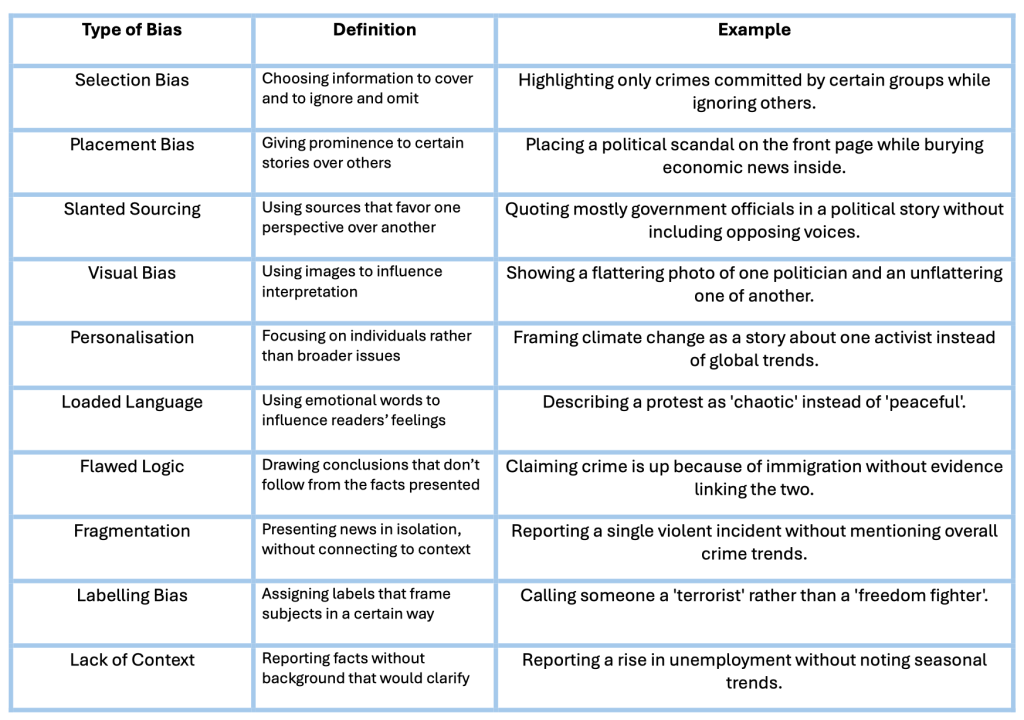
News isn’t always neutral. Journalists and editors make choices about what to report, how to present it, and which words or images to use. These choices can introduce bias, influencing readers’ and viewers’ perceptions without us even realising it. In the table above are ten common types of bias found in news reporting. By learning these patterns, you’ll become a more critical reader and better able to separate facts from distortion and falsification. Use this presentation to see examples of different kinds of bias from real world news reporting:
Activity: Bias in Climate Coverage
Climate change is one of the most pressing issues of our time… and also one of the most politically charged. It’s a topic that sparks strong opinions and often divides public opinion. Because of this, news coverage about climate change can easily reflect bias. Sometimes that bias is obvious, but more often it’s subtle: choice of words, the sources quoted, or the context provided can all lead how readers interpret the story. In this activity, explore how subtle biases appear in reporting. You’ll read three articles about climate change from different sources: a politically conservative source (Fox News) a neutral source (BBC) and a progressive source (The Independent).
However, the task is not to look for political bias or argue which perspective you think is right. Focus on identifying the biases that lead your opinion in a certain direction, wherever that may be. Loaded language, slanted sourcing, and labelling bias may appear in any or all of these sources, nudging your perception without explicitly saying so. Use the bias tracking worksheet to keep track of your observations as you read. If you think a source doesn’t contain a type of bias, simply leave that entry blank. After you share your findings, ask which biases most strongly affect readers, and what they might think about climate change should exposure to these biases continue over time. You can write up your conclusions for your Learner Portfolio when you are done:
3. Pressure and Censorship
“Journalism’s first obligation is to the truth”
Bill Kovach and Tom Rosenstiel, The Elements of Journalism: What Newspeople Should Know and the Public
Should Expect
Journalism is built on the principle of truth-telling, yet the path to truth is rarely straightforward. Reporters operate in a world of competing priorities like tight deadlines, commercial pressures, and the need to protect sources – all of which can challenge their ability to deliver accurate and complete information. Ethical dilemmas arise when the ideal of truth clashes with practical constraints. Should getting the exclusive out first ever trump the need to verify what’s right? Does the need to protect a source justify withholding key facts? How do financial interests decide what becomes news? Look at the presentation embedded here to find out about the pressures on journalists that might force them to cut ethical corners and create news that’s not truthful – whether intentionally or not:
Activity: Dramatising the News On The Small Screen
The Newsroom, created by Aaron Sorkin, is a critically acclaimed drama that explores the inner workings of a fictional cable news network. Known for its sharp dialogue and ethical dilemmas, the series examines the tension between journalistic ideals and real-world pressures. Arguably most famous for the opening scene of the pilot (star Jeff Daniels credits this scene for resurrecting his career), over its three year run of 25 episodes, the show often dramatised the struggle between getting the story first and getting the story right, dealing with challenges such as personal biases and external pressures on reporting along the way. In Season 1, Episode 4 (I’ll Try to Fix You, embedded above) the newsroom faces a breaking story about a tragic shooting, forcing the team to navigate the dilemma of accuracy, speed, and the responsibility to the truth, despite commercial imperatives and powerful pressure from above.
After watching this episode (or another episode of your choosing), identify at least two moments from the show that dramatise challenges to journalistic integrity. For each moment write a paragraph explaining what happened in the scene and which ethical principle or challenge does it illustrate (e.g. accuracy vs speed, sensationalism driving revenue, powerful pressure, and so on)? How does the show suggest such challenges can be reconciled or overcome?
4. Information Disorder: Modern Media Challenges
“The term ‘fake news’ doesn’t begin to cover all of this. Most of this content isn’t even fake; it’s often genuine, used out of context and weaponized by people who know that falsehoods based on a kernel of truth are more likely to be believed and shared”
Claire Wardle, Understanding Information Disorder
In today’s hyper-connected world, the flow of information is faster and more complex than ever before. Digital platforms have made news more accessible… but at the same time they have created fertile ground for information disorder, a term that encompasses other concepts like misinformation, disinformation, and malinformation. Like a Russian Doll hiding replicas of itself inside, these challenges contain fake news, misleading headlines, and manipulated content such as deepfakes, which blur the line between truth and fiction. Social media algorithms amplify sensational stories, and push content at you that, due to confirmation bias, you are more tempted to believe. The consequences? Increasing erosion of public trust in the news media and politics, polarisation which makes rapprochement harder to achieve, and the manipulation of fake news into policy that causes real-world harm. In this lesson, you’ll be encouraged to find out about these issues, learn how to spot them, and arm yourself against them with some simple media-literacy strategies.
Activity: Real or Fake? Fact Checking!
How alert are you to fake news? Does a dodgy headline send you into a spin? Or can you sniff out obfuscation and misinformation? In the resource embedded below are a mixture of real and fake news headlines based on stories that circulated widely online. Your job is to fact check the stories and discover whether it is real or fake news. Simple and accessible ways to discover if a story is true or false are: to search for the headline in a reliable news source (e.g. BBC, Reuters, Associated Press); to use fact-checking websites such as Snopes, PolitiFact, or FactCheck.org; to look for multiple credible sources reporting the same story:
Learner Portfolio: Dummies Guide to Information Disorder
In today’s digital world, misinformation spreads faster than ever, and understanding how to navigate this is increasingly becoming an essential skill for young people. Work in teams to research the concept of Information Disorder, involving topics like fake news, disinformation, misinformation, confirmation bias, echo chambers, filter bubbles, the role of AI in shaping media, and any other topics you encounter that you think should be included. Come together with what you’ve researched to create a Dummies Guide that simplifies these complex ideas for readers of your own age. Your guide should be clear, engaging, and practical, helping others learn how to spot misinformation and make informed decisions online. Break down key concepts like misinformation, disinformation, malinformation, and so on. Explain why these issues are important and how they affect society, and provide practical tips for detecting and avoiding fake news.
Importantly, you should practice research integrity throughout this assignment. Aim to present work that demonstrates the following attributes: effective quotation and paraphrasing (not copy-paste); accurate citation of sources; inclusion of credible and varied sources; clear summaries of complex ideas; create your own images rather than using found images (if found images are used they should be cited and credited).
Body of Work: Black Mirror – The Waldo Moment
Black Mirror is a dark satirical anthology series that examines disturbing aspects of modern society, particularly as it relates to technology. Each standalone episode presents a picture of a near-future world that’s believable, yet twisted in some way. In The Waldo Moment, Jamie is a comedian initially struggling to make it as the creator and voice of Waldo, his animated creation. However, bit by bit, Waldo becomes more and more popular until, despite Jamie’s scepticism about his own creation, Waldo is a hit! Unfortunately, Waldo’s success gives Jamie no joy because, while Waldo is superficially entertaining, Jamie does not believe in the things Waldo says and stands for.
This kind of self-conflict is completely relatable in our modern age. Think about when you see the reaction to your social media posts: you make a genuine comment or post a picture in the hopes of garnering ‘likes’, but nobody seems to respond. However, when you post a remark you don’t truly believe in – friends and strangers seem to love it. So you’re caught in a sudden existential dilemma: should you stick to your ‘real’ self or give in to the ‘fake’ you that other people seem to like? Black Mirror takes this concept and, with the addition of VR technology that enables Jamie to pretty much constantly inhabit his alter-ego, runs with it to a terrible conclusion. The Waldo Moment depicts a populist outrage figure defying the election polls and clinching a swathe of votes. Its final scenes of Waldo as a form of passive mind control may have seemed far-fetched back in 2013 – but seem all too familiar after the election results of 2016 and 2024!
Towards Assessment: Individual Oral
Supported by an extract from one non-literary text and one from a literary work, students will offer a prepared response of 10 minutes, followed by 5 minutes of questions by the teacher, to the following prompt: Examine the ways in which the global issue of your choice is presented through the content and form of two of the texts that you have studied. (40 marks)
A scene from The Waldo Moment would make a good text to discuss in this assessed activity – a single episode is sufficient to count as a complete Body of Work, and you should select a scene of around 30 -45 seconds to use as your ‘extract’ (provide two or three screen shots and a transcript). Here are suggestions as to how you might use this Body of Work to create a Global Issue. You can use one of these ideas, or develop your own. You should always be mindful of your own ideas and class discussions and follow the direction of your own thoughts, discussions and programme of study when devising your assessment tasks:
- Field of Inquiry: Science, Technology and the Environment
- Global Issue: How anonymity can affect our behaviour
- Rationale:
In The Waldo Moment, Jamie begins his animated project out of a sense of anger and frustration. But when the project begins to gather momentum, things seem to take on a momentum of their own. Ironically, though, Jamie gets no joy from his success, because he doesn’t really believe in the things Waldo says, yet he’s shielded by his animated alter-ego. Discussing the way people act when they are protected by anonymity could also be achieved through Osamu Dazai’s No Longer Human, where Yozo adopts a clownish persona to disguise his ‘true’ self.
- Field of Inquiry: Beliefs, Values and Education
- Global Issue: The common failure to stand up for one’s beliefs and values
- Rationale:
Jamie seems caught in an existential dilemma: Should he stick to his ‘real’ self or give in to Waldo, his ‘fake’ self that other people seem to like? Jamie’s not the only person who has trouble sticking to his beliefs and values – especially when those beliefs put a person in conflict with wider society. Many literary works feature characters who’s values are in conflict with the majority, including Waiting for the Barbarians by J.M. Coetzee. Consider how the unnamed magistrate has always felt that there is something rotten at the heart of the empire – but he has never managed to stand up for what he believes is right. Ditto for Christian characters in The Merchant of Venice, who make eloquent appeals for mercy and kindness, but fail to uphold these values when they are given the chance.
Towards Assessment: Higher Level Essay
Black Mirror has always been particularly interested in the concept of our ‘digital self’ and, if you’re interested in this concept too, you could investigate how the Black Mirror series presents the relationship between our ‘selves’ and our ‘digital selves.’ If you want to venture beyond the scope of The Waldo Moment alone, you should keep focus on episodes relevant to this idea. Fortunately, the show has given us: animated avatars in Fifteen Million Merits; the posthumous re-creation of people in Be Right Back; the possibility of being digitised for eternity in San Junipero; digital clones in USS Callister… to name but a few.
In truth, the show provokes so many questions and explores so many themes that you should be able to investigate something to your liking. The topics covered include: the obsession with celebrities, reality TV, social networks, video games and smartphones; the end of private life; robots and androids; social and commercial profiling; fake news and opinion manipulation; dating sites and matching systems; immersive augmented reality; cybersecurity and cyberbullying; the transfer of memory or consciousness into a machine; and trans-humanism. What’s important to remember is that, because this Body of Work is a TV show, your essay must involve analysis of how the show provokes questions and explores issues through filmic devices such as dialogue, mise-en-scene, camera, and/or editing as well as more traditional methods such as character and symbolism. Here are one or two examples of lines of inquiry suitable for this text – but remember to follow your own interests and the direction of your own class discussion to generate your own line of inquiry. It is not appropriate for students to submit responses to an essay question that has been assigned:
- How does the characterisation of Jamie suggest the sublimation of humanity by technology in Charlie Brooker’s The Waldo Moment?
Further Reading:
- Media Manipulation (Boredpanda reader’s article)
- The Election Wot the Tabloids Won (article in The Conversation)
- How the News Media Distorts Reality (youtube explainer)
- Noam Chomsky’s Manufacturing Consent Revisited (The Listening Post video retrospective)
- The Balance of Speed and Accuracy in Journalism (University of Utah blogpost)
- Coverage Rapid – and Wrong – in Tragedy’s Early Hours (NPR article)
- The First Casualty of War Is Truth (by Joe Plenzler at military.com)
- Errors in Newtown Coverage Reflect Growing Pressures (by Margaret Sullivan in the Public Editor’s Journal)
- The Times and Jayson Blair (Ethics Case Study at SPJ)
- Jayson Blair: The New York Times’ Plagiarism Nightmare (article at Factual America)
- New York Times Reporter Exposed As a Fraud (EBSCO analysis)
- NPR Investigation Leads News Orgs to Retract Story (NCPR report)
- How Retracted Story ‘A Rape on Campus’ Came To Print (ABC News)
- Iraq ‘WMDs’: Remembering The Lies of Past Wars (People’s World 100th Anniversary special series)
- The Grunt Truth (embedded journalism critique)
- Behind the Scenes With The Snowden Files (by Ellen Nakashima abstract)
- Glimpses and Admissions (by Tommy Conlon for the Irish Independent)
- Media Creates False Balance on Climate Science (UCMerced report)
- The Anonymous Source Game (by Heidi Lynn Russel at LinkedIn)
- How To Destroy the Media’s Credibility (opinion column at the New York Times)
- The Integrity Crisis In Journalism (by Cass Almendral at LinkedIn)
- Ethnocentrism in American News (2001 news comparison)
- Herbert J. Gans (article in The New York Times on the day of Gans’ death in 2025)
- How A Mail on Sunday About a Non-Existent Crimewave Led to Protest (NovaMedia report by Simon Childs)
- Exploring Catastrophic Language Use In Climate Journalism (research paper)
- Misleading Headlines More Dangerous Than Fake News (analysis in El Pais)
- How to Spot and Counter Misinformation Online (Unicef online course)
- Deepfakes and AI Generated Media (GlassofAI discussion article)
- The Death of Truth (article in the Guardian by Michiko Kakutani)
- Finding Facts in the Mess of Misinformation (TedTalk by Lisa Remillard, award-winning journalist)
- How We Can Protect Truth in an Age of Misinformation (TedTalk by data scientist Sinan Aral)
- Fake News Explained (Global News video explainer)
- Google: Behind the Screen (behind-the-scenes documentary by Ijsbrand van Veelen)
- The Future of Journalism (Ted Talk by Tom Rosenstiel)
- Evaluating Online Information (library resource at the University of Iowa)
- Understanding Information Disorder (FirstDraftNews publication)
- Think Like a Journalist (TedTalk by reporter Kelsey Samuels)
Categories:News, Information, and Public Opinion
 IB Language and Literature 3.0