“Good artists copy; great artists steal.”
Attributed to Pablo Picasso – stolen by Steve Jobs
Intertextuality is everywhere in today’s culture, and one of its most striking forms is the cultural mash-up. Sampling, remixes, and collages dominate the digital world. But they’re far from new. In the 1960s, William Burroughs and Brion Gysin popularized the ‘cut-up’ technique, rearranging words, sounds, and images to create unexpected meanings. Woody Allen’s 1966 film What’s Up, Tiger Lily? re-dubbed a Japanese spy movie into a comedy about egg salad. By the 1980s, hip-hop artists were sampling musical hooks from other tracks, sparking debates about originality and copyright that reached the U.S. Supreme Court. Later, Danger Mouse’s Grey Album famously fused Jay-Z’s Black Album with The Beatles’ White Album, and today artists like Girl Talk create intricate musical collages from dozens of songs.
Digital tools and the internet have made remixing accessible to everyone. From mash-ups and fan edits to street art and fan fiction, creators now reimagine beloved stories and cultural icons with ease. While some of this work is playful or amateurish, much of it is inventive and meticulously crafted, raising questions about creativity, ownership, and the blurred lines between high and low culture. To understand more about the phenomena of culture mashing and fan fiction, choose one or two articles from the list below and have a go at the activities in this section:
- High Culture versus Pop Culture (Guardian Article)
- What is Fanfiction and Why Does it Matter? (blogpost)
- Telling Stories Through Intertextuality (Fullstop blogpost)
- Remixing Culture and Why the Art of the Mash-up Matters (Techcrunch Article)
Reading Challenge
This is a longer and more challenging piece of reading, but spending time on this piece, and discussing it with your teacher, will help you master this topic:
Discussion Points
After you’ve got your head around the reading material, pair up, pick a question, spend five minutes thinking and noting down your thoughts – then discuss your ideas with a friend and report back to the class:
- If you were a musician, how would you react to another musician or DJ using your licensed hooks as a sample? How about an artist who’s creative motifs appear in another artist’s work? What are the arguments for and against? Where do you stand?
- Is it true that many cultural experiences are locked behind ‘paywalls’ of different kinds? What is your personal experience of trying to access art or culture? What examples exist of culture being shared for free? Should the general public be expected to pay for certain cultural or artistic experiences? Why or why not?
- Supporters of fan fiction argue that it is an important creative outlet for diverse and counter-culture representation. Do you think there is enough alternative representation in popular culture? Does modern mainstream media feature enough eg black heroes, parts for disabled actors, stories about older people, same-sex relationships and so on?
1. Relationships Between Texts
“Every text builds itself as a mosaic of quotations, every text is absorption and transformation of another text.”
Julia Kristeva on Intertextuality

Intertextuality is the concept that texts do not exist in isolation but are connected to other texts through references, styles, structures, and ideas. When writers borrow elements from other works, they create a deliberate relationship between their text and the original. Readers who recognise the connection can appreciate the layers of meaning embedded within the text. For example, a modern novel that echoes the structure of a classic story may invite readers to compare the two, revealing how cultural values or interpretations have evolved over time. This process of imitation or adaptation is not mere copying; it is purposeful and used to convey new meanings or perspectives. By doing so, writers engage in a dialogue with previous works, allowing readers to interpret the new text in light of the old one.
Intertextuality can take many forms. It may appear as direct quotation, where words from another text are used verbatim, or as allusion, where a writer indirectly refers to a well-known work, event, or figure. Other forms include parody, which humorously imitates a text to critique or entertain, and pastiche, which blends styles from multiple sources. Adaptations, such as films based on novels or retellings of myths in modern settings, are also examples of intertextuality at work.
Activity: More Than Copying
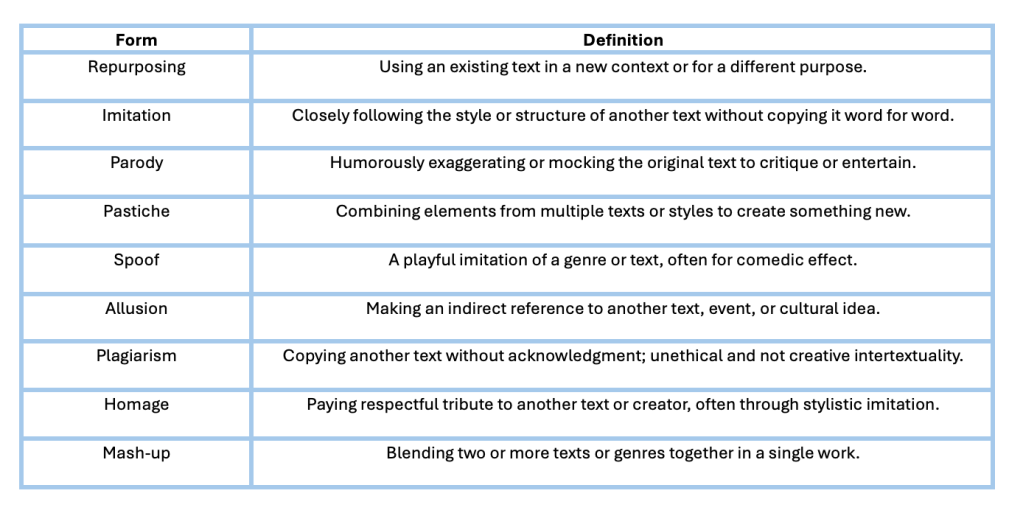
When we study adaptation and intertextuality, it’s important to recognise that these concepts can take many different forms. Writers and creators often borrow, transform, or respond to existing texts in ways that create new meanings and relationships. Using this table, and the pairs of texts in the presentation below, can you identify different forms of intertextuality at work?
2. High vs Low Culture (and Culture Mashing)
“High culture and popular culture are not opposites; they are two sides of the same coin.”
Raymond Williams, cultural theorist
High culture refers to artistic and intellectual works traditionally associated with society’s elite, such as classical music, opera, fine art, and canonical literature. These forms are often considered refined, timeless, and requiring specialized knowledge to appreciate. By contrast, low culture encompasses popular entertainment and everyday cultural products, such as pop music, television, memes, and comic books. These are typically seen as accessible and commercial. The distinction between high and low culture emerged from historical class divisions: cultural consumption was a marker of social status, and familiarity with ‘high’ art signalled education and privilege. Over time, institutions like museums, universities, and critics reinforced these hierarchies, shaping what society deemed ‘valuable’ or ‘worthy.’
These hierarchies are maintained through gatekeeping, which is the control of access to cultural spaces. Gatekeepers include critics, publishers, and institutions that decide which works are made widely available and which remain marginal. Economic barriers play a crucial role in this process. Museums and galleries might charge high admission fees or require memberships for exclusive exhibitions, while opera houses and concert halls set ticket prices that make attendance a luxury. Academic journals and archives frequently operate behind expensive paywalls, limiting access to scholarship. These financial obstacles reinforce cultural hierarchies by making high culture more accessible to those with economic privilege, while popular culture remains widely available and cheap. Such systems reflect broader value structures that privilege certain cultures over others, often aligning with social class, race, and gender dynamics. Pierre Bourdieu, a French sociologist known for his theories of cultural capital, explains how knowledge of high culture confers social advantage, perpetuating inequality.
Cultural mash-ups disrupt these traditional hierarchies by blending elements of high and low culture, creating ‘hybrids’. Pop art, for example, disrupts the traditional idea that fine art should remain separate and elite. Music sampling brings classical compositions into hip-hop tracks, collapsing boundaries between prestigious and popular forms. Memes that remix Renaissance paintings with internet humour democratise culture, making it accessible for people without cost or institutional approval. These mash-ups reveal that culture is fluid and socially constructed, not fixed or inherent. By doing so, they invite audiences to reconsider who defines cultural worth and open space for more inclusive, participatory forms of creativity, forms that often bypass traditional gatekeepers and economic barriers entirely. Use this presentation to learn more about Culture Mashing, and see plenty of examples, before trying the activity below:
Activity: Clash of Cultures
Nowadays, art doesn’t have to be locked away in galleries or reserved for experts anymore. With widely available tools – whether digital editing software, your phone camera, or just a pencil and paper – everyone has the power to create. You don’t need expensive equipment or formal training; you just need imagination and a willingness to experiment. So… in this spirit, create an original mash-up of your own. Want to collide East and West? Want to refigure masculine texts as feminine? Want to bring an elite artistic style to the attention of a new audience? The key is to combine elements that don’t usually belong together and see what sparks. Share your creation and ask your classmates if they can see what you combined and why.
Learner Portfolio: write a fan-fic
This is one for all you budding writers out there. Create your own fan fiction story. Choose a character from a popular book, movie or TV show and write your own story about the further adventure of this character. Share your story with your classmates, enter it into your Learner Portfolio – and, if you’re really brave, publish it online or in a fan fiction forum and see what other readers make of your work.
Body of Work: Mr Brainwash
“Art is freedom and you can do it any way you want. I can take a bottle and put it on top of this table and say this is art. If I believe it, it’s art for me, and it can be art for other people.”
Thierry Guetta (aka Mr Brainwash)

Mr. Brainwash is the alias of enigmatic French street artist Thierry Guetta. He rose to fame in 2010 after his collaboration with Banksy, a British street artist, on the award-winning documentary Exit Through the Gift Shop (which I highly recommend you watch as part of the study of this body of work). His debut exhibition was in 2008. Called Life is Beautiful, it was a critical and commercial success. On the back of his rising popularity, eminent singer Madonna asked him to create the cover for her new album, Celebration. He currently lives and works in Los Angeles.
Mr. Brainwash creates pieces of art that collide the genres of street art and pop art. His work resembles famous pop artist Andy Warhol, who is one of his major influences. One of his signature themes is the replication of famous faces and contemporary icons: for example Marilyn Monroe, Charlie Chaplin or iconic symbols from other street artists like Banksy. Through recycling images and repeating motifs, Mr Brainwash aims to create art for everybody that can be experienced anywhere.
However. not everybody is convinced of the value of Mr. Brainwash’s art. His artwork uses copyrighted images from popular culture, history, and art history. Subtly altering the context of the image or the original source material, the artist mischievously undermines its tone, sometimes through juxtaposition, allusion, mash-ups or other technique – but often through barely concealed imitation. Just check out his ‘homage’ to Andy Warhol’s 1984 artwork Flowers (Mr. Brainwash calls his piece Flowarh$ ) to make up your own mind about this. Here is a selection of pieces by Mr Brainwash that you can use as a Body of Work.
Towards Assessment: Individual Oral
Supported by an extract from one non-literary text and one from a literary work, students will offer a prepared response of 10 minutes, followed by 5 minutes of questions by the teacher, to the following prompt: Examine the ways in which the global issue of your choice is presented through the content and form of two of the texts that you have studied. (40 marks)
A piece of art by Thierry Guetta (aka Mr Brainwash) would be a creative choice to bring into this activity. Here are two suggestions as to how you might use this Body of Work to create a Global Issue. You can use one of these ideas, or develop your own. You should always be mindful of your own ideas and class discussions and follow the direction of your own thoughts, discussions and programme of study when devising your assessment tasks:
- Field of Inquiry: Culture, Community and Identity
- Global Issue: The Accessibility of Art and Culture
- Rationale:
In this section you have learned that art has an economic as well as aesthetic dimension. What kind of art and culture one ‘consumes’ depends to some extent on what one can afford, especially if works of art or cultural experiences are placed in venues that are not accessible without purchasing an entrance ticket. And while Mr Brainwash began his career as a street artist, meaning his work could be viewed for free, it’s ironic that after his show Life is Beautiful in 2008, his work began to sell for tens of thousands of dollars a piece. You could pair Mr Brainwash’s work with Balzac and the Little Chinese Seamstress by Dai Sjie. In this short novel, the Little Seamstress is brought up in a remote village in the mountains of Sichuan. Under Mao’s regime, works of art, Western books and classic Chinese literature are all prohibited. However, when she is able to access the novels of Balzac, Sijie shows how the seamstress grows and changes beyond anybody’s expectations.
- Field of Inquiry: Art, Creativity and Imagination
- Global Issue: The Creative Impulse
- Rationale:
If you watched Exit Through the Gift Shop, you will have seen and heard Mr Brainwash, as well as other street artists like Banksy and Shepard Fairey, try to explain the impulses behind their guerilla art. While each artist has their own creative drives and impulses, common themes include sending a counter-culture or anti-capitalist message and the simple desire to ‘make a mark’ and express oneself. Mr Brainwash began his journey by simply following street artists with a camera – even he struggled to explain the reasons for his actions. You could use this body of work to explore this issue in an interesting individual oral talk.
Towards Assessment: Higher Level Essay
Students submit an essay on one non-literary text or a collection of non-literary texts by one same author, or a literary text or work studied during the course. The essay must be 1,200-1,500 words in length. (20 marks).
Once you’ve finished studying No Longer Human, and if you are an HL student, you might consider using this text to write your HL Essay. Here are one or two examples of lines of inquiry suitable for this text – but remember to follow your own interests and the direction of your own class discussion to generate your own line of inquiry. It is not appropriate for students to submit responses to an essay question that has been assigned:
- How does Thierry Guetta (Mr Brainwash) replicate iconography to comment on the nature and purpose of street art and pop art in his works?
Wider Reading and Research
- Innovation, Invention and Discovery – a Filipino teacher presents a globalised view of high and popular culture.
- Folk Culture vs High Culture – this Million-Peso Question vid presents the same contrast.
- Just Two Things – a brilliant blog that collects bad mashups. If you can imagine any cross between two IPs you’ll probably find it here.
- Danger Mouse: The Grey Album Considered (Elsewhere Article, including audio sample)
- What is Fanfiction? (Conversation Explainer)
- What is Fanfiction and Why Does it Matter? (blogpost)
Categories:Intertextuality
 IB Language and Literature 3.0