FRom the pRL / originally written in english / C19TH / Europe / england
Introduction
For many readers, John Keats fits the image of the tortured artistic genius. Born in London in 1795, he came from a relatively modest, working-class background. His father was a stable-keeper, and family stories suggest that Keats may even have been born above the stables where his father worked. His early years were happy, and despite not being wealthy, the family was able to send him to school in Enfield. Far from the delicate, bookish poet we might imagine, Keats was remembered as robust, energetic, and particularly fond of fighting! However, tragedy struck early. His father died in a riding accident, his mother later died of tuberculosis, and the young Keats found himself confronting loss and uncertainty at an age when most people are only beginning adulthood.
These experiences gave Keats’s poetry much of its emotional urgency. The deaths of family members, financial insecurity, poor health, and a passionate relationship with Fanny Brawne all shaped his writing. Yet from these difficulties came an astonishing burst of creativity. During 1819, often described as his annus mirabilis, Keats composed the sequence of great odes that would secure his place in literary history: Ode to Psyche, Ode to a Nightingale, Ode on a Grecian Urn, Ode on Melancholy, and To Autumn. In these poems he grappled with beauty, truth, imagination, mortality, and the passing of time, striving, as he put it, to explore the “untrodden regions” of the mind.
Sadly, Keats’s health was failing just as his literary reputation was beginning to rise. In 1820 he was diagnosed with tuberculosis after coughing up blood and recognising the symptoms that had already claimed members of his family. Hoping to recover, he travelled to Italy with his friend Joseph Severn, but died in Rome on 23 February 1821 at the age of twenty-five. Before his death, Keats feared he would be forgotten, requesting a gravestone inscribed only with the words, “Here lies one whose name was writ in water.” History proved otherwise. Although his career lasted only a few short years, the poems he produced are now regarded as some of the greatest achievements of the Romantic movement, and continue to be read, studied, and admired throughout the world.
IB Learner Profile: Inquirers
We nurture our curiosity, developing skills for inquiry and research. We know how to learn independently and with others. We learn with enthusiasm and sustain our love of learning throughout life.
If any historical figure can be considered an inquirer it might be John Keats. In his short life he not only became one of the most accomplished Romantic poets, but he also studied at Guy’s Hospital in London, taking – and passing! – his surgeon’s exam, allowing him to practice medicine. Reading Keats’ poems, especially his wonderful ode sequence, can be thought of as a type of inquiry. All composed in a few short months, the odes ask you to contemplate abstract concepts such as what it means to suffer, the nature of happiness and sadness, the point of art, what is beauty, and more. These are not the kinds of subjects to which you can find easy answers – so best to approach these poems in the spirit of inquiry and curiosity.
Lang and Lit Concept: Creativity

By studying John Keats, you are joining generations of readers, writers, and artists who have found inspiration in his work. Although Keats died at just twenty-five and was not fully appreciated during his lifetime, his poetry survived long after his death. His career reminds us that powerful acts of creativity can outlast both the passing of time and the capriciousness of critics. As the nineteenth century progressed, Keats’s reputation grew. Writers such as Alfred Lord Tennyson admired his poetry, while artists associated with the Pre-Raphaelite Brotherhood drew inspiration from his vivid imagery and storytelling. Poems such as La Belle Dame sans Merci and The Eve of St Agnes inspired paintings, showing how creative ideas can live on in new forms and influence other artists across different media.
Keats also helped shape later movements such as Aestheticism, which celebrated beauty and the power of art to affect the senses. By the end of the Victorian period, he was widely recognised as one of England’s greatest poets. His legacy demonstrates an important idea about creativity: while human lives are temporary, great works of art can continue to inspire new audiences long after their creators are gone.
Ode on a Grecian Urn
“Beauty is truth, truth beauty, – that is all ye know on Earth…”
Ode on a Grecian Urn was written in 1819, soon after the death of Keats’ mother and brother from disease. Haunted by loss, he accompanied a group of friends to the newly opened British Museum and found himself astonished by the collection of art and objects, many of them classically Greek, collected within. Among these were the Elgin Marbles, the Townley Vase, and the Sosibos Vase (Keats traced the engraving of this last piece), and the urn in his famous poem is thought to be an imaginative composite of all these influences.
His poem can be easily interpreted as a meditation on mortality. As Keats contemplates the lively scenes depicted on the urn, he calls attention to the paradox that the youth and vigour of the scene is frozen in time: the singers can never finish their songs, the lovers can never sate their desires, the trees will never shed their leaves. Unlike human reality, nobody ages, falls ill, is heartbroken, or dies. While the reader might ponder why one might long for a love with no kisses, a hunt with no capture, Keats’ wish for immortality was driven by his own existential crisis. He had recently diagnosed himself with tuberculosis, the deadly disease that had taken so many of his nearest and dearest. His response was to lose himself in contemplation of artwork, and to discover his own relief from suffering through making his own piece of art.
Resources
Wider Reading
KEats COntext
Poetry that is written about a work of art like a decorated urn (be it Grecian or otherwise), is called ekphrastic poetry. Keats, ambitious yet haunted by the recent deaths of his mother and young brother, met his friends at the British Museum where he was captivated by the objects of antiquity displayed therein. His urn, while an imagined creation, was probably inspired by artifacts such as the Sosibos vase and the Elgin Marbles.
Learner Portfolio: Ode to…
An ode is a poem written in praise of, or in conversation with, a person, thing, place, feeling, or idea. Traditionally, odes were serious poems that celebrated something the poet found beautiful, important, or worthy of deep reflection. The word comes from Ancient Greece, where odes were often written to accompany music and public celebrations. That might sound rather grand, but poets have written odes about an astonishing range of subjects. John Keats wrote Ode to a Nightingale and Ode on a Grecian Urn, using a bird and an ancient vase to explore questions about beauty, art, and mortality. Percy Bysshe Shelley addressed the wind itself in Ode to the West Wind, while Pablo Neruda wrote odes to everyday objects such as socks, tomatoes, and onions. More recently, poets have playfully stretched the genre even further, producing works with titles such as Ode to a Pot Noodle, proving that almost anything can become the subject of an ode.
For this Learner Portfolio challenge, explore the poetic tradition of the ode by writing your own poem in praise of… well, anything you like. Choose an object or piece of artwork (in which case your ode would be ekphrastic) about which to write an ode. Challenge yourself to include a select range of poetic devices similar to those John Keats used; for example, you can use apostrophe in your own ode.
Ode on Melancholy
Ode on Melancholy was most likely written in May of 1819, although the exact date of composition is uncertain. The poem is about how to cope with a deep, almost unbearable sadness, which Keats believes is an inescapable part of human experience. Keats’ speaker is like an advisor or councillor who warns against consuming drink or drugs in order to find relief from melancholy. Instead, the speaker agues that melancholy should be embraced. The reason is quite surprising: Keats believes that, because anything good is doomed to end, all beauty is suffused with a kind of poignant sadness. Therefore, the poem leaves the reader with the impression that Joy and Melancholy are not opposite emotions at all, but deeply intertwined.
resources
- Ode on Melancholy Questions and Activities
KEats COntext
“This morning I am in a sort of temper indolent and supremely careless … Neither Poetry, not Ambition, nor Love have any alertness of countenance as they pass by me: they seem rather like three figures on a Greek vase – a Man and two women – whom no one but myself could distinguish in their disguisement. This is the only happiness; and is a rare instance of advantage in the body overpowering the Mind.”
Written in a letter from Keats to his brother and sister, March 1819.
Learner Portfolio: Practise for Paper 1 (Literature students only)
If you are a Language A: Literature student, at the end of your course you will sit Paper 1: Guided Literary Analysis. This paper contains two previously unseen literary passages. SL students write a guided analysis of one of these passages; HL students write about both passages. The passages could be taken from any of four literary forms: prose, poetry, drama or literary non-fiction. Each of the passages will be from a different literary form.
Ode to a Nightingale
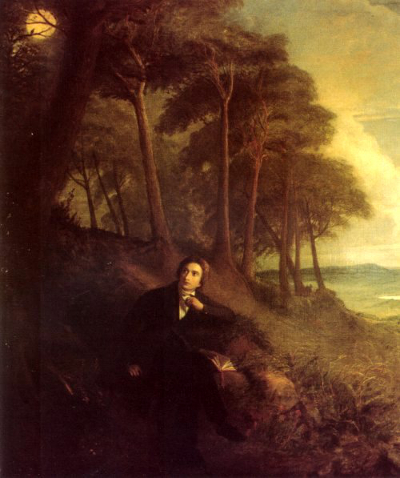
“In the spring of 1819 a nightingale had built her nest near my house. Keats felt a tranquil and continual joy in her song; and one morning he took his chair from the breakfast table to the grass plot under a plum tree, where he sat for two or three hours. When he came into the house, I perceived he had some scraps of paper in his hand, and these he was quietly thrusting behind the books. On inquiry, I found those scraps, four or five in number, contained his poetic feeling on the song of our nightingale.”
Written by Charles Brown, with whom Keats was living in London.
Ode to a Nightingale considers the idea that nothing can last. The speaker sits in a forest, listening to the beautiful song of a nightingale, and fancies he can hear ‘immortality’. He thinks about how the bird is unbothered by human feelings such as anxiety, and does not fear its own death. He fixates on the song of the bird, which he imagines has been sung for centuries – it is unbounded by time. Eventually, the nightingale flies away, leaving the speaker with a deep sense of loss and the belief that everything inevitably fades away.
RESOURCES AND WIDER READING
Keats COntext
Having witnessed the death of his brother Tom from tuberculosis a few months previously, Keats was now succumbing to the same illness, so would be familiar with the effect – and consequence – of ‘The weariness, the fever, and the fret’ which had already caused him ‘leaden-eyed despairs’. Fond of paradoxes, Keats writes this poem like an elegy, a poem for somebody who has passed away. The difference here is that he writes it for something that has not yet died.
Learner Portfolio: Imaginary Realms
This poem captures a paradox, something of which Keats is fond: on the one hand the nightingale’s song brings relief from the day-to-day pains of living, ‘the weariness, the fever and the fret’; on the other hand the seeming immortality of birdsong makes Keats painfully aware of the fragility of his own life and how quickly death can come. Keats seeks escape from this paradox – but knows that by escaping his own pain he will fall into an imaginary realm from which there is no return.
Create a learner portfolio entry in which you visualise Keats’ ‘imaginary realm’. You could make a chart, create a collage or piece of artwork (with explainer), devise a presentation for the class, or write a mini-essay. Think about the ‘realms’ you might find buried inside his poems. How are they characterised? What methods are used to create them? What do they represent?
- A realm outside of time;
- A wondrous realm of natural beauty;
- The faery realm;
- The realm of Lethe.
Ode to Autumn
TBC
Learner Portfolio: Practise for Paper 2
Write this Learner Portfolio in the style of a practice Paper 2 response, which must be a compare and contrast essay (visit this post for more help with Paper 2 compare and contrast skills). You can use one of the prompts below, or another prompt given to you by your teacher. Choose a single prompt, talk with your teacher about how to approach and structure your writing, then complete your portfolio entry:
- If beauty is a relative term, how does one or more of the works you have studied explore this idea?
- “All that glitters is not gold.” Discuss how appearances are misleading in literary works you have studied.
- In what ways, and with what techniques, do writers you have studied appeal to the emotions of the reader?
- Discuss the ways in which philosophical or aesthetic ideas are represented in literary works you have studied.
Towards Assessment: Individual Oral
Supported by an extract from one non-literary text and one from a literary work (or two literary works if you are following the Literature-only course) students will offer a prepared response of 10 minutes, followed by 5 minutes of questions by the teacher, to the following prompt: Examine the ways in which the global issue of your choice is presented through the content and form of two of the texts that you have studied. (40 marks)
John Keats’ poetry would be a good choice with which to conduct this oral assessment. The poems explore several themes which can be used to create Global Issues: the role of art and imagination, mortality and time, nature, sadness and melancholy – even the dangers of drinking as a form of escapism! Now you have finished reading and studying the poetry collection, spend a lesson working with the IB Fields of Inquiry: mind-map Keats’ poems, come up with ideas for Global Issues, make connections with other Literary Works or Body of Works that you have studied on your course and see if you can make a proposal you might use to write your Individual Oral. Here are one or two suggestions to get you started, but consider your own programme of study before you make any firm decisions about your personal Global Issue. Whatever you choose, remember a Global Issue must have local relevance, wide impact and be trans-national:
Literary pairing
Body of work Pairing
- Field of Inquiry: Beliefs, Values and Education
- Global Issue: how poor mental health can cause existential crises
- Rationale:
In Keats’s odes (such as Ode to a Nightingale and Ode on Melancholy) he presents his despair, anxiety about mortality, and emotional exhaustion. These aspects of mental health create a longing to escape the limits of human suffering, revealing how fragile mental states can push one into crisis. A work studied in translation in which characters experience disorienting mental crises is Haruki Murakami’s The Elephant Vanishes. For example, the protagonist of Sleep drifts through life feeling hollow and detached from her own family. Her psychological instability leads to crisis at the end of the story. Another perfect pairing for this global issue might be Death and the Maiden by Ariel Dorfman.
- Field of Inquiry: Art, Imagination and Creativity
- Global Issue: the power and pitfalls of creativity
- Rationale:
Keats celebrates imagination as a transcendent power capable of lifting the speaker beyond suffering in poems like Ode to a Nightingale. Yet he also acknowledges its pitfalls, as the escape offered in the odes risks becoming a retreat from reality. A perfect parallel in a body of work would be Diesel’s Be Stupid ads. These images and slogans also present creativity as bold, liberating, encouraging audiences to embrace risk and unconventional thinking. However, their glorification of ‘stupidity’ risks oversimplification, pushing young viewers into recklessness in pursuit of popularity. A slightly more challenging, but equally profitable, pairing for this activity might be The Waldo Moment by Charlie Brooker.
Towards Assessment: Higher Level Essay
A student wanting to write an impressive HL Essay need look no further than Keats’ poetry. Rich and linguistically dense, the poems offer up a wealth of possible topics to investigate in detail. Remember, your essay should treat Keats’ poetry as a literary body of work, so choose an aspect of his poetry that you have noticed in two or three poems you have studied. Here are one or two examples of lines of inquiry suitable for this text – but remember to follow your own interests and the direction of your own class discussion to generate your own line of inquiry. It is not appropriate for students to submit responses to an essay question that has been assigned:
- How do motifs of eating and drinking suggest ideas about the human condition in John Keats’ Ode Sequence?
- How does John Keats use language to explore time in his famous Ode Sequence?
- HL Essay Planning Framework (Blank)
Categories:Poetry


An excellent tribute to a poet above poets.
LikeLike