FRom the pRL / originally written in english / C20TH / Europe / england
Shifting from daring social critique to old-fashioned romance to keen character study, the play is acutely mindful of the way life is inextricably political.
LA Times Review of the Old Globe production of Pygmalion, 2013.
Introduction
When George Bernard Shaw (1856–1950) was awarded the Nobel Prize in literature in 1925, he was praised for turning “his weapons against everything that he conceives of as prejudice.” This is clearly true of Pygmalion, which was premiered in German in Vienna in 1913. The play is a modern interpretation of an ancient myth, the tale of Pygmalion and Galatea. In Ovid’s Metamorphoses, Pygmalion, an artist, falls in love with Galatea, a statue of an ideal woman that he created. Pygmalion is a man disgusted with real-life women, so chooses celibacy and the pursuit of an ideal woman whom he carves out of ivory. Wishing the statue were real, he makes a sacrifice to Venus, the goddess of love, who brings the statue to life. By the late Renaissance, poets and dramatists began to contemplate the thoughts and feelings of this woman, who woke full-grown in the arms of a lover. Shaw’s central character—the flower girl Liza Doolittle—expresses articulately how her transformation has made her feel, and he adds the additional twist that Liza turns on her “creator” in the end by leaving him.
In Shaw’s rendition, Higgins, a teacher, “creates” Eliza, his pupil, by teaching her to speak like a duchess—a transformation that allows Shaw to attack the superficial class prejudices of his time. Shaw’s version discards the romantic element, and transposes the Pygmalion myth into pre-war England, a period in which rigid social class structures were being challenged and gender roles were undergoing profound transformations. In Pygmalion, received ideas on the roles of men and women, teacher and student, and upper and working classes are turned on their heads, and Shaw’s essential humanity, feminism, and egalitarianism shine through. Since its initial English staging in 1914 and its first English publication in 1916, the play has been adapted and updated several times, most prominently in the Broadway musical and later film, My Fair Lady. In addition, Shaw attached to the play a “Sequel,” in which he discusses what took place for the characters after the play proper. The rags to (relative) riches aspect of Shaw’s witty and spirited social commentary have helped contribute to its success.
IB Learner Profile: Balanced
We understand the importance of balancing different aspects of our lives – intellectual, physical, and emotional – to achieve well-being for ourselves and others. We recognize our interdependence with other people and with the world in which we live.
IB Learner Profile
Your understanding of the literary works you study will be assessed in two ways: Paper 2 (at the end of the course) and in an oral examination called the Individual Oral. You are allowed to choose the literary text(s) that you want to prepare for the Individual Oral. Pygmalion is a great text for you to think about using, as it contains many passages that connect to Global Issues you will have encountered in other parts of the course. Some students enjoy this activity as it does not require spending lots of time writing essays, and allows you space to work on other aspects of the IB; this is called having intellectual balance in the learner profile. Other students find the Individual Oral stressful and even a little nerve-wracking (affecting what the learner profile calls emotional balance). The important thing to do is to remain balanced: if you gather your thoughts regularly throughout the course and record them in your Learner Portfolio, and hone preparation techniques that work for you, you’ll find this is a great way to boost your internal assessment score.
Lang and Lit Concept: Transformation
Transformation is a central theme of Shaw’s play: Pygmalion‘s all about turning a poor girl into a duchess! Eliza’s metamorphosis is indeed stunning. You could even go so far as to call it a ‘Cinderella story.’ But remember: Cinderella turned back into a poor girl before she finally found her prince. Pay attention and you’ll notice that not all the attempts at transformation here are successful. There are plenty of false starts and false endings. By play’s end, Shaw’s made one thing very clear: be careful what you wish for.
Cinderella may be the most well-known, but it’s not the only source Shaw may have drawn on or transformed. In addition to the importance of the original Pygmalion myth to Shaw’s play, critics have pointed out the possible influence of other works, such as Tobias Smollett’s novel The Adventures of Peregrine Pickle (which similarly involves a gentleman attempting to make a fine lady out of a “coarse” working girl), and a number of plays, including W.S. Gilbert’s Pygmalion and Galatea and Henrik Ibsen’s A Doll House. Shaw denied borrowing the story directly from any of these sources, but there are traces of them in his play, and shades of the famous stories of other somewhat vain “creators” whose experiments have unforeseen implications: Faust, Dr. Frankenstein, Svengali. While you read and study Pygmalion you might like to consider how the meaning of Shaw’s text is bound to one or more of these ‘sources’ and how Shaw transformed them into his own original work.
Areas of Exploration Conceptual Guiding Question
In psychology, the word ‘identity’ is used to mean the characteristics that make you who ‘you’ are. You have a particular way of speaking (called your idiolect), acting, and seeing the world that makes you distinct from other people. Despite this, humans like to characterise, and social distinction is a convenient way to place people into certain ‘groups’. In this way, the language we use can be revealing – even if we don’t realise it – and our accent can reveal where we are from and our social class. Read through the following resource, which discusses the opening scene of Pygmalion, to explore the guiding conceptual question:
Act 1: Covent Garden
“Her features are no worse than theirs.”
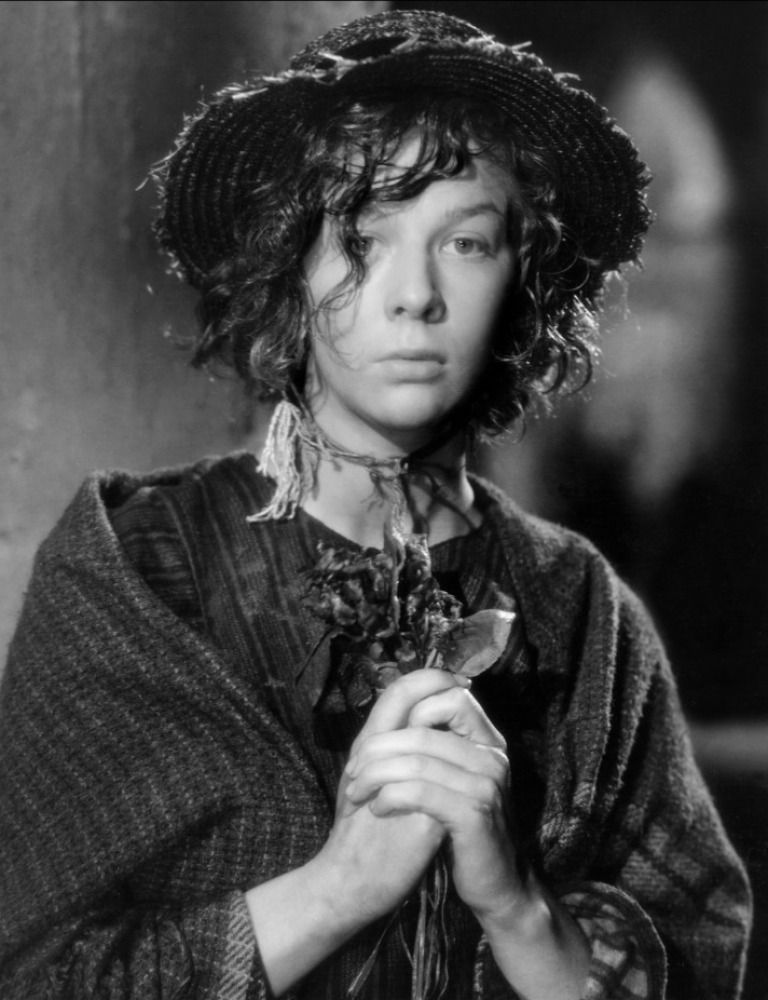
The action begins at 11:15 p.m. in a heavy summer rainstorm. An after-theatre crowd takes shelter in the portico of St. Paul’s Church in Covent Garden. A young girl, Clara Eynsford Hill, and her mother are wailing for Clara’s brother Freddy, who looks in vain for an available cab. Colliding into flower peddler Liza Doolittle, Freddy scatters her flowers. After he departs to continue looking for a cab, Liza convinces Mrs. Eynsford Hill to pay for the damaged flowers; she then cons three halfpence from Colonel Pickering. Liza is made aware of the presence of Henry Higgins, who has been writing down every word she has said. Thinking Higgins is a policeman who is going to arrest her for scamming people, Liza becomes hysterical, Higgins turns out, however, to be making a record of her speech for scientific ends. Higgins is an expert in phonetics who claims: “I can place any man within six miles. I can place him within two miles in London. Sometimes within two streets.” Upbraiding Liza for her speech, Higgins boasts that “in three months I could pass that girl off as a duchess at an ambassador’s garden party.” Higgins and Pickering eventually trade names and realize they have long wanted to meet each other. They go off to dine together and discuss phonetics. Liza picks up the money Higgins had flung down upon exiting and for once treats herself to a taxi ride home.
Resources
Pygmalion Then…
1910s: Despite the promotion of a standard ‘Queen’s English,’ Britain is marked by a wide diversity of spoken English and regional variation in accent, dialect and pronunciation. This diversity was further shaped by large-scale immigration, eg Irish in the 1830s, Germans in the 1840s, Scandinavians in the 1870s, and Eastern Europeans in the 1880s.
…and Now
Today: The diversity of English culture – especially in major cities – has been increased, along with the diversity of English dialects, by twentieth-century immigration from Africa, the Caribbean, the Indian subcontinent, and the Far East.
Learner Portfolio: ‘London at 11.15. Torrents of heavy summer rain.’
The opening scene of Pygmalion is set on the streets of London in the rain – a difficult challenge for a stage designer to replicate in a theatre. Produce a series of director’s notes that you will deliver to the stage designer and producer of the play, outlining your ideas for performing the opening scene and communicating the effects you want to create. If you enjoy visual, creative challenges you could design the stage and set for the opening scene and provide accompanying notes, or present your design as a ‘pitch’ to a theatre company who might fund your show.
In your work, consider how you might address the following concerns of staging a play’s opening scene:
- What is the backdrop to the action?
- What mood or atmosphere will be evoked?
- How will your design help construct relationships between the main characters?
- How will your design hint at the deeper themes and concerns of the play?
- What will ‘hook’ the audience and help create tension or conflict?
- What opportunities are there for visual and dramatic ‘spectacle’?
Act 2: Higgins’ laboratory
“Women upset everything. When you let them into your life, you find that the woman is driving at one thing and you’re driving at another.”
Henry Higgins
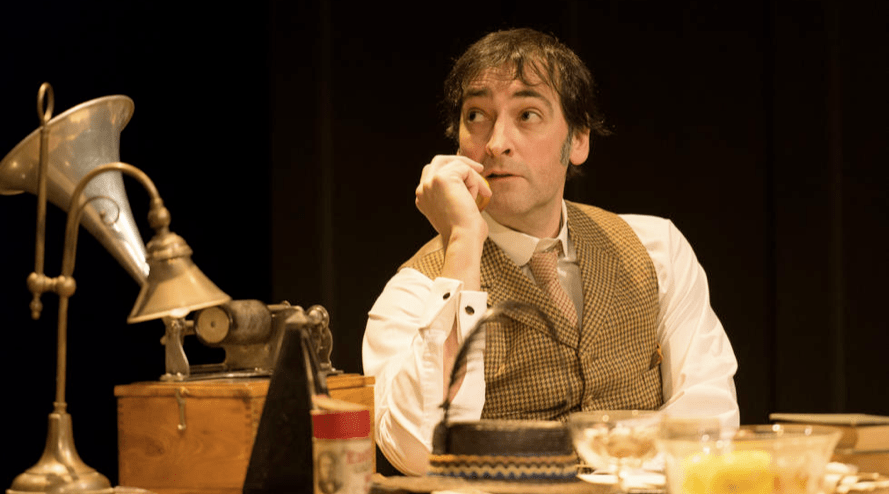
The next morning at 11 a.m. in Higgins’s laboratory, which is full of instruments. Higgins and Pickering receive Liza, who has presented herself at the door. Higgins is taken aback by Liza’s request for lessons from him. She wants to learn to “talk more genteel” so she can be employed in a flower shop instead of selling flowers on the street. Liza can only offer to pay a shilling per lesson, but Pickering, intrigued by Higgins’s claims the previous night, offers to pay for Liza’s lessons and says of the experiment: “I’ll say you’re the greatest teacher alive if you make that good.” Higgins enthusiastically accepts the bet, though his housekeeper, Mrs. Pearce, pleads with him to consider what will become of Liza after the experiment. Liza agrees to move into Higgins’s home and goes upstairs for a bath. Meanwhile, Higgins and Pickering are visited by Liza’s father, Doolittle, “an elderly but vigorous dustman.” Rather than demanding to take Liza away, Doolittle instead offers to “let her go” for the sum of five pounds. Higgins is shocked by this offer at first, asking whether Doolittle has any morals, but he is persuaded by Doolittle’s response, that the latter is too poor to afford them. Exiting quickly with his booty, Doolittle does not at first recognize his daughter, who has re-entered, cleaned up and dressed in a Japanese kimono.
Resources
Pygmalion Then…
1910s: While industrialization and legislative reform begin a process of diversification, Britain’s society is nevertheless rigidly hierarchical, with a tradition of a landed aristocracy and a pyramid of descending ranks and degrees.
…and Now
Today: The political power of royalty and the nobility has been greatly reduced. Britain’s society remains stratified primarily by wealth rather than rank. The middle class grew considerably throughout the century, however, divisions between rich and poor persist in Britain. The expansion of the university system greatly increased opportunities for higher education.
Learner Portfolio: the Myth of Pygmalion
In Greek mythology, Pygmalion was a sculptor disgusted by what he saw as sexual promiscuity of the women of Cyprus. Vowing to remain celibate, Pygmalion devoted himself to his craft and began carving the statue of a beautiful woman out of ivory. On completing his work, he found it so beautiful that he fell in love with his own creation. On the festival day for Aphrodite, the goddess of love, Pygmalion made an offering at her altar wishing for a wife just like his statue. The goddess was so moved by this prayer that she granted Pygmalion’s wish, bringing his statue to life. Pygmalion and the statue (named Galatea in some versions of the myth) married and had a son, Paphos, whose name is given to the capital city of Cyprus.
Compare and contrast the original Pygmalion myth (this version is presented in Ovid’s Metamorphosis) with Shaw’s play. What are the similarities between Henry Higgins and Pygmalion? How are Eliza and Galatea (Pygmalion’s statue) alike and how are they different? How is the Pygmalion myth ‘updated’ – and why? What lessons can we draw from a comparison between the two?
Act 3: Mrs Higgins’ at-home
“You silly boy, of course she’s not presentable. She’s a triumph of your art and of her dressmaker’s; but if you suppose for a moment that she doesn’t give herself away in every sentence she utters, you must be perfectly cracked about her.”
Mrs Higgins

The setting is the flat of Mrs. Higgins, Henry’s mother. Henry bursts in with a flurry of excitement, much to the distress of his mother, who finds him lacking in social graces (she observes that her friends “stop coming whenever they meet you”). Henry explains that he has invited Liza, taking the opportunity for an early test of his progress with Liza’s speech. The Eynsford Hills, guests of Mrs. Higgins, arrive. The discussion is awkward and Henry, true to his mother’s observations, does appear very uncomfortable in company. Liza arrives and, while she speaks with perfect pronunciation and tone, she confuses the guests with many of her topics of conversation and peculiar turns of phrase. Higgins convinces the guests that these, including Liza’s famous exclamation “not bloody likely!” are the latest trend in small talk. After all the guests (including Liza) have left, Mrs. Higgins challenges Henry and Pickering regarding their plans; she is shocked that they have given no thought to Liza’s well-being, for after the conclusion of the experiment she will have no income, only “the manners and habits that disqualify a fine lady from earning her own living.” Henry is characteristically flip, stating “there’s no good bothering now. The thing’s done.” Pickering is no more thoughtful than Higgins, and as the two men exit, Mrs. Higgins expresses her exasperation.
Resources
Pygmalion Then…
1910s: The sensation caused by Shaw’s use of the profanity ‘bloody’ went a long way to ensure the publicity for Pygmalion, but many critics found the language of the play shocking. T. F. Evans commented: “[it] is almost impossible … to assess accurately the critical response to the play itself because of the space, time and attention that was given to the word ‘bloody'”
… and Now
Today: By 1938 (the year Pygmalion was made into a movie) Shaw’s text was still dramatic and challenging but much of the shock had faded. Of the film version, Desmond MacCarthy observed: “‘bloody’ still gets its laugh, but it no longer releases the roar that greets the crash of a taboo.”
Learner Portfolio: Multiple Intelligences
Higgins and Pickering are academics who have studied linguistics and phonetics. They are intelligent and learned; but it’s no accident that these qualities are the providence of the upper classes, beneficiaries of formal education and training. Higgins displays his brilliance in Act One, easily identifying various bystanders as coming from different parts of the city and country based on their accents. On meeting Higgins, Pickering is starstruck, suggesting that Higgins is an esteemed and famous scholar. Yet, despite all his education, Higgins lacks other sorts of ‘intelligence’. He has a scientific mind so approaches all interactions as if they are laboratory experiments. This creates problems for others, as shown in the first act when his note-taking causes confusion and fear. More, he reduces others to objects to use in his experiments, treating Liza coldly and discarding her as a ‘thing’ when his project is over.
At the same time, Shaw’s other characters display ‘intelligence’ that was not learned in school. Characters like Liza, Alfred, and Mrs Pearce did not receive any of Higgins’ formal education, yet they surpass him in their ability to recognise others’ feelings and motivations. Alfred even instinctively uses classical rhetoric to great effect! Mrs Higgins, too, demonstrates an emotional intelligence far beyond her celebrated son’s when she is compassionate to those less fortunate than herself in this scene.
Write a piece (or create a chart) that exposes various forms of ‘intelligence’ in the play: natural talent, emotional intelligence, social intelligence, and so on. Include what you believe Shaw implies about the benefits and drawbacks of formal academic intelligence as well.
Act 4: Wimpole Street
“Anyhow, it was a great success: an immense success. I was quite frightened once or twice because Eliza was doing it so well. You see, lots of the real people can’t do it at all: they’re such fools that they think style comes by nature to people in their position; and so they never learn.”
Colonel Pickering

Midnight, in Henry’s laboratory. Higgins, Pickering, and Liza return from the party. Higgins loudly bemoans the evening: “What a crew’ What a silly tomfoolery!” Liza grows more and more frustrated as he continues to complain (‘ Thank God it’s over!”), not paying attention to her or acknowledging her role in his triumph. Complaining about not being able to find his slippers, Higgins does not observe Liza retrieving them and placing them directly by him. She controls her anger as Higgins and Pickering exit, but when Higgins storms back in, still wrathfully looking for his slippers, Liza hurls them at him with all her might. She derides Higgins for his selfishness and demands of him, “What’s to become of me?” Higgins tries to convince her that her irritation is “only imagination,” that she should “go to bed like a good girl and sleep it off.” Higgins gradually understands Liza’s economic concern (that she cannot go back to selling flowers, but has no other future), but he can only awkwardly suggest marriage to a rich man as a solution. Liza criticizes the subjugation that Higgins’s suggestion implies: “I sold flowers. I didn’t sell myself. Now you’ve made a lady of me I’m not fit to sell anything else.” Liza infuriates Higgins by rejecting him, giving him back the rented jewels she wears, and a ring he had bought for her. He angrily throws the ring in the fireplace and storms out.
Resources
Learner Portfolio: Practise for Paper 2
Write this Learner Portfolio in the style of a practice Paper 2 response. You can use one of the prompts below, or another prompt given to you by your teacher. Although Paper 2 requires you to write about two literary works, for the sake of this exercise you could focus only on your response to Pygmalion, or you could try to compare your ideas to another literary work you have studied (visit this post for more help with Paper 2):
- Some literary texts, although set in a particular time and place, convey ideas that are universal. In what ways is this true of the works you have studied?
- Explore how women are represented as stronger than men in the works you have studied.
- How do works you have studied portray the struggle to be understood?
- Consider why writers create characters who do not conform to norms in the literary works you have studied.
Act 5: Mrs Higgins’ drawing room
“Oh, when I think of myself crawling under your feet and being trampled on and called names, when all the time I had only to lift up my finger to be as good as you, I could just kick myself.”
Eliza Doolittle

Mrs. Higgins’s drawing room, the next day. Henry and Pickering arrive and while they are downstairs phoning the police about Liza’s disappearance, Mrs. Higgins asks the chambermaid to warn Liza, taking shelter upstairs, not to come down. Mrs. Higgins scolds Henry and Pickering for their childishness and the careless manner in which they treated another human. The arrival of Alfred Doolittle is announced; he enters dressed fashionably as a bridegroom, but in an agitated state, casting accusations at Higgins. Doolittle explains at length how by a deed of Henry’s he has come into a regular pension. His lady companion will now marry him, but still he is miserable. Where he once could “put the touch” on anyone for drinking money, now everyone comes to him, demanding favors and monetary support. At this point, Mrs. Higgins reveals that Liza is upstairs, again criticizing Henry for his unthoughtf ul behavior towards the girl. Mrs. Higgins calls Liza down, asking Doolittle to step out for a moment to delay the shock of the news he brings. Liza enters, politely cool towards Henry. She thanks Pickering for all the respect he has shown her since their first meeting: calling her Miss Doolittle, removing his hat, opening doors. ‘ The difference,” Liza concludes, “between a lady and a flower girl is not how she behaves but how she’s treated.”
At this point, Doolittle returns. He and Liza are re-united, and all the characters (excepting Henry) prepare to leave to see Doolittle married. Liza and Higgins are left alone. Higgins argues that he didn’t treat Liza poorly because she was a flower girl but because he treats everyone the same. He defends his behavior by attacking traditional social graces as absurd: “You call me a brute because you couldn’t buy a claim on me by fetching my slippers,” he says. Liza declares that since Higgins gave no thought to her future, she will marry Freddy and support herself by teaching phonetics, perhaps assisting Nepommuck. Higgins grows furious at Liza and “lays his hands on her.” He quickly regrets doing so and expresses appreciation of Liza’s newfound independence. At the play’s curtain he remains incorrigible, however, cheerfully assuming that Liza will continue to manage his household details as she had done during her days of instruction with him.
Resources
Learner Portfolio: a Cinderella Story?
What are the elements of a Cinderella Story? How does Shaw seem to promise – then undermine – these generic expectations in Pygmalion? Why do you think he adapts this type of plot for his play? Create a visual guide to a ‘cinderella story’ with notes as to how Pygmalion adheres to or subverts generic expectations.
Shaw’s Epilogue
‘The ending of Pygmalion provokes an interesting controversy among critics. Higgins and Eliza do not marry at the end of the written text, while the play as it is usually produced often does reconcile the two main characters. Obviously many directors and many readers feel that the apparent unromantic ending is an arbitrary bit of sarcasm appended to the play merely for spiteful humor.’
(Stanley J. Solomon, The Ending of Pygmalion, 1964)
Class Activity
Watch the 1938 film of Pygmalion (embedded above) or a version of My Fair Lady. Pay particular attention to the ending of the play – is the ending faithful to Shaw’s ambiguous original, or does it provide clarity to the reconciliation between Liza and Higgins? Discuss your view of the ending, then attempt the Learner Portfolio task below.
Learner Portfolio: Alternative Endings
Pygmalion is one of Shaw’s most popular plays and, in some ways, the transformation of Eliza Doolittle from flower-girl to duchess to real woman is a straightforward journey to follow. Yet the ending of Pygmalion has produced controversy, not least because Shaw himself rewrote it for the 1938 movie version. In his original post-script, Shaw explains at some length exactly why Eliza does not marry Higgins – years later he directly contradicts himself by having her marry him at the end of the film!
Here you will find two critical responses to this conundrum; one arguing why the original play has the more natural ending, the other supporting the changes made for the ending of the film. Read these two sources, then decide for yourself which ending you prefer. Write a one-two page journal entry explaining your choice and reasoning. Include some of the research you’ve come across in the course of your study.
Towards Assessment: Individual Oral
Supported by an extract from one non-literary text and one from a literary work (or two literary works if you are following the Literature-only course) students will offer a prepared response of 10 minutes, followed by 5 minutes of questions by the teacher, to the following prompt: Examine the ways in which the global issue of your choice is presented through the content and form of two of the texts that you have studied. (40 marks)
Pygmalion would be a good text to discuss in this oral assessment. The play explores a multiplicity of important themes connected to class, gender, aspiration, education, themes of family, the roles of men and women in society, fantasy versus reality, and more. Now you have finished studying Pygmalion, spend a lesson working with the IB Fields of Inquiry: mind-map the novel, come up with ideas for Global Issues, make connections with other Literary Works or Body of Works that you have studied on your course and see if you can make a proposal you might use to write your Individual Oral. Here are one or two suggestions to get you started, but consider your own programme of study before you make any firm decisions about your personal Global Issue. Whatever you choose, remember a Global Issue must have local relevance, wide impact and be trans-national:
Literary pairing
Body of work Pairing
- Field of Inquiry: Beliefs, Values and Education
- Global Issue: how emotional intelligence is underestimated or even stigmatised
- Rationale:
In Pygmalion, Shaw exposes how Higgins equates intelligence with formal education and linguistic precision, leading him to misjudge Eliza’s emotional insight and moral clarity. He fails to recognise these forms of intelligence because they fall outside his academic world, which is privileged… but narrow. A similar dynamic occurs in Broken April by Ismail Kadare which is a work in translation. Diana’s empathetic response to the horrors of the Kanun is repeatedly undervalued by her highly educated husband, Bessian. Although she grasps the emotional and ethical dimensions of the highland people’s suffering far more acutely than Bessian, her intuitive, compassionate intelligence is dismissed as naivety. Alternatively, you could explore the same issue through talking about Balzac and the Little Chinese Seamstress, a novel studied in translation by Dai Sijie.
- Field of Inquiry: Art, Imagination and Creativity
- Global Issue: how marginalised or undervalued people can be re-centred in art and literature
- Rationale:
Shaw’s story focuses on the transformation of Eliza Doolittle, whose working‑class background initially marks her as insignificant in society’s eyes. As the play unfolds, Eliza’s intelligence and moral strength push her into the centre of the story, challenging society’s (classist) assumptions that limit her. A body of work that achieves something similar is eL Seed’s calligraffiti which elevates communities often undervalued in modern cultures. By painting large‑scale, Arabic‑script artworks on neighbourhoods associated with poverty (or other stigmas) he transforms neglected spaces into sites of beauty and pride. You could conduct a similar talk using Angelina Jolie’s speeches as UN Ambassador for Refugees in place of el Seed’s calligraffiti to good effect as well.
Towards Assessment: Higher Level Essay
Students submit an essay on one non-literary text or a collection of non-literary texts by one same author, or a literary text or work studied during the course. The essay must be 1,200-1,500 words in length (20 marks).
When Shaw wrote Pygmalion, women could not vote in the United Kingdom; in 1918 women over the age of 30 were given the right, and it took another ten years for all women to be given a voice. Shaw’s depiction of women and attitudes toward them is impressively and sometimes confusingly varied. They are shown in conventional roles – as mothers and housekeepers – and as strong-willed and independent. The play pays special attention to the problem of women’s “place” in society (or lack thereof), and Shaw offers no easy answers to the tough questions that arise. Here are one or two examples of lines of inquiry suitable for this text – but remember to follow your own interests and the direction of your own class discussion to generate your own line of inquiry. It is not appropriate for students to submit responses to an essay question that has been assigned:
- How does the conflict between Higgins and Eliza in Pygmalion by George Bernard Shaw represent a wider social conflict between men and women?
- How do Shaw’s female supporting characters reveal the belief that women, while constrained by Victorian society, can still exercise autonomy and agency in his play Pygmalion?
Categories:Drama
 IB Language and Literature 3.0