“It is absurd to hold that a man ought to be ashamed of being unable to defend himself with his limbs, but not of being unable to defend himself with speech and reason, when the use of rational speech is more distinctive of a human being than the use of his limbs.”
Aristotle, the ‘father of rhetoric’.
All speeches contain three basic ingredients: ethos, pathos and logos. These are the terms used by the ancient Greeks to describe the different ways a speech appealed to an audience. Ethos refers to the trustworthiness of the speaker: it is what gives the speaker the right to stand before an audience. Ethos can be understood as a process of establishing credit with an audience, and building confidence in the listener. Pathos is any part of the speech that appeals to our emotions (the word shares a root with pathetic, sympathy and empathy). Whenever speakers remind you to be patriotic, make you smile or frown, or make you feel guilty they are appealing to your emotions. Logos is the part of the speech that appeals to our sense of logic and all good speeches do this. Statistics, arguments with sound premises, and examples of reasoning are all indicative of a logical approach to winning over the audience.
You can think of a speaker as an artist or craftsperson and ethos, pathos and logos as the framework upon which the artisan works. The artist will also carry around a tool bag of rhetorical devices – paints, tools and other kit – to be used to a greater or lesser degree, whatever is judged best to bring out the beauty of the artwork. Read a selection of the articles below to hone your own knowledge of these rhetorical tools, and how to recognize and appreciate them in speeches you study:
Rhetoric
Reading Challenge
This is a longer and more challenging text, but spending time on this piece, and discussing it with your teacher, will help you master this topic:
Areas of Exploration Guiding Conceptual Question
There is no doubt that language use varies between text types and literary forms. The context of a text, the purpose of the writer, and the audience for which it was written will all effect the language of the text. Using the resource below, you’ll discover how Martin Luther King Jr’s background, his persuasive intention, and his knowledge that many of his listeners might be illiterate shaped the language he used in his famous ‘I Have a Dream’ speech:
Discussion Points
After you’ve got your head around the material in this section, pair up, pick a question, spend five minutes thinking and noting down your thoughts – then discuss your ideas with a friend and report back to the class:
- What makes a speech or speaker linger in your memory? Can you remember any particularly good speaker or speech you have heard? What made this speech memorable?
- What is more important to you when somebody is trying to persuade you: an emotional appeal or a logical appeal? Why? Can you give an example of a time you were persuaded in a particular way?
- What is rhetoric and why is it important?
1. Speak to the Elephant First
“Reason is, and ought only to be, the slave of the passions…”
Scottish Philosopher David Hume, 1751
Effective persuasion isn’t just about presenting facts; it’s about understanding how people actually make decisions. In the video explainer embedded above, you’ll learn about Psychologist Jonathan Haidt’s powerful metaphor: the Elephant and the Rider. The Rider represents our rational, analytical mind, the part that reasons and explains. The Elephant, however, is our emotional, intuitive side. This is the part that moves us toward action. While the Rider thinks it’s in control, the Elephant usually leads the way.
In this section, you’ll see that most decisions are driven by emotion, not logic. Reason often comes later to justify what we already feel. Traditional rhetoric emphasizes logos (logic) and ethos (credibility), but if you ignore pathos, the emotional appeal, you’re speaking only to the Rider. To truly persuade, you must speak to the Elephant first. Haidt’s concept transformed the traditional approach to rhetoric. It reminded speakers that persuasion is not a battle of facts but a dance of feelings and logic. When you connect before you convince, your message doesn’t just inform… it moves. Watch Mister Rogers and the Power of Persuasion (embedded above) and see if you don’t feel the magical prickle when he connects through finding common emotional ground with his listeners.
Activity: Finding the Emotional Connection
Listen to Wendy Troxel’s engaging speech on teenage sleep hours and discover how she applies Jonathan Haidt’s principle of ‘speaking to the elephant first.’ According to Haidt, effective persuasion begins by engaging the audience’s emotions and values (the Elephant) before presenting logical arguments (the Rider). As you listen, pay attention to moments where Troxel uses stories, vivid examples, or empathetic language to connect emotionally with her audience. Consider how these elements prepare listeners to accept her later evidence and reasoning. After listening, discuss:
- Which parts of the speech appealed most strongly to emotions?
- How did these emotional appeals support her overall argument?
- Do you think the overall structure of her speech was effective? Why/why not?
2. ‘Coulda, Woulda, Shoulda’: The Subtle Power of Modality
“Yes. We. Can.”‘
Barack Obama, presidential election victory speech, 2008
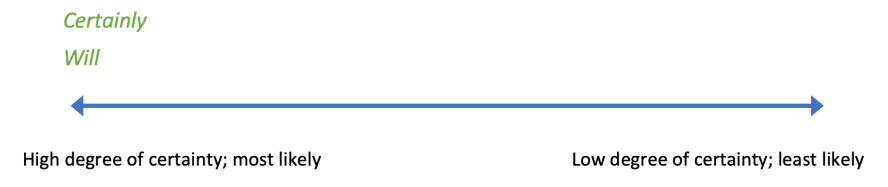
In language, the way we express our views, whether we are very certain, or somewhat less certain, is frequently shown through modality. It is an integral part of persuasion; sometimes present overtly, and at other times less obviously expressed. Modality is most often expressed through the use of modal auxiliary verbs (words, like will, should and may that often precede main verbs in English) and adverbs or adverbial phrases (for example, probably or no doubt). As an introductory activity, brainstorm modal auxiliary verbs and adverbs and place them on a ‘continuum of possibility’ like the above.
Activity: Yes We Can
Barack Obama’s ‘Yes We Can’ speech was delivered after he lost the state’s Democratic primary to Hillary Clinton. Despite the setback, the speech became a defining moment in his presidential campaign. Rather than focusing on defeat, Obama framed the loss as part of a larger movement for hope and change, using the phrase ‘Yes We Can’ as a rallying cry for unity and perseverance. The speech appealed to a broad audience of Democrats, independents, and even Republicans, by emphasising shared values and collective action. Obama combined pathos (emotional appeal) with ethos (credibility) and logos (reason), inspiring optimism while addressing real issues like healthcare, economic fairness, and political division, appealing to a wide a varied audience of rich and poor, black and white, Latino and Asian and uniting them in a shared vision of the future.
Modality is central to the persuasive power of Obama’s speech. From the repeated phrase ‘Yes we can’ , Obama shifts to stronger modals like will (‘We will restore opportunity’) and invokes obligation with must, framing action as a moral imperative. His progression, from possibility, to certainty, to duty, created a motivational arc that moved his listeners deeply. Through his use of modality, Obama transformed a campaign slogan into a powerful call for unity… and a political setback into the springboard that propelled him all the way to the White House.
Listen to Obama’s powerful speech (above) and use the tracking grid (below) to mark modality throughout. Afterwards, discuss how modality, and anything else you’ve noticed, makes this speech so effective:
3. A Way With Words (Classic Rhetorical Devices)
“He mobilised the English language and sent it into battle.”
American journalist Edward R Murrow, on hearing Winston Churchill’s political speech, 1940
“A way with words has always been an asset, and, when used for political ends, or in times of crisis, is worth a hundred battalions,” writes Stephen Fry in his book Planet Word. And he’s not wrong. Throughout history, great speakers from Demosthenes warning ancient Greek citizenry of imminent invasion, to Queen Elizabeth rousing an army to repel the Spanish armada, to Martin Luther King uniting black and white listeners together in common cause, to Winston Churchill who famously “mobilised the English Language and sent it into battle” have understood the power of words to move, challenge, sway opinion, and force decisive action.
While rhetorical styles change with the times, what all these speakers have in common is a talent for feeling the rhythms of speech and the shape of language; they all have a way with words. Use the Matching Cards below to learn the names of some of the structures, patterns, and rhetorical devices that help shape persuasive language. Cut out the cards and match each technique to a prominent example from history:
Activity: analyse a famous historical speech
Visit this archive of excerpts from 40 famous historical speeches and enjoy browsing the samples presented. Then, choose one excerpt to annotate and analyse (alternatively your teacher can assign excerpts). Try to comment on: whether the speech uses emotional or rational appeals (or a mixture of both pathos and logos) and how; the speaker’s use of specific rhetorical devices to create effects; the overall structure and progression of the speech, including the resolution. Present your findings through e.g. a short presentation, annotations for display, or a piece of analytical writing.
Learner Portfolio
Take an issue that is important to you; for example, an environmental issue, a school issue, or a Global Issue. Write a speech that is approximately 2 – 3 minutes long (on average, between one and two pages of writing) in which you employ the rhetorical devices you’ve learned in this unit:
- Begin with an anecdote or emotional appeal (pathos)
- Establish your credibility (ethos)
- Employ logical appeals (such as facts, statistics, and reasoned arguments: logos)
- End your speech in an effective way (such as with a call to action)
- Sprinkle a small selection of rhetorical devices throughout your speech
For inspiration there are many contemporary speeches in this excellent collection that you might like to browse before writing your own.
Body of Work: Smith Family Stories
The Smith Family Stories campaign was part of The Smith Family’s broader effort to encourage donations by sharing real-life success stories of disadvantaged children who were able to break the cycle of poverty through educationin Australia. These stories were featured on their official site and in video formats, highlighting how programs like Learning for Life provided essential support (such as school supplies, mentoring, and sponsorship) to help students stay engaged in school and achieve their goals. The campaign aimed to make the impact tangible and personal, showing donors the difference their contributions could make. Each short video highlights a student’s journey from disadvantage to achievement, thanks to support from The Smith Family’s programs. By focusing on personal narratives, dreams realised and barriers overcome, the campaign aimed to connect emotionally with viewers, showing that their contributions could make a real difference. These stories didn’t just ask for help; they demonstrated hope, resilience, and the power of education to break the cycle of poverty.
Here is a collection of four of the Smith Family Stories for you to study as a Body of Work. You can find more films and articles by visiting The Smith Family campaign pages and by conducting your own wider research.
Towards Assessment: Individual Oral
Supported by an extract from one non-literary text and one from a literary work, students will offer a prepared response of 10 minutes, followed by 5 minutes of questions by the teacher, to the following prompt: Examine the ways in which the global issue of your choice is presented through the content and form of two of the texts that you have studied. (40 marks)
Selected screenshots would make a perfect text for you to bring into your Individual Oral assessment. The campaign’s core theme is ’empowerment through education’ and the films show how small, meaningful actions have a ripple effect, changing the lives of individuals, families, and wider society. As such, you can investigate the Field of Inquiry Beliefs, Values, and Education. There’s a strong selection of methods and techniques for you to analyse, such as the emotional appeal of hearing people tell their own stories, uplifting visuals, and warm music. Below are one or two suggestions about how you could develop Global Issues from a study of this Body of Work. You might use one of these ideas or you can develop your own, always being mindful of your own ideas and class discussions and folowing your own path when devising your assessment tasks:
- Field of Inquiry: Beliefs, Values, and Education
- Global Issue: The Transformative Power of Education
- Rationale:
A central theme of The Smith Family Stories is the importance of education in transforming lives and lifting people out of poverty. The films tell stories of hope over adversity, and achievement in the face of struggle through access to education. A perfect literary pairing in this case would be Night Sky with Exit Wounds by Ocean Vuong, in which he puts his success and identity as a writer down to his mother’s determination in ensuring he got his early lessons, despite being illiterate in English herself. Another strong pairing would be Balzac and the Little Chinese Seamstress by Dai Sijie or Fun Home by Alison Bechdel, both works featuring characters who self-actualize through reading and educational opportunities.
Towards Assessment: Higher Level Essay
Students submit an essay on one non-literary text or a collection of non-literary texts by one same author, or a literary text or work studied during the course. The essay must be 1,200-1,500 words in length. (20 marks).
If you are an HL student, you might consider using this text to write your HL Essay. Here are one or two examples of lines of inquiry suitable for this text – but remember to follow your own interests and the direction of your own class discussion to generate your own line of inquiry. It is not appropriate for students to submit responses to an essay question that has been assigned:
- How do The Smith Family Stories short films present personal stories in a way that connects with viewers on an emotional level?
- How does narrative structure combine with visual techniques to create empowering stories of hope over adversity in The Smith Family Stories short films?
Paper 1 Text Type Focus: speeches
At the end of your course you will be asked to analyze unseen texts (1 at Standard Level and 2 at Higher Level) in an examination. You will be given a guiding question that will focus your attention on formal or stylistic elements of the text(s), and help you decode the text(s)’ purpose(s). Below are several examples of speeches: use these practice texts to familiarise yourself with the different features of this text type, including identifying ethos, logos and pathos. Add the texts to your Learner Portfolio; you will want to revise text types thoroughly before your Paper 1 exam. You can find more information – including text type features and sample Paper 1 analysis – by visiting 20/20. Read through one or two of the exemplars, then choose a new paper and have a go at writing your own Paper 1 analysis response:
key features of speeches
- Ethos: the speaker establishes his or her credibility and may allude to a moral, social or spiritual leader with whom the audience cannot disagree.
- Logos: clear, reasonable arguments, facts and statistics and quoting experts in the field are all ways of establishing a logical appeal.
- Pathos: emotive language and imagery are ways of helping the audience empathise with the feelings of other – often vulnerable – people.
- Persuasive: the speaker attempts to make his or her listener think in a certain way, believe something or take action.
- Direct address: the speaker tries to draw closer to the listeners by addressing them as ‘you’ – look out for the use of ‘we’ or‘us’ to include the speaker and listener on the same side – and be wary of attempts to compliment the listener.
- Modality: modal verbs are small but important words (such as ‘must’, ‘need’, ‘should’, ‘might,’ and so on) that reveal the speaker’s degree of certainty and strength of feeling. You can study modality here.
- Rhetorical devices: all kinds of rhythmical, structural, auditory and linguistic tricks can be employed by a skilled speaker. They are too many to list here, but rhetorical strategies can be studied and learned.
- Logical Fallacies: also called ‘argumentation fallacies.’ Common fallacies in speeches are glittering generalisations, simplification and slippery slope. Learn more about logical fallacies here.
Further Reading
- Rediscovering Rhetoric: Persuasion from the Heart (TedTalk by Michael Collender)
- 30+ Rhetorical Devices Everyone Must Know (blogpost)
- 16 Rhetorical Devices that will make you sound like Steve Jobs (blogpost)
- Speeches – the Secrets (Handout)
- Persuasive Techniques in Language (Handout)
- How Today’s Politicians Have Got Away with Words (Guardian article about modern political rhetoric)
- Litotes: the most common rhetorical device you’ve never heard of (Martin Shovel, published on The Guardian website)
- Rethinking Rhetoric (TedTalk by Douglas Tippin)
Categories:The Language of Persuasion
 IB Language and Literature 3.0
Absolutely brilliant resources, many many thanks! As a neophyte IB teacher, these materials are totally on point.
LikeLike
love this 😍
LikeLike