FRom the pRL / translated work (German) / C20TH / Europe / switzerland
“He considers it a part of his philosophical business to reach a mass audience through his [works] without diluting that one main idea which permeates much of his writing: justice.”
William Gillis, writing in the German Quarterly, 1962
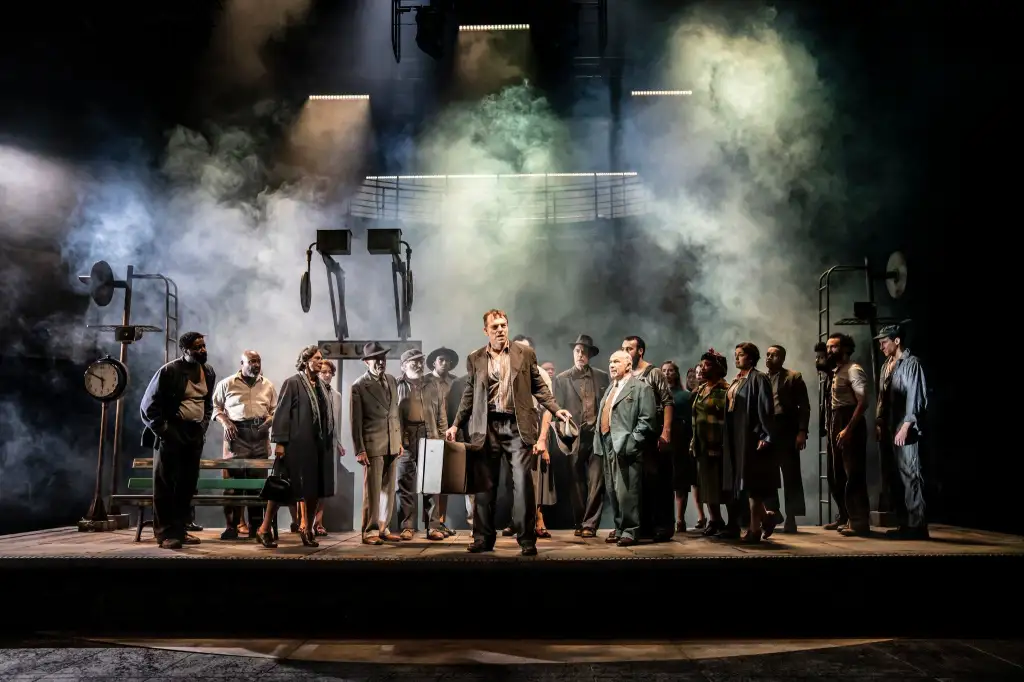
Introduction
The impoverished town of Guellen looks to multi-millionaire Claire Zachanassian for financial salvation. When she offers them a million dollars, they think their dreams have come true – but her offer comes with a condition attached. They must kill a citizen of the town, named Ill, a popular man standing for mayor – and someone who just happens to be her former lover. Initially, the townspeople refuse, but their resolve is tested by the allure of wealth. Will they hold true to their morals, or will they end up carrying out her wish?
The Visit, written in 1956, was Dürrenmatt’s third published work and is set approximately ten years after the end of the war. Famously, Switzerland remained neutral throughout the conflict, siding with neither Allied nor Axis forces. However, Switzerland had deported its Jewish citizens, refused to allow migrant Jews fleeing the Nazis to enter Switzerland, hosted Allied soldiers in prisoner of war camps, and accepted looted gold from German forces. In Dürrenmatt’s opinion, ‘neutrality’ was merely a euphemism for ‘complicity’. Therefore, his play is set in Guellen, a thinly veiled representation of Switzerland; a community forced to choose between moral convictions and material gain.
IB Student Learner Profile: Thinker
“We use critical and creative thinking skills to analyse and take responsible action on complex problems. We exercise initiative in making reasoned, ethical decisions.”
If any writers on your course can be called a thinker, Friedrich Dürrenmatt must be near the top of the list. He was born in 1921 in Konolfingen, a small town just outside the Swiss capital of Bern. The son of a pastor, he developed a keen interest in philosophy and went to Berlin where he began a doctoral dissertation on the philosopher Kierkegaard. In the middle of his studies, though, he came to believe that greed and hypocrisy had polluted life in Switzerland after the second world war. He abandoned his dissertation and returned to Switzerland, becoming a playwright and crafting controversial works full of dark humour and grotesqueries, laying bare the absurdity of European politics and society. He famously said, “it is not only possible to think with the philosophy, but also with the theater stage.”
IB Lang and Lit Concept: Communication

Arguably the defining language feature of Dürrenmatt’s play is pervasive irony. Hardly anybody says what they really mean, and their actions contradict their words. Even the ‘hero’ of the piece is guilty of shifting the truth when it suits his purposes. As you read The Visit, consider how certain uses of language can be used to conceal as well as reveal, to distort as well as illuminate, and how communication is rarely straightforward in Dürrenmatt’s play.
Welcome to Guellen (Act 1)
“Everything can be bought.”
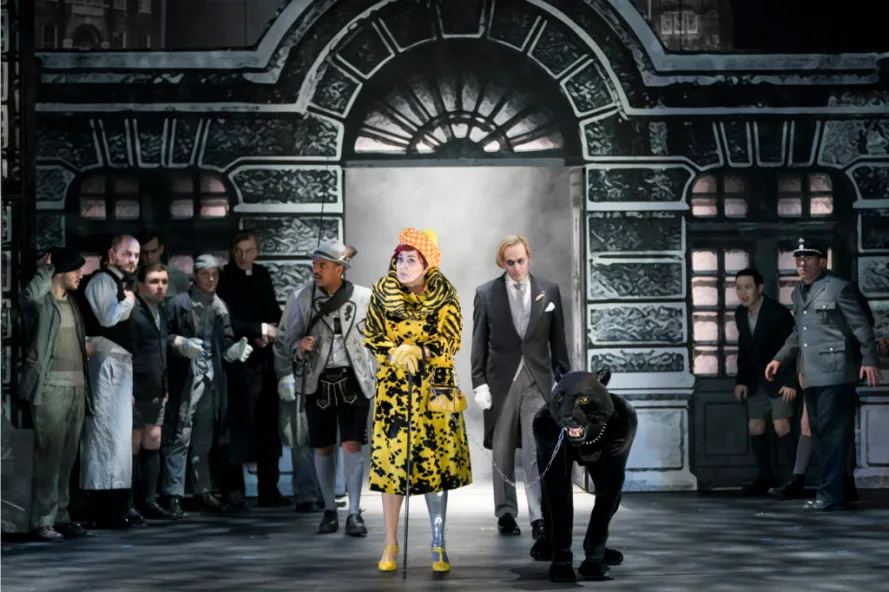
Act 1 begins at the train station in the struggling town of Guellen. The townspeople lament the town’s economic decline, symbolised by the fact that few trains stop there anymore. Their hopes rest on the arrival of Claire Zachanassian, a former resident who left the town in disgrace but has since become fabulously wealthy. They believe her generosity may be their last chance to restore Guellen to prosperity.
Claire arrives in dramatic fashion, pulling the emergency brake on a train that would otherwise pass through the town. Her wealth and influence are immediately apparent as railway officials and townspeople alike rush to satisfy her every wish. While touring places connected to her youth with Alfred Ill, her former lover, Claire recalls how he abandoned her and married another woman. Although Ill insists that the past worked out for the best, Claire’s memories reveal a far more painful story. Later, at a reception in her honour at the Golden Apostle, the Mayor delivers an elaborate speech praising Claire and celebrating her return. Claire responds by announcing that she will donate one million dollars to Guellen and its citizens. The offer seems to fulfil the townspeople’s hopes… but their excitement quickly turns to shock when she reveals the condition attached. In exchange for the money, they must kill Alfred Ill.
Resources
OFF stage
Guellen is a fictional town of Dürrenmatt’s invention meant to represent any Swiss town in the decade following the second world war. The townspeople of Guellen also represent average Swiss people – if not European people as a whole – and so their fixation on money can be seen as a criticism of post-war European materialism. Equally, the town’s mayor, who is eager to welcome Claire and writes an oily speech praising her intelligence and generosity, can represent any politician who is willing to put materialism first and and say whatever he needs to say to secure financial rewards.
Learner Portfolio: Stage Design
Why is Dürrenmatt so specific about the appearance of Guellen? The shoddily tiled railway station, the torn posters, and the crumbling buildings in the background immediately communicate the town’s economic decline before a single character comments on it. Through these visual details, the audience gains an understanding of Guellen’s desperation and the importance of Claire Zachanassian’s return.
Explore stage designs for productions of The Visit, such as these set designs by Milan Butina created for the Ljubljana City Theatre 1958 production. Then, imagining you want to put on a production of The Visit at school, create a brand new design concept for the staging of Act 1 at curtain up. Consider how scenery, props, costumes, lighting, and stage space could help communicate the town’s poverty, its hopes for Claire’s visit, and the contrast between appearance and reality. Annotate your design with brief explanations of the effects you want these choices to have on the audience.
(If visual design is not your preferred medium, you may instead present your ideas as a ‘letter from the director’ to the production team, explaining your creative choices and the audience response you hope to achieve. )
Money Vs. Morality (Act 2)
“You can get anything you want with money”
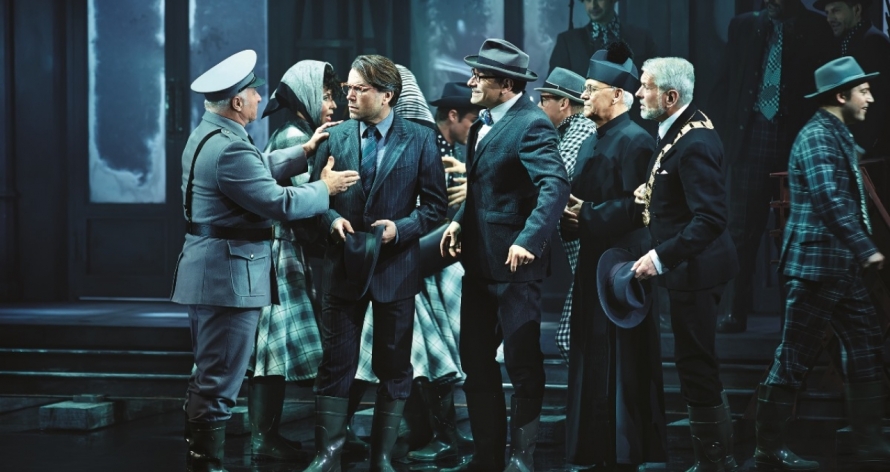
As Act 2 begins, Ill is alone in his shop. His son and daughter have both found reasons to be elsewhere, leaving him to watch as the townspeople decorate the coffin Claire has displayed as a reminder of her offer and its condition. Throughout the morning, customers flock to his store, buying more expensive goods than usual and asking that their purchases be charged to their accounts. Their confidence in taking on debt suggests they expect money to arrive soon, and Ill quickly realizes they must be counting on Claire’s promised fortune.
As both his curiosity and anxiety grow, Ill seeks reassurance from the Mayor and the Priest. The Mayor insists that Guellen’s citizens would never betray their principles for money, but he becomes irritated when Ill demands Claire’s arrest and points out that Ill’s treatment of Claire years earlier was hardly blameless. He even informs Ill that his hopes of becoming mayor are over. The Priest proves little more comforting, suggesting that Ill’s troubled conscience, rather than any real danger, is the source of his fears. Throughout Act 2, although everyone continues to dismiss Ill’s fears, the atmosphere of the town seems to be unmistakably changing.
So eventually, Ill decides he must leave Guellen. When he arrives at the train station with his suitcase, however, he finds himself surrounded by townspeople who insist that Guellen is the safest place for him. As they block his departure, the question becomes increasingly difficult to ignore: is Ill simply paranoid, or is the lure of wealth beginning to erode the town’s moral convictions?
Off stage
Durrenmatt’s relationship to his native land is not easy. While he loved the geographical attributes of the landscape, he was dismayed by the political hypocrisy of the government and found himself at odds with some citizens; one of his early plays was roundly booed when first performed in public. He observed and criticized the Swiss government’s official declarations of neutrality during the Second World War, angry that his native land did not do more to uphold humanist values especially in light of their unwillingness to help Jewish refugees.
Learner Portfolio: Practise for Paper 1 (Literature students only)
If you are a Language A: Literature student, at the end of your course you will sit Paper 1: Guided Literary Analysis. This paper contains two previously unseen literary passages. SL students write a guided analysis of one of these passages; HL students write about both passages. The passages could be taken from any of four literary forms: prose, poetry, drama or literary non-fiction. Each of the passages will be from a different literary form.
Here are two passages taken from The Visit; as this is a play the literary form is ‘drama’. Each passage is accompanied by a guiding question to provide a focus or ‘way in’ to your response. Choose one passage and complete this Learner Portfolio entry in the style of Paper 1: Guided Literary Analysis.
Act 3
“The world turned me into a whore. I shall turn the world into a brothel.”
In Act 3, the Press arrives to report on Claire’s visit to Guellen. They know she has promised the town a large donation, but remain unaware of the condition attached to it, and the townspeople are determined to keep it that way. The Schoolmaster, fortified by alcohol and plagued by guilt, attempts to reveal the truth. Unexpectedly, it is Ill himself who stops him. By this point, Ill has come to accept that his past actions helped create the situation he now faces.
The next stage in the town’s moral decline is an attempt to bargain with Claire. The Mayor and other citizens suggest that she invest in Guellen’s industry rather than pursue her demand for revenge. Their proposal falls on deaf ears. Claire has no interest in profit; she wants justice on her own terms. Meanwhile, Ill returns to his shop to find his family enjoying the luxuries made possible by Claire’s promised money. Later, he meets Claire in the Village Wood, which she now owns. As they recall their past together, Claire calmly discusses his impending death and explains that, once he is gone, she will finally be free of the memories that have haunted her for decades.
Finally, Ill returns to the Town Hall, where reporters have gathered to cover the council meeting. Although still unaware of Claire’s offer, they sense that an important decision is about to be made. The Mayor publicly thanks Ill for helping secure Claire’s donation, and the town prepares to vote. Having abandoned hope of escape, Ill declares that he will accept whatever decision is reached. Will Guellen’s humanist ideals prevail, or will the lure of money prove too powerful to resist?
Resources
Off stage
Ill’s situation seems to have prompted some powerful reflection on his part, signified by the way he is directed to pace up and down in his shop. Do you think that his remorse over his past actions is genuine? Or is he still hoping to avoid his fate by evoking the pity of the townsfolk?
Learner Portfolio: Practise for Paper 2
Write this Learner Portfolio in the style of a practice Paper 2 response, which must be a compare and contrast essay (visit this post for more help with Paper 2 compare and contrast skills). You can use one of the prompts below, or another prompt given to you by your teacher. Choose a single prompt, talk with your teacher about how to approach and structure your writing, then complete your portfolio entry:
- In what ways can the term ‘artificial’ be applied to literary works you have studied?
- Works of literature can often function as social or political commentary. Discuss this idea with reference to literature you have studied.
- Consider how works of literature employ humour, and to what effect.
- It is not always easy to ‘forgive and forget.’ Illustrate this observation with reference to literary works you have studied.
Resources
OFF Stage
This scene helps the audience understand Claire’s offer more fully. As a rich woman Claire always gets what she wants: if she wants to travel somewhere, buy up an entire town, buy a panther, she can. So far, however, she has not been able to shake the heartbreak Ill caused. Therefore, she uses the same tactic of throwing money at a problem to solve it. Do you think, though, that killing Ill will really make her problem go away?
Learner Portfolio: Crime and Punishment
‘The most obvious overall themes of The Visit are those of vengeance and justice. Claire’s driving force in the play is vengeance and what she believes is justice for the crime which drove her from town in humiliation – and she stops at nothing to get it.’
Write a one-two page Learner Portfolio entry about vengeance and justice as presented in The Visit. Consider the following points to help you structure and develop your response:
- What type of justice does Claire represent? What does ‘justice’ mean to her?
- What does ‘justice’ mean to the townspeople? Are they really motivated by a sense of justice for Ill’s past crimes?
- How has Ill’s notion of justice developed and changed over the course of the play? What does ‘justice’ mean to him?
- Given that Guellen is a microcosm of Europe, what, seemingly, does Durrenmatt conclude about justice in Western societies?
Towards Assessment: Individual Oral
Supported by an extract from one non-literary text and one from a literary work (or two literary works if you are following the Literature-only course), students will offer a prepared response of 10 minutes, followed by 5 minutes of questions by the teacher, to the following prompt: Examine the ways in which the global issue of your choice is presented through the content and form of two of the texts that you have studied (40 marks).
The Visit could be an excellent text to talk about in your oral assessment. The themes of humanism, morality, money, denial, deception, revenge and justice can be formulated into the Global Issue which will form the core of your talk. Now you have finished reading and studying the play, spend a lesson working with the IB Fields of Inquiry: mind-map the play, include your ideas for Global Issues, make connections with other Literary Works or Body of Works that you have studied on your course and see if you can make a proposal you might use to write your Individual Oral. Here are one or two suggestions to get you started, but consider your own programme of study before you make any firm decisions about your personal Global Issue. Whatever you choose, remember a Global Issue must have local relevance, wide impact and be trans-national:
Literary pairing
Body of work Pairing
- Field of Inquiry: Politics, Power and Justice
- Global Issue: how justice is warped by bias and subjectivity
- Rationale:
InThe Visit, justice becomes dangerously warped by bias and subjectivity, revealing how moral judgment collapses under pressure. The townspeople initially claim to uphold objective justice, but their poverty causes them to reinterpret morality to suit Claire’s bribe, turning bias and self‑interest into a justification for murder. So too in Waiting for the Barbarians by J.M. Coetzee, a work originally written in English, does the empire’s justice rely on prejudice against the so‑called ‘barbarians.’ This allows torture without evidence and the waging of genocide against people of another race and culture. Both works show how justice is warped when driven by emotion or the biases of those who hold power over others. You could talk about a very similar issue using Shakepeare’s The Merchant of Venice as well, in which the fourth act shows how the Duke’s bias and subjectivity distort justice as meted out to Shylock.
- Field of Inquiry: Culture, Community and identity
- Global Issue: the ways poverty affects judgment
- Rationale:
In The Visit, the impoverished townspeople’s judgment is clouded by their poverty. While they initially insist on moral integrity, their need easily overpowers their ethics, and they rationalise killing Ill for the promise of wealth. Leah den Bok’s photographic portraits flips the perspective and reveals how poverty affects judgment from the outside. She exposes how economic hardship invites harsh, dehumanising judgments and challenges perceptions of the homeless as threatening or invisible by showing them as people with their own individuality and stories to tell.
Towards Assessment: Higher Level Essay
Students submit an essay on one non-literary text or a collection of non-literary texts by one same author, or a literary text or work studied during the course. The essay must be 1,200-1,500 words in length. (20 Marks).
Now you have studied the entirety of The Visit, if you are a Higher Level student, you might like to turn your thoughts to the essay that all Higher Level students must write. Here are one or two examples of lines of inquiry suitable for this text – but remember to follow your own interests and the direction of your own class discussion to generate your own line of inquiry. It is not appropriate for students to submit responses to an essay question that has been assigned:
- How does dialogue reveal the subjectivity of truth in The Visit by Friedrich Durrenmatt?
- How is irony used to critique society in The Visit by Friedrich Durrenmatt?
- HL Essay Planning Framework (Blank)
Wider Reading
Categories:Drama


best website ever, super useful
LikeLiked by 1 person
This is fantastic! So well organized and clear. Really useful! Thanks!
LikeLike
Love this, thank you!
LikeLike
love this so helpful but can you please share the answers to the worksheet
LikeLike
Hi –
I haven’t made ‘answers’ – the multiple choice questions are easy enough to find in the text. The ‘understanding’ questions, I have my students write short answers or make notes and simply compare ideas. Any that are too difficult, the students listen to each other and note down ideas. Sometimes it’s interesting when students have similar or different answers. You can set these to do as prep for a class or let students do them in the first part of the lessons (15 – 20 minutes, then share answers and ideas).
LikeLiked by 1 person
very very cool
LikeLike
This is a great resource. Thank you so much.
LikeLike
You’re welcome!
LikeLike
This is such an amazing resource. Thank you so much for this.
LikeLike
You’re welcome
LikeLike