FRom the pRL / originally written in English / C20TH / North America / usa
“All words are finally nothing because it’s only money that really talks.”
Frank Rich, New York Theatre Critics’ Reviews, 1984.
Introduction
Glengarry Glen Ross, by American playwright David Mamet, was first performed by the Royal National Theatre, in London, England, on September 21st 1983. Critic reviews were overwhelmingly positive and the production played in front of sold-out audiences. It won the Society of West End Theatres Award as best new play. In 1984 the play transferred to America, playing first in Chicago and then on Broadway in New York, where critics also recognized the play as brilliant. Nevertheless, ticket sales were slow and the play initially lost money. However, when it won the Pulitzer Prize, sales increased significantly, and it ran for over 300 performances before the first run of shows closed in 1985.
The play opens in a Chinese restaurant in Chicago. Three pairs of men sit in different booths, eating and talking. They all work for the same real estate sales office across the road. Bit by bit, we discover that there is a sales contest on: the winner of the first prize will receive a Cadillac; second prize a set of steak knives – all the rest of the salesmen will be fired! The second act relocates to the sales office the next morning: it has been ransacked and a set of important ‘leads’ – information about potential buyers – has been stolen. A police detective is there to investigate the burglary and one by one the salesmen are interrogated. It seems that one of them is the prime suspect. Glengarry Glen Ross is a modern morality play, an abrasive attack on rapacious business cultures and a withering depiction of the men whose values are twisted by a world in which they must lie, cheat, and even steal in order to survive.
The major theme of Glengarry Glen Ross is business and capitalism. Mamet never lectures his audience on his personal belief, either to praise nor to condemn the workings of business; instead his play shows us the quintessential truth of life lived according to pure business principles: the salesman strives to survive by his wits in a system that damages and drains his better humanity. In the published play, Mamet includes a quote from the real life business book, Practical Sales Maxim:“Always Be Closing.” To the men in the play, everything is business – even personal relationships.
IB Learner Profile: Reflective
“We thoughtfully consider the world and our own ideas and experience. We work to understand our strengths and weaknesses in order to support our learning and personal development.”
Many people, including some studying this course, live in comfortable, well-developed circumstances in societies that have adopted capitalism and free market economics. And it’s true that this system has delivered success and wealth to many countries, institutions and individuals. But, how many of us take the time to wonder about the hidden side of capitalism? As you read this play, be reflective about the societies we live in, and about our global economic systems. What is the human cost of the comfort and convenience many of us enjoy?
Lang and Lit Concept: Communication

In Glengarry Glen Ross, language as a means of communication has been twisted. Language is used by (almost) all the characters in the play only as a tool to manipulate potential customers or each other. Deception is at work on every level. We see lying and fantasy as a way of thinking and operating: certainly there is little truth to anything anyone says to anybody, even when it seems to support a friendship or express a philosophy. As you read through the play, think about language as a tool of communication and ask how certain uses of language can hide and conceal the truth.
1. A Dog-Eat-Dog World
“That’s ‘talk’, my friend, that’s ‘talk’. Our job is to sell.”
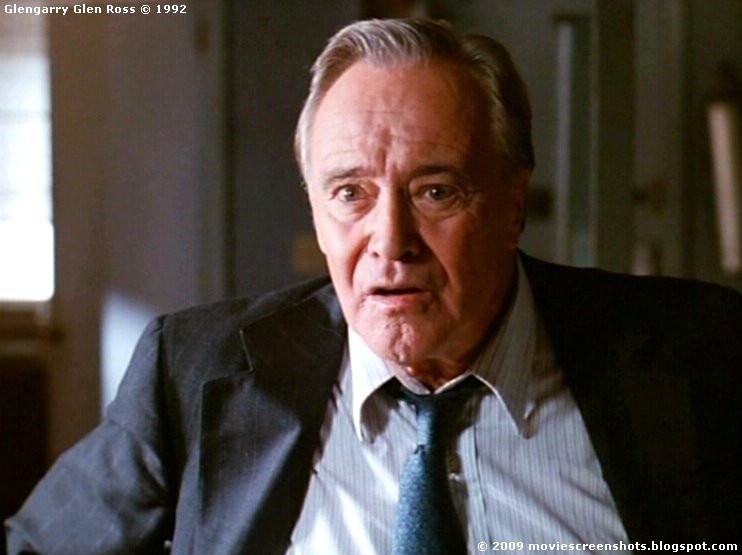
Act 1 is structured like a triptych: the action all takes place in the same Chinese restaurant, with each pair of men seated in separate booths, and is structured in three scenes that mirror each other. In the first duologue two men are engaged in a heated discussion related to real estate sales goals. Shelly Levene, an old salesman, is having a run of bad luck and is trying to convince the real estate office manager, a younger man named John Williamson, to help him by sending a few good sales leads his way. The sense of panic and frustration are almost palpable as Levene comes as close as his dignity will allow to begging for his job from someone who has never actually sold anything in his life. Levene’s outrage is directed at more than the office manager – he’s frustrated with how life seems to be pushing him aside for younger men with more vitality and effectiveness.
In a different booth at the same Chinese restaurant, Moss and Aaronow, two other sales agents from the real estate company, have just finished dinner. They are disgruntled over the injustice of a new sales contest. It’s outrageous to them that their jobs should hinge on some contest and not prior performance or loyalty, especially given the sales volume they each made in the Glen Ross subdivision. Now the pressure is just too great: Aaranow has the bent countenance of a man resigned to a dire fate, while Moss puts up a false bravado. Both men know that, in this dog-eat-dog world, the axe could fall on one – or both – of them.
resources
Wider reading
Office Gossip
While most people may not be familiar with the inner workings of a high-pressure real estate sales office, the events surrounding Glengarry Glen Ross in the 1980s (the play was first performed in ’83) certainly made that world seem not only plausible but almost inevitable. The 1980s in American business were a time of corporate takeovers, both friendly and unfriendly, in which those engineering those takeovers reaped personal rewards in the tens of millions of dollars. Frequently, those takeovers were funded by high-yield “junk bonds,” first proposed by Drexel Burnham Lambert executive Michael R. Milkin.
Learner Portfolio: Trapped in Cubicles
Although the salesmen in Glengarry Glen Ross work in the same office and rub shoulders daily, sharing a common purpose and environment that should encourage camaraderie, the reality is starkly different: they suffer profound alienation from one another and from the world beyond their workplace. They are emotionally isolated, each consumed by personal fears and ambitions that others fail to understand. The office has all the ingredients for intimacy (shared struggles, constant interaction, and a common goal) yet competition and desperation fracture any sense of solidarity. Their alienation extends outward as well: the land they sell is reduced to mere “crap,” a commodity stripped of its natural value, and customers are objects of contempt rather than connection. Even moments that seem to suggest unity, such as their shared resentment of the unfair system or reminiscences over past glories, quickly dissolve into betrayal and manipulation. Any appearance of friendship reveals itself as just another scam, revealing how a culture of ruthless capitalism corrodes human bonds.
In this Learner Portfolio task, think about how to represent how each character is trapped in their own ‘cubicle’ of thought. You can design a chart, diagram, or creative layout where each character is placed in a separate space with notes about their main preoccupations (e.g. money, job security, resentment) and how these prevent genuine empathy or connection. Consider adding arrows or broken lines to show failed attempts at communication or moments of conflict. Find a way of illustrating how proximity does not equal intimacy in Mamet’s world.
2. Snake Oil Sales Tactics
“The true reserve that I have is the strength that I have of acting each day without fear.”

By the time we reach the third of Act 1’s short scenes, Mamet has already shown us the ‘lower-ranked’ salesmen, struggling, desperate, and clinging to scraps of opportunity. Now he wants us to see the opposite: a master at work. Rick Roma sits at the top of the sales board, at the peak of his powers, and in this scene he turns his slick, confident patter on an unsuspecting mark called James Lingk. Roma doesn’t just sell property; he sells ideas, dismantles fears, and reshapes reality to close the deal. This is persuasion at its most polished… and most dangerous.
In Act 1, Scene 3 of Glengarry Glen Ross, we watch Rick Roma, the consummate salesman, work his magic on Lingk. Roma isn’t really selling land; he knows the Glengarry Highlands property is worthless. Instead, he sells an idea, a seductive worldview designed to dissolve Lingk’s doubts. Roma launches into a smooth monologue about morality, fear, and the illusion of security, arguing that most of what people worry about never happens and that the only thing anyone truly has is “the moment.” By reframing risk as freedom and fearlessness as strength, Roma removes emotional obstacles and creates a false sense of confidence in Lingk. This is classic snake oil sales tactics: the product is secondary as the real sale is psychological.
Office gossip
Glengarry Glen Ross is dedicated to Harold Pinter, a British playwright who stated that: ‘words are not the vessels of meaning but rather tools used by the characters to conceal the truth and attack others.’ Mamet often points to politicians who would speak pleasing platitudes to conceal their true intentions. Moments in American history when seemingly innocuous statements have been used as weapons in civil disputes include those used by McCarthy, Nixon, and Clinton.
Resources
Learner Portfolio: Practise for Paper 1 (Literature students only)
If you are a Language A: Literature student, at the end of your course you will sit Paper 1: Guided Literary Analysis. This paper contains two previously unseen literary passages. SL students write a guided analysis of one of these passages; HL students write about both passages. The passages could be taken from any of four literary forms: prose, poetry, drama or literary non-fiction. Each of the passages will be from a different literary form.
Here are two passages taken from Glengarry Glen Ross; as this is a play the literary form is ‘drama’. Each passage is accompanied by a guiding question to provide a focus or ‘way in’ to your response. Choose one passage and complete this Learner Portfolio entry in the style of Paper 1: Guided Literary Analysis.
3. Act 2: The Ransacking
“That’s cold calling. I don’t even know their name. I’m selling them something they don’t even want.”

Act Two opens in chaos, as the real estate office has been broken into overnight. The men arrive for work the next day to find Williamson and Aaranow milling about with a police detective nearby. Sensing immediately what has happened, Roma demands to know if the contracts are safe – especially Lingk’s who’s signature he secured yesterday. Williamson confirms that the contract was safely delivered to the bank last night. Elated, Roma is over the top and has won the contest: the new Cadillac is his. However, the police detective wants to interview the men one by one and starts pulling people into his interrogation room. It transpires that one of them must have burgled the office.
Resources
Wider reading
Office gossip
Mamet based the characters in Glengarry Glen Ross to some extent on the men with whom he had worked for a year in a dubious real estate office in Chicago. He admired their ability to live by their wits and their dynamic addiction to what they did. He found them amazing. That does not mean that he approves of what they do. He later wrote: “The desire to manipulate, to treat one’s colleagues as servants, reveals a deep sense of personal worthlessness: as if one’s personal thoughts, choices, and insights could not bear reflection, let alone a reasoned mutual examination.”
Learner Portfolio: Could the salesmen study IB?
The International Baccalaureate (IB) Learner Profile describes a broad range of human attributes that go far beyond simple academic success. These attributes are aspirational qualities for individuals to develop; they imply a commitment to members of the school community in learning to respect each other, oneself, and the wider world.
It probably won’t surprise you to hear that the men in the office are not ideal representations of IB students! But does that mean they don’t embody any of the Learner Profile attributes? Below are ten traits from the IB Student Learner Profile. Discuss these traits and mind-map the sales agents’ traits, personalities, and dialogue. Which of these traits could you convincingly argue that they exhibit? Are there any traits the men actively oppose? Once you have finished, share your mind-maps with others, making reference to characters’ speech and evidence of their personality traits:
4. Act 2: The Unraveling
“Always tell the truth. It’s the easiest thing to remember.”

Roma spots Lingk entering the office and instantly senses danger. Thinking fast, he pulls Levene into an improvised charade, casting him as a wealthy investor to impress Lingk who, under pressure from his wife, insists on canceling the deal. Roma counters smoothly, stalling with the excuse he has to rush Levene to the airport and they’ll talk on Monday. Just as Roma’s web of words seems to ensnare Lingk once more, Williamson blunders in, ‘helpfully’ revealing that Lingk’s check has already been cashed. The illusion shatters, Lingk exits, and Roma erupts at Williamson. The office’s top closer has been undone by one careless comment.
At the end of the play, Mamet masterfully draws together all his themes, plot strands and clues to reveal who ransacked the office and burgled the leads. Was it Moss, the man who first proposed the idea in the Chinese restaurant? Did Aaranow allow himself to be duped into committing the crime? Could it even have been an inside job pulled by Williamson, trying to pin the blame onto one of the salesmen who constantly belittle and insult him? Mamet doesn’t keep us in suspense for long as, at the end of the play, the culprit betrays himself with his very own words…
resources
Wider Reading
office gossip
Upon its first run of performances in 1983- 85, virtually all of the critics commented extensively on Mamet’s use of language, not only to create tension and define character, but also as a sort of musical poetry: “hot jazz and wounding blues,” as Frank Rich, critic for the New York Times put it. Even those few critics who were lukewarm about the play as a whole appreciated the distinctive, powerful language. Critics also appreciated the savage, scalding comedy of the play.
Learner Portfolio: Practise for Paper 2
Write this Learner Portfolio in the style of a practice Paper 2 response. You can use one of the prompts below, or another prompt given to you by your teacher. Although Paper 2 requires you to write about two literary works, for the sake of this exercise you could focus only on your response to Glengarry Glen Ross, or you could try to compare your ideas to another literary work you have studied (visit this post for more help with Paper 2 compare and contrast skills):
- “Fear of failure is our main motivation to act.” Discuss this statement with reference to works you have studied.
- How and to what effect are different moral values conveyed in works you have studied?
- Compare and contrast the role of minor or supporting characters in literary works you have studied.
- Writers can present their ideas in unusual or thought-provoking ways. How, and to what effect, has this been shown in two works you have studied?
Towards Assessment: Individual Oral
Supported by an extract from one non-literary text and one from a literary work (or two literary works if you are following the Literature-only course) students will offer a prepared response of 10 minutes, followed by 5 minutes of questions by the teacher, to the following prompt: Examine the ways in which the global issue of your choice is presented through the content and form of two of the texts that you have studied. (40 marks)
Glengarry Glen Ross could be an excellent text to talk about in your oral assessment. The themes of capitalism, deception, alienation and loneliness, language, and the American Dream are rich and lend themselves well to creating the Global Issue which will form the core of your talk. Now you have finished reading and studying the play, spend a lesson working with the IB Fields of Inquiry: mind-map the play, include your ideas for Global Issues, make connections with other Literary Works or Body of Works that you have studied on your course and see if you can make a proposal you might use to write your Individual Oral. Here are one or two suggestions to get you started, but consider your own programme of study before you make any firm decisions about your personal Global Issue. Whatever you choose, remember a Global Issue must have local relevance, wide impact and be trans-national:
Literary pairing
Body of work Pairing
- Field of Inquiry: Culture, Community and Identity
- Global Issue: how systems oppress individuals
- Rationale:
In Glengarry Glen Ross, Mamet shows how systems of power oppress the salesmen by reducing them to instruments of productivity. The real‑estate office functions as a brutal capitalist machine in which people are coerced through fear, competition, and constant surveillance; the system forces them into unethical behaviour revealing how structural pressures crush individuality. A work in translation that explores a similar issue is Osamu Dazai’s No Longer Human. Here the system is rigid social expectations and norms that demand conformity, leaving Yozo unable to express his authentic self. Society’s systems cage him psychologically. Like Mamet’s economic system, Dazai’s social systems leave his protagonist morally compromised and dehumanised. Alternatively, this issue would work well with Murakami’s The Elephant Vanishes, also a work in translation, that explores the corroding effect of modern capitalist-consumer societies on the psyches of a range of protagonists.
- Field of Inquiry: Beliefs, Values and Education
- Global Issue: how society defines manhood
- Rationale:
On Mamet’s stage, society’s definition of manhood is built on aggression and dominance. The men are pressured men to inhabit masculine roles that are all about winning, toughness and emotional stoicism. Their world is cut-throat, leaving no room for vulnerability. A body of work that demonstrates a similar idea of manhood – defined by charm, aggression, danger, and self-control – is the collection of James Bond film posters that you can study here. Bond’s slick, gun-wielding identity depicts mastery over every situation, reflecting society’s expectation of a certain type of manhood. If you want to flip the script and show how a body of work may offer an alternative vision of masculinity, look no further than Joshua Rashaad McFadden’s Come to Selfhood portrait gallery and exhibition.
Towards Assessment: Higher Level Essay
Students submit an essay on one non-literary text or a collection of non-literary texts by one same author, or a literary text or work studied during the course. The essay must be 1,200-1,500 words in length (20 marks).
Now you have studied the whole play, if you are a Higher Level student you might like to turn your thoughts to the essay that all Higher Level students must write. For those who are interested in investigating Glengarry Glen Ross further, here are one or two examples of lines of inquiry suitable for this text. But remember to follow your own interests and the direction of your own class discussion to generate your own line of inquiry. It is not appropriate for students to submit responses to an essay question that has been assigned:
- How does David Mamet use language to critique corporate culture in Glengarry Glen Ross?
- How does David Mamet use character interaction to suggest that dishonesty is the only way to succeed in a capitalist system in Glengarry Glen Ross?
Categories:Drama
 IB Language and Literature 3.0