Unseen Text: Tiktok and the Nome King
Text Type: Children’s Story
Guiding Question: How might the use of fantastical elements in this text appeal to young readers?
Less a text type, and more a category of writing, texts which appeal to children might appear in Paper 1. Whether a website with accessible or interactive features, a text book designed to educate or, like this text, a story presented in an engaging way, learning to identify features of texts written for children is a skill you can transfer across a variety of text types. Read the story of Tiktok and the Nome King and see how many of features that might be designed for a young reader you can pick out for yourself. Then examine the answer below to see how you might construct an analytical response. As ever, this is just one way of writing about this text: alternative approaches can be equally valid.
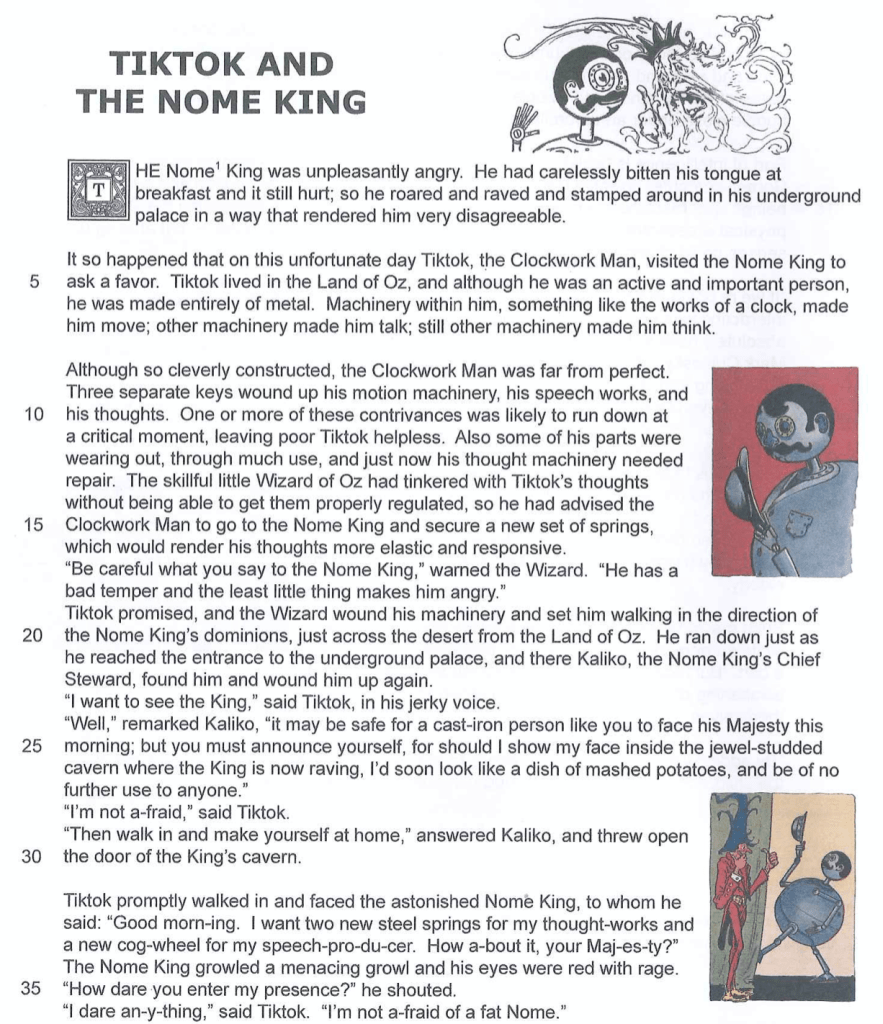
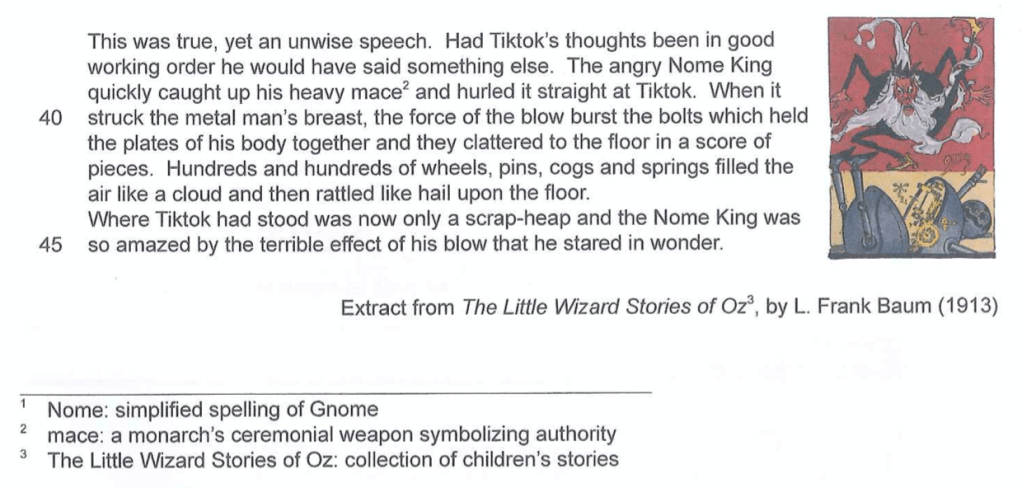
Sample Response:
Tiktok and the Nome King is a story by L. Frank Baum, author of the famous tale The Wizard of Oz. As a story intended for children, Baum uses fantastical elements such as an otherworldly setting, magical characters, and an allegorical structure to not only appeal to young readers, but to impart a lesson about the importance of politeness as well.
Firstly, the fantastical settings may appeal to young children by activating their imaginations and constructing a world that is both familiar-yet-strange. For example, the settings range from ‘underground palaces’ to ‘jewel-studded caverns’ to a vast ‘desert’, the ever-changing settings tell a ‘fantastical journey’ story that appeals to a young person’s desire to explore the world and have adventures in faraway places. The settings are described using sensory imagery that make it easier for children to visualise: for instance,‘jewel-studded caverns’ employs the visual sense to make the dark cavern walls seem to glitter with light. All this is framed in a fairy tale diction that might be familiar to children from other stories, such as ‘dominion’ as a synonym for ‘lands’. Thus, Baum uses vivid imagery to describe fantastical settings in a way that is designed to appeal to young readers by stimulating a sense of adventure and making imaginary lands come alive in their minds.
Furthermore, Baum populates his imaginary lands with magical characters as a way of teaching children lessons in a way that is unusual and appealing. For example, Tiktok is a mechanical creation, ‘constructed’ in a way that might fire a child’s imagination: ‘he was made entirely of metal. Machinery within him… made him move… made him talk… made him think.’ (This sentence makes deliberate use of anaphora to create a rhythm which would sound appealing if the story is read aloud.) Yet despite his fantastical construction, his character can be understood in real terms as well. For example, Tiktok’s flaws are not only physical but flaws of character and behaviour. The way he speaks rudely to the Nome King creates the story’s conflict and serves as a way to teach children about the consequences of poor behaviour: when he ‘promptly walked in’ and speaks in a casual manner to a king (‘How a-bout it, your Majesty’) children might recognise behaviour they have been taught is wrong. Therefore, the writer uses the fantastical element of magical characters as a way of teaching young readers about right and wrong in a way that is not preachy, but fun to follow.
Ultimately, the fantastical elements of the story make the conflict between the Nome King and Tiktok an allegory of the conflict between adult authority and childhood rebellion. The authority of the adult is symbolised by the king’s mace, which he uses to punish Tiktok for calling the king ‘fat’. What happens to Tiktok at the end is quite shocking and unexpected, but young children can understand the punishment comes from rudeness to an authority figure, and can transfer this lesson to their behaviour towards adults, parents and teachers. The text makes an allegorical point that ‘had Tiktok’s thoughts been in good working order he would have said something else.’ While real children are not robots, they can understand that bad behaviour is the result of ‘defective’ thoughts which they should try to correct. Therefore, Baum uses the allegory of Tiktok and the Nome King to teach children not to challenge adult authority through fear of punishment and to control their impulses to be rude or badly behaved.
In conclusion, the writer employs fantastical elements such as imaginary settings and magical characters to hook young readers by firing their imaginations. Once they are hooked, however, the allegorical structure of the story is used to deliver a moral lesson. While the violence of the punishment may date the text (many modern parents do not believe in punishing children physically, and rudeness is not now commonly believed to be a character defect, but a result of emotional stress) nevertheless, the story carries a timeless lesson about the importance of politeness towards others.
Categories:Paper 1 Analysis
 IB Language and Literature 3.0
OMG THIS WAS AMAZING SLAY QUEEEN
LikeLike
Thank you for this. I truly loved it. This is quite the essay.
LikeLike