Unseen Text: Climate Change
Text Type: Comic Strip
Guiding Question: How does the relationship between image and text support the writer’s argument?
In many ways, the Language and Literature course relates more closely to Theory of Knowledge than any other subject. This text has a definite ToK feel to it. While the topic of the text is Climate Change, careful reading reveals the author is interested in the way some people jump to conclusions based on their own perceptions and have a habit of denying other, more compelling, evidence. Always read the text carefully and, when approaching multimodal texts like comic strips, be careful not to ignore the words. The guiding question for this text reminds you to treat words and images equally and the sample response below shares analysis comments between visual and textual elements. Of course, this response is just one of many possible ways of analysing this text; your own approach will be equally valid should you always argue your ideas with reference to the text.
Sample Response:
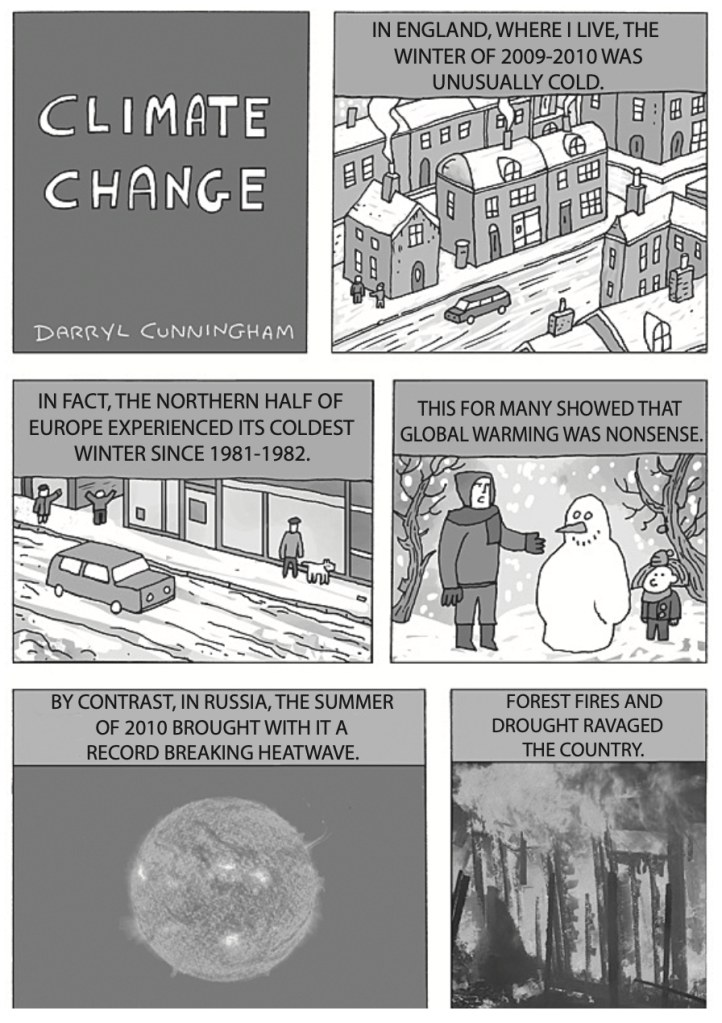
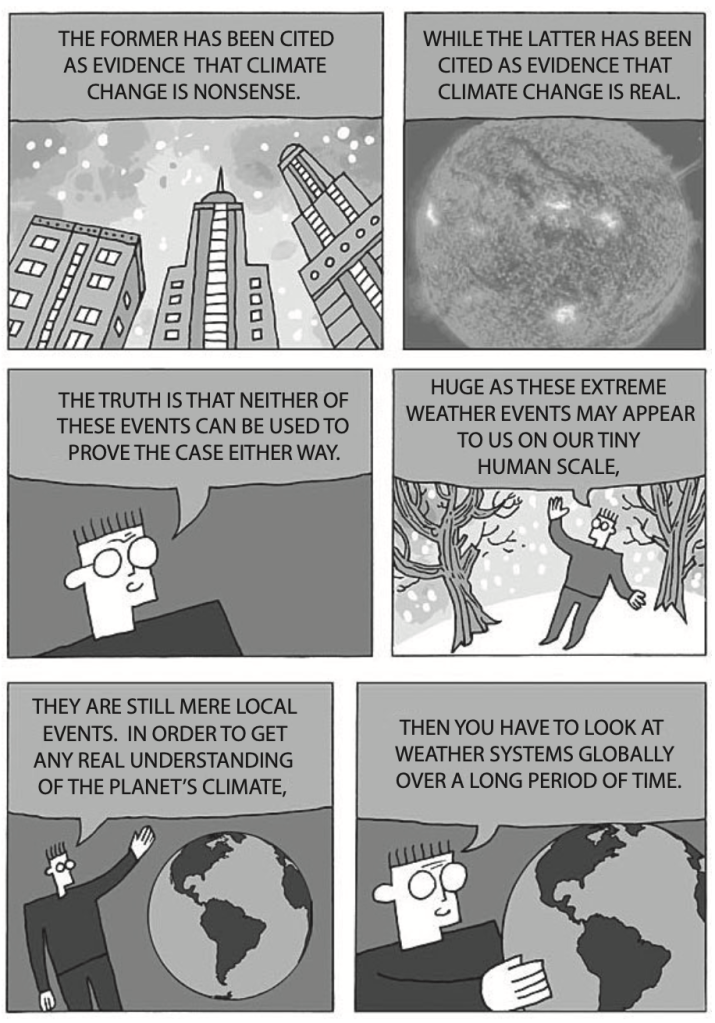
This extract is pointedly called “Climate Change” which is a semantic shift from ‘global warming’. This terminology was abandoned as some people liked to say that because weather seemed to be turning colder, how could global warming be real? This text is a rebuttal to such arguments. Cunningham lampoons people with opinions that clash with reality through humourous images and factual text. He uses shifting scale and perspective to argue that a single person’s viewpoint is not as reliable as the proof of scientific research, and uses a photorealistic art style to imply that some evidence is too “compelling” to deny.
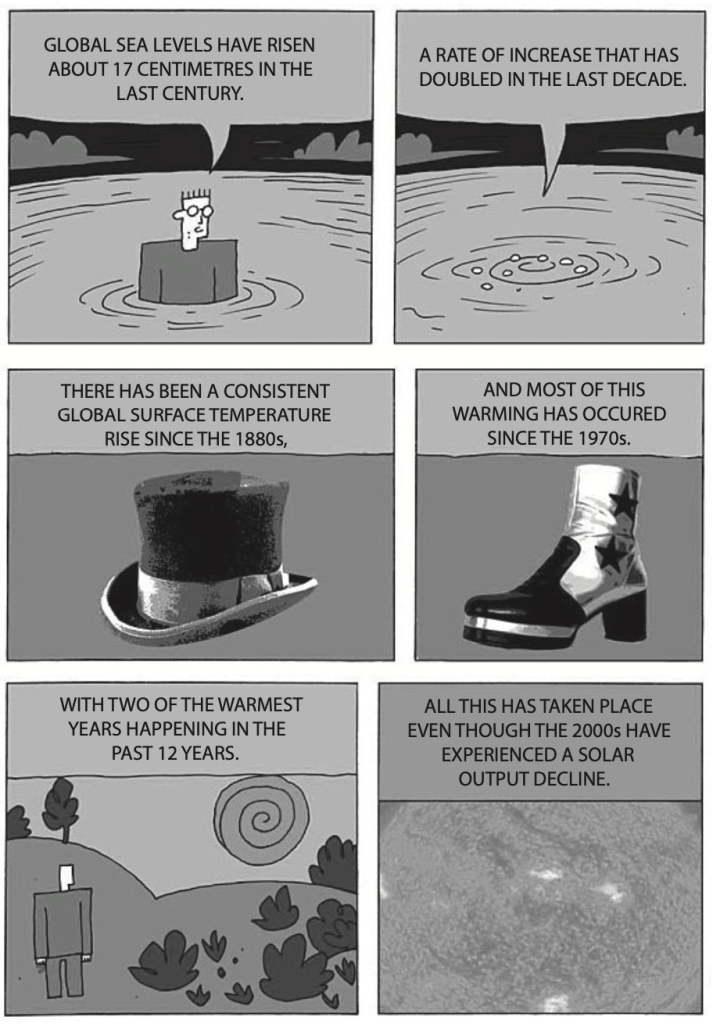
Firstly, Cunningham uses a humourous juxtaposition of text and image to lampoon people who use the semantic shift between ‘global warming’ and ‘climate change’ to deny reality. For example, in the nineteenth and twentieth panels, the narrator stands in an ocean explaining that “global sea levels have risen about 17 centimetres in the last century.” Between two panels the sea level rises until it covers the man and he is speaking underwater. These panels poke fun at the kind of person who is so blinded by their prejudices that they refuse to acknowledge evidence staring them in the face; the kind of person who would rather drown than admit they are wrong about climate change. In another example, the text explains that “the northern half of Europe experienced its coldest winter since 1981-1982” and that “this for many showed that global warming was nonsense.” The accompanying picture shows a man gesturing somewhat angrily at a grinning snowman, while presumably explaining to his child that global warming can’t be real because it’s snowing. The picture pokes fun at the simplistic statements of people who deny climate change even though the evidence – personified as a grinning snowman – is literally staring him in the face.
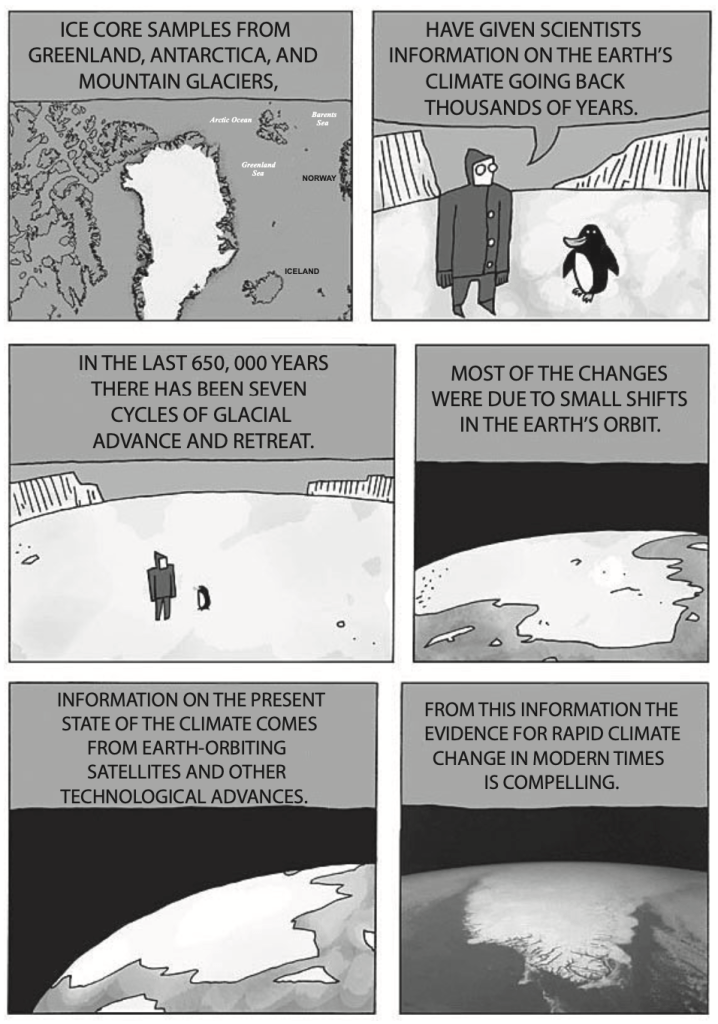
Furthermore, Cunningham uses frequent shifts in perspective and scale to caution readers against relying only on the evidence of their eyes when drawing conclusions about climate change. The captions in the tenth-twelfth panels make a point that our human scale is “tiny” and that “you have to look at weather systems globally over a long period of time” to get an accurate perspective on shifts in the global climate. This line introduces a contrast between the viewpoint of individual people (‘tiny’) and a larger ‘global’ scale; so accompanying this are frequent images of people and the Earth. Images of the Earth are sometimes small, as if the viewer is far away, zoom down to the planet’s surface (the human scale), then back out to space again. In the twelfth panel, Cunningham distorts scale so much that his avatar is pictured holding the entire world in his hands. This image suggests to the reader the impossibility of a single person being able to see all the evidence for climate change from only a single perspective, encouraging more open-mindedness about receiving information from other sources. Similarly, Cunningham uses the possibilities of spatial mechanics to take the reader on a tour around the planet, letting us experience what it might be like if we could view climate change from a global perspective instead of our individual positions. Locations in the text range from ‘England’ to ‘Russia’ to ‘Greenland and the Antarctic,’ sometimes jumping from place to place in adjacent panels. Overall, shifts in perspective, whether spatial or in scale, is a way of presenting the writer’s argument: an individual perspective is limited, and we have to make an imaginative ‘shift’ in order to think properly about climate change.
Finally, Cunningham uses authoritative language combined with realistic images to convey the argument that scientific evidence for climate change is “compelling”. Throughout the text he employs a lexical field of ‘knowledgeable’ words such as ‘truth’, ‘prove’. ‘evidence’, and ‘scientists’. These words help frame the text’s argument in a credible and authoritative voice, ensuring it sounds trustworthy. To this end, Cunningham also uses proven facts to support his argument. For example: he tells us how science has proved that “in the last 650,000 years there has been seven cycles of glacial advance and retreat.” In this way the text emphasises the importance of research that can discover facts and truths hidden to the naked eye or which lie buried in the past. Combined with this is his choice to draw some panels in a photorealistic art style. This can be seen clearly in the last two panels, which both feature a sweltering sun: the first is drawn with circular swirls; the second is a close up of the surface of a boiling, roiling sun. Cunningham criticises a denial of basic science through captions that say “two of the warmest years” have occurred in a time of “solar output decline.” Therefore, the switch between realistic and simplistic art reinforced with straightforward facts and statistics encourages the reader to question what is real and what is fake – our own perceptions, or the evidence science provides.
In conclusion the writer makes a compelling argument about the limitations of an individual person’s perspective and how we should be careful to not rely only on the evidence of our eyes. The comic strip is a perfect way to do this, as the form allows the writer to play with time and place, switching perspective, altering scale and jumping from place to place between panels. Simplification is used ironically as a way of illustrating the danger of holding simple opinions and ignoring the evidence of science and research – especially if it doesn’t happen to match a person’s personal beliefs.
Categories:Paper 1 Analysis
 IB Language and Literature 3.0
Amazing
LikeLike
One of most organized and professional responses I’ve seen. The responser shows rich knowledge of linguistic terms and analysis. Great work!
LikeLike
really great work, big slay BUT he didn’t answer ‘Hot or Not’
LikeLike
super cool article
LikeLike