“A word can be a history.”
Melvin Bragg, The Adventure of English
As you read this, it’s likely that English is all around you. It’s the world’s lingua franca, the common language used between people who don’t share the same mother tongue. Today, it’s the most widely learned language in the world, spoken in countless accents and styles. But English didn’t start that way and in this section, you’ll find out about its journey from a small island tongue to a global powerhouse. First, uncover the origins of English, tracing its roots from ancient Indo-European beginnings through invasions and borrowings that made it a ‘mongrel language.’ Next, examine why this language – out of thousands of contenders – became the world’s lingua franca, and what historical, cultural, and technological forces drove its rise. Finally, learn how divergence and local identity have created unique forms like Singlish, Geordie, and Jafraican, each a reflection of the people and cultures that speak it. By the end of this section, you’ll see English not as a single uniform language, but as a living, evolving tapestry of voices from all over the Anglophone world. Begin by choosing one or two items from this reading list:
- The History of English In a Nutshell (article at IELC)
- A short history of the English language (Linguaenglish blog)
- Spread of English (IB Textbook extract)
- English All Over the World (extract from Mother Tongue by Bill Bryson)
- The Spread of English Across the Globe (blogpost)
- The Upside Down (from the Byline Times)
- Varieties of English (IB Textbook extract)
- From Seaspeak to Singlish (Guardian Article)
- Linguistic Variation (Thoughtco article)
- Advance Australia (extract from The Adventure of English)
- Indian Takeover (extract from The Adventure of English)
- West Indies (extract from The Adventure of English)
Reading Challenge
This is a longer and more challenging text, but spending time on this piece, and discussing it with your teacher, will help you master this topic:
Areas of Exploration Guiding Contextual Question
All varieties of writing can be seen as a product of the environment in which they were produced. Writing can be affected by the political climate, major events, popular trends and more. Part of this resource explores diversity in English language works and texts, and considers the impact of the British Empire and ‘linguistic imperialism’ on countries and writers:
Discussion Points
After you’ve got your head around the material in this section, pair up, pick a question, spend five minutes thinking and noting down your thoughts – then discuss your ideas with a friend and report back to the class:
- What benefits has English being a lingua franca brought to the world? How can it be argued that having English as a lingua franca is a positive or negative phenomenon? Does the world need a lingua franca? Does it have to be English?
- What is the difference between a language, a dialect, and a slang? Do these differences matter? Why or why not?
- How do people use languages to define themselves and/or create social relationships?
1. The Origins of English
“Old English had two words – ‘wer’ and ‘wif’ – which meant ‘male human’ and ‘female human’ respectively. ‘Wer’ lives on only in ‘werewolf’… ‘Wif’ is still used today, of course, as ‘Wife’.
Alex Games, Balderdash and Piffle
English is often described as a ‘mongrel language’ because it has never been pure or isolated. From its earliest Germanic roots to the language we speak today, English has absorbed words from countless other languages. This borrowing happened through centuries of invasion, migration, trade, and cultural exchange, each leaving its mark on the vocabulary we use every day. From Norse words like sky and egg to French terms like justice and beauty, English is a patchwork of influences that tell the story of its history. Understanding these origins helps us see why English is so rich, flexible, and full of surprises. You can use this resource to discover milestones in the origins of the English language, from ancient Proto-Indo-European roots to the ascendancy of American English in the latter half of the 20th century:
Activity: Dictionary Detective
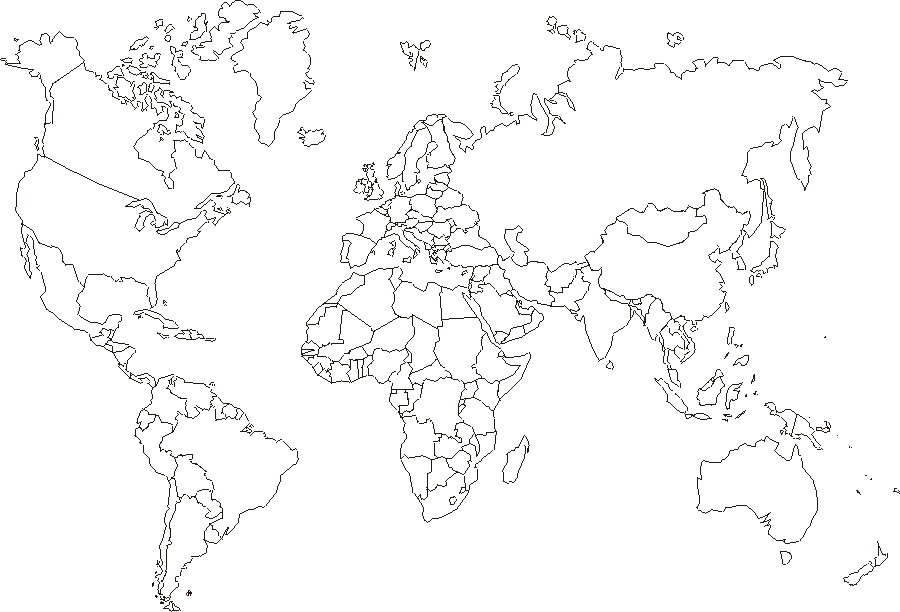
Now you know that English is a ‘mongrel tongue’, try an activity to see that diversity in action. Best done with a paper dictionary (if you’ve never spent twenty minutes idly flicking through a dictionary to see what you can find, now’s your chance!) browse through entries and pay attention to the etymology notes, little explanations that tell you where a word came from. Look out for words that English has ‘borrowed’ from other languages, such as French, Latin, Norse, or even Hindi, or words that can be traced right back to Anglo-Saxon times. Present your findings in a simple word-splash or graphic organiser, or for a true lexicographic challenge, use this blank world map to record the origins of different words. How many countries can you cover? Include the word, its language of origin, its meaning, and any interesting notes (for example, why it was borrowed). When you’re done, share your discoveries with the class. Together, you’ll see just how many cultures and languages have shaped English into the ‘hybrid language’ we use today.
2. The Spread of English
“…the English language flooded all over the world, until by the year 2000 no-one was in any way surprised that a Polish Pope, the head of a Latin-speaking Vatican, on his arrival in a Hebrew-speaking state, should speak in English.”
Melvin Bragg, The Adventure of English
Modern English is rich, flexible, and remarkably successful. Today, it is the most widely learned language in the world, the third most-spoken native language after Chinese and Spanish, and the most popular official second language, with more than 60 countries listing it as an official language. Yet this raises a question that this section will encourage you to explore: of all the languages on Earth, why did English, the language of a small island nation in the cold northern Atlantic, become the world’s lingua franca?
Several key factors explain this phenomenon. First, the British Empire spread English across continents during the 18th and 19th centuries, establishing it in administration, trade, and education from India to Africa to the Americas. At the same time, the Industrial Revolution ensured English became the language of patents, engineering, and scientific research. Later, the rise of the United States as an economic superpower in the 20th century reinforced English as the language of international relations and global commerce. In the modern era, mass media, film, and music, followed by the internet and digital technology, have cemented English as the dominant language of global communication. Marshall McLuhan coined the phrase ‘global village’ in the 1960s to describe a world increasingly connected by technology. He could not have predicted that the unifying language of this village would be English. But history, economics, and culture combined to make it so. Learn more about the spread of English and global communication by sorting into small teams and running this friendly class quiz:
Activity: Visualising the Spread of English
An infographic is a visual representation of information that combines images, diagrams, and text to make complex ideas easy to understand at a glance. It often uses charts, timelines, maps, and short annotations rather than long paragraphs. After reading one or two of the articles from this section’s reading list, transform your learning into an infographic that explains, at a glance, the factors behind why English has become the world’s lingua franca. Be creative to make your infographic visually appealing while making sure it clearly communicates the story of English’s global rise.
3. Varieties of English (Linguistic Divergence)
“A language is a dialect with an army and a navy.”
Aphorism, unknown origin (first published by Max Weinreich)
Languages are never static: they change over time and space. A process called ‘divergence’ happens when groups of speakers become separated, either geographically or socially, and their shared language begins to evolve in different directions. For English, this process started as soon as it left its original home in Britain. As it spread through migration, colonization, and trade, communities around the world adapted it to their own needs. They borrowed words from local languages, developed new slang, and sometimes changed pronunciation or grammar. Over generations, these changes accumulated, creating distinct varieties such as American English, Australian English, Indian English, and Nigerian English. Even within the UK, regional dialects like Geordie or Scouse emerged because of historical isolation and local identity. Divergence reflects culture: each variety of English carries the imprint of the people who speak it, their history, humour, and worldview. English today isn’t one uniform language but a global family of voices, each with it’s own distinctness from another.
Activity: English Remixed
As you’ve seen, English isn’t just one language – it’s been shaped by history, geography, and culture into dialects and slangs, like members of the same family who share traits, but have their own individuality too. Working by yourself or in pairs, choose one variety of English from the list provided (or another you’re interested in) and research it using accessible sources like blogs, YouTube videos, and social media explainers (there’s one or two articles in the reading lists on this page you could use too). Compile notes on: where it is spoken; what makes it distinctive (pronunciation, slang, grammar quirks); cultural character, or how the dialect reflects the identity or lifestyle of its speakers. Don’t forget to collect a few words or phrases unique to this variety and explain their meaning. Finally, are there any songs, films, or media texts that showcase this variety in action? Once you’ve completed your research, create a poster to share your variety of English with others:
REgional dialects
- Geordie
- Scouse
- Yorkshire
- Cockney
- Californian
World Englishes
- Australian English
- Indian English
- Nigerian English
- American English
- Canadian English
Cultural Dialects
- Singlish (Singapore)
- Jafraican
- AAVE (African American Vernacular English)
- Hinglish (Hindi + English)
- Chinglish (China)
Learner Portfolio: Do You Speak X?
Using the lighthearted style of the article Do You Speak Kiwinglish? as inspiration, write your own short blog post about a variety of English you know well or have researched. This could be Jafraican, Geordie, Singlish, Chinglish, American English, or another variety of your choosing. When writing, aim to do more than list features of a dialect; try to convey how your chosen variety of English expresses a particular character and culture. Think about its slang, pronunciation, idioms, and even attitudes. Does it sound relaxed, urgent, humorous, or inventive? What does the dialect imply about the people who speak it? Include examples of words or phrases that make this variety distinctive, and explain their cultural significance.
Body of Work: HSBC ‘Different Points of View’ Ad Campaign
Cultures are increasingly mingling with each other, swapping ideas, concepts, words and mixing cultural practices such as cuisine, fashion – and even language. For a case study in the impact of globalisation on culture, you need look no further than this famous series of adverts produced by HSBC (Hong Kong Shanghai Banking Corporation). Indeed, if you are a frequent flyer, you may even have seen these adverts lining the gangways of airplane boarding gates. As a global brand in an increasingly intertwined world, HSBC want to make a point about how they understand and respect different cultures, and these adverts are the result of this thinking.
In a famous campaign called ‘Different Points of View‘, created by JWT for HSBC in 2008, gangways of boarding lanes at airports around the world (perhaps because passengers are a captive audience?) were lined with images and words in various patterns. Included in this collection are three variations: three different images and one word; or three different words and same image; a third version shows two images and two keywords, each with opposite meanings. Through these juxtapositions, HSBC implies that it understands different markets, and customers can trust the bank to take this into account when operating in different cultural contexts. Here is a collection of samples from the Different Points of View campaign for you to print and annotate for yourself.
Towards Assessment: Individual Oral
Supported by an extract from one non-literary text and one from a literary work, students will offer a prepared response of 10 minutes, followed by 5 minutes of questions by the teacher, to the following prompt: Examine the ways in which the global issue of your choice is presented through the content and form of two of the texts that you have studied. (40 marks)
If you choose, you could bring a four-panel ad from HSBC’s Different Points of View campaign into your Individual Oral. The campaign lends itself best to an investigation in the Field of Inquiry of Culture, Community and Identity, in particular, ideas of intercultural understanding or globalisation. Below are one or two suggestions as to a Global Issue that would work alongside a literary work. You can use one of these ideas, but should always be mindful of your pursuing your own interests and following the direction of your own thoughts, discussions and programme of study when devising your assessment tasks:
- Field of Inquiry: Culture, Community and Identity
- Global Issue: The need for intercultural understanding in a connected world
- Rationale:
Both the content and context of this campaign directly engages with this issue. The campaign’s core message – that meaning depends on perspective – reflects the challenges and opportunities of globalisation, where diverse cultural viewpoints coexist and often collide. By placing these ads in airport gangways, HSBC situates its message in a space symbolic of international movement and cultural exchange, reinforcing the idea that global connectivity demands openness and adaptability. Literary works sometimes deal with culture clashes and exchanges. For example, four centuries ago Shakespeare’s The Merchant of Venice made an eloquent argument for intercultural understanding. If you’re looking for something more recent, in A Thousand Years of Good Prayer Yiyun Li writes movingly about the challenges of understanding between the new generation of Chinese (exposed to travel and connected to the world) and their parents to whom the modern world is often a strange and indecipherable place.
- Field of Inquiry: Beliefs, Values, and Education
- Global Issue: How individual perspective shapes meaning
- Rationale:
The Different Points of View campaign foregrounds how one’s own perspectives shape interpretation and meaning. Through its use of contrasting captions and interrogative statements, the campaign demonstrates that language is not neutral; its significance depends on the beliefs and values of the viewer. By presenting the same image alongside different interpretations, HSBC invites audiences to reflect on how perspective influences understanding. If any of your literary texts present the same ideas, you could pair them with these ads. For instance, Bessian and Diana from Ismail Kadare’s Broken April take very different perspectives on the kanun, a code of conduct followed by the denizens of Albania’s northern plateau. And the end of Barbara Demick’s Nothing to Envy shows how defectors from North Korea have difficulty integrating into the South, often misinterpreting simple, everyday interactions.
Towards Assessment: Higher Level Essay
Students submit an essay on one non-literary text or a collection of non-literary texts by one same author, or a literary text or work studied during the course. The essay must be 1,200-1,500 words in length. (20 marks).
If you are an HL student, you might consider using this text to write your HL Essay. Here are one or two examples of lines of inquiry suitable for this text – but remember to follow your own interests and the direction of your own class discussion to generate your own line of inquiry. It is not appropriate for students to submit responses to an essay question that has been assigned:
- How does HSBC’s Different Points of View airport gangway campaign use the interplay of text and image to create meaning for viewers?
Further Reading:
- The History of English (comprehensive website)
- A Language Family Tree (picture essay at The Guardian)
- How Did English Evolve? (TedEd lesson)
- Viking Words: The Old Norse Influence of English (Life in Norway blog)
- The Words the Vikings Left Behind (Robb Words video)
- Viking Influence on the English Language (at Nordic Culture)
- Norman Invasion 1066 (British History wiki)
- The Norman Conquest: Shaping the English Language (at The English Nook)
- French Influence on the English Language Under Norman Occupation (Morocco World News)
- How Did William caxton Influence Modern English (at Social Shorthand)
- The Invention That Broke English (Rob Words video)
- Why Does the Whole World Speak English (Olly Richards explainer)
- English in America (The Adventure of English by Melvin Bragg episode 5)
- World Englishes (interview with David Crystal)
- Englishes (online exhibit at Kansas University Library)
- The Language of Empire (The Adventure of English by Melvin Bragg episode 7)
- Steam, Streets and Slang (from The Adventure of English by Melvyn Bragg)
- How the Word Conquered the World (Planet Word by Stephen Fry episode 3)
Categories:Language On the Move
 IB Language and Literature 3.0