Unseen Text: Prospero’s Cell by Lawrence Durrell
Literary Genre: Prose Non-Fiction / Travel Writing
Guiding Question: How does the author use descriptive language to create atmosphere?
The title of this passage, Prospero’s Cell by Lawrence Durrell, alludes to the antagonist of Shakespeare’s The Tempest: Prospero, a sorcerer whose pursuit of knowledge traps him on an exotic island. Similarly, Lawrence Durrell writes his diary as he arrives on the island of Corfu, with the intention of using this place to stimulate his imagination. Like the Romantic poets who found inspiration in nature, Durrell intends to immerse himself in the natural landscape and connect with classical antiquity, hoping for inspiration to write a book. Even without knowing this allusion, careful reading should reveal a sense of ‘something’ hidden beneath the island’s cold and inhospitable exterior. While Durrell’s diary evokes the loneliness and seclusion of physical austerity, at the same time, the island feels rich and fecund, abundant in movement, colour, and life. A good answer is likely to wrestle with this challenge, such as the sample you’ll read below which was written in collaboration with Isabella Wang of UWCCSC as a way of practising for her upcoming Paper 1. Her response captures the dual-essence of the island’s atmosphere beautifully and her answer is filled with insightful analysis of descriptive writing methods such as imagery, personification, and descriptions of setting. Although her writing is entirely successful in answering the guiding question, remember it’s not the only possible way to respond: if you have other ideas, alternative answers can be equally valid:

Sample Response:
The given extract depicts the author Lawrence Durrell’s arrival on a Greek island in excerpts from his travel diary. Through use of descriptive language techniques ranging from similes and personification to imagery and contrast, the author creates a secluded and lonely atmosphere, but also one that’s charming and refreshing. The contrast between the grandiosity of nature and the minuteness of individuals establishes the island as a place that could be overwhelming for humans, but, through bonding with nature and paying attention to life, the writer sees it as a place where he can gain fresh insights so that a ‘book can grow’ from the seemingly bare rocky landscape.
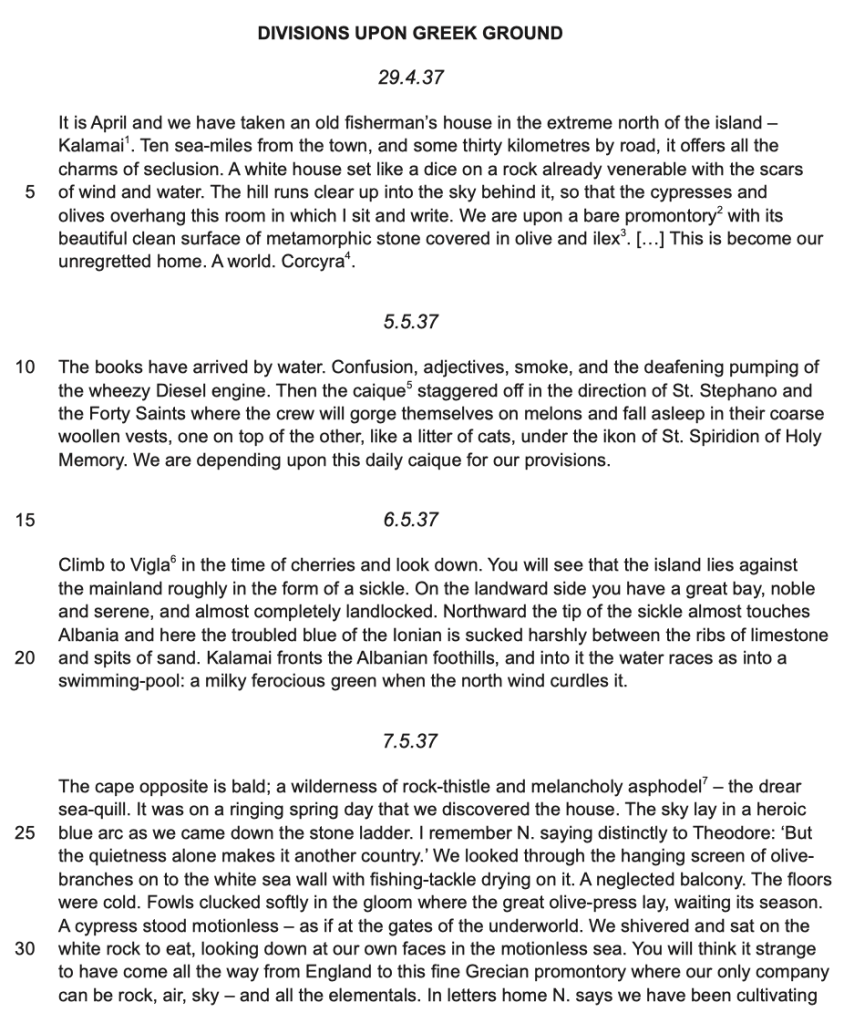
The writer’s new Grecian home is described using imagery that creates an atmosphere of seclusion from the outside world in both space and time. Phrases like ‘old fisherman’s house’, ‘extreme north’, and ‘bare promontory’ suggests the remoteness of the location, and the bareness of the rocky landscape evokes a barren image, foreshadowing the physical hardship of living in a faraway place. Durrell uses a simile to support the atmosphere: ‘a white house set like a dice on a rock’ where contrast is created between the smallness of the house (a tiny cubed dice shape) and the expanse of rock on which it sits, so the scope of nature seems to dwarf the human habitat. Initially this creates a sense of distance between the writer and the landscape, but he brings in a perspective of time that shows he connects with his new home, describing the house as ‘venerable with the scars of wind and water.’ The word ‘venerable’ personifies the house as an aged being, with the ‘scars’ on the outside conveying the passage of time through the changing of the seasons and exposure to weather. The writer appreciates the house because of its long history, and the wisdom it has accumulated through its long-life experience. Compared to the history of the house, human lives are so short so he might hope for some of the house’s ancient knowledge to transfer to him. Therefore, through conveying the grandiosity of the island and the age of the house, the writer creates the lonely and secluded atmosphere of the place that he intends to make his home.
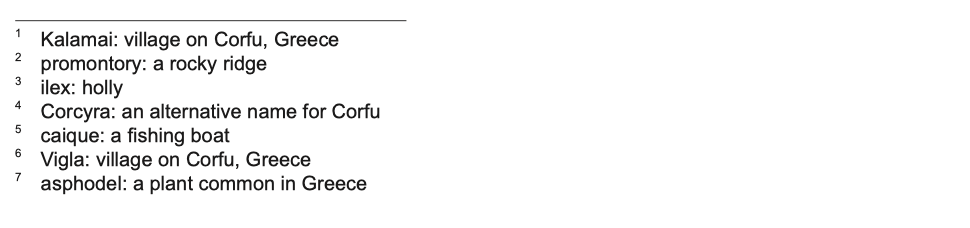
As such, the loneliness and severity are not the type that makes people sad and desperate, but feelings that are charming and refreshing. When the author describes the ‘bare promontory,’ he follows this with a visual description of the ‘beautiful clean surface of metamorphic stone covered in olive and ilex’. Throughout the extract, the author frequently uses the colour white: ‘white house… white sea wall… white rock…’ White can be linked to purity, emptiness and serenity, and this background colour lays the foundations for a forgotten, secluded place that is serene and calming. However, on top of this backdrop the writer draws other colours such as the ‘heroic blue of the sky’, the ‘ferocious green’ of the sea, and the greens and browns of ‘olive and ilex’ trees growing on top of the white rocks. All this visual imagery is artistic, as if the landscape is a canvas that can be painted upon. Other images are auditory and tactile. He describes the ‘cold’ of the floor and chickens that ‘clucked softly in the gloom where the great olive-press lay,’ conveying the contrast between the ‘cold’ austerity and loneliness of the island, and the life that it supports. While he seems to be living on an abandoned promontory, he is accompanied by all the splendour of nature, the ‘rock, air, sky – and all the elements’ suggesting that the author can live well in a calm yet stimulating atmosphere that will focus him on his writing.
The happiness that can be gained from a secluded way of living is exemplified in the descriptions of the people who crew the supply boat that visits the island every day. They are described as ‘gorging themselves on melons’ and ‘fall asleep… one on top of the other like a litter of cats.’ The unusual images and simile show that the crew lives a natural, serene life transcending the normal conventions of human existence and social constraints. The word ‘gorge’ suggests they can live as they please on abundant fruit, a symbol for the abundant resources of nature, and sleep without any troubles or anxiety as cats do. Ultimately, this sense of abundance is what the writer is trying to tap into, as his intention is to use the island’s resources as a stimulant for his imagination. His friend N comments that they are ‘cultivating the tragic sense’, meaning to ‘grow’ a new appreciation by immersing themselves in the island’s atmosphere. Therefore, several images hint at the potential for creativity, such as the description of the ocean as ‘a milky ferocious green when the north wind curdles it’. The image suggests the environment has a transformative power, the word ‘curdle’ implies the thickening of milk into cream. Even the rock is described as ‘metamorphic’, a word that directly connotes transformation.
Overall, the writer creates a complex and nuanced atmosphere that implies both hardship and abundance at the same time. The foundations of the island are bare, barren and lonely, and it is this seclusion from the comforts and distractions of the human world that the writer is seeking. However, overlaid on the rocky surface are images of growth and the abundance of nature that correlates with the writer’s imagination. In coming to this island, he hopes to write a book that will ‘grow out of these scraps, as… the cypress cracks the slabs and rises up fresh and green.’
Categories:Paper 1 Analysis

