Unseen Text: What’s Wrong With McDonalds?
Text Type: Opinion Column / Leaflet
Guiding Question: Analyse the methods that both engage and persuade readers of this leaflet.
I was given this leaflet by a colleague many years ago, and I’ve always found it to be a great practice text. True, it’s unlikely that the texts selected for Paper 1 nowadays would be as dense as this leaflet. But that’s what makes it a good text for training. It’s impossible to cover all the points and methods used by the writers in a single sitting, so you have to make clear choices about what you are going to focus on analysing and the evidence you will include in your response. Will you use the tried and tested ethos-pathos-logos route? Will you focus on heading, image, subheading, copy? Will you try to separate out the various attack strategies employed in the leaflet? The response below was written by Enrico Merisi in DP1 as a practice for his end of year exams. What I like about Enrico’s answer is the way he links his paragraphs together using the theme of ‘duplicity’ and carefully chooses only the parts of the text that support his main ideas. If you want to practice yourself, you can read through the leaflet and create an outline for how you would analyse this text before comparing your ideas to Enrico’s. As this is an especially rich text, you shouldn’t be worried if your angle is different to his, as alternative approaches can be just as successful:
Sample Response:
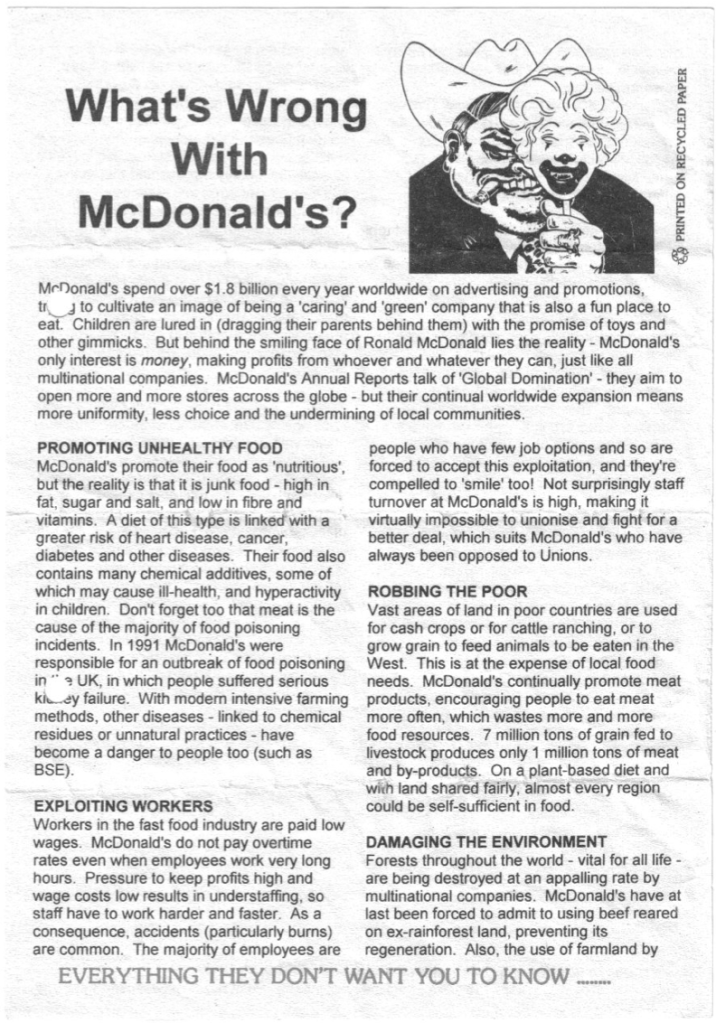
This leaflet is written by the sustainability warriors of Greenpeace and is a form of attack on the mega food corporation McDonald’s. The purpose of the text is to highlight the dark aspects of McDonald’s food chain, in an attempt to raise awareness, before calling for people to ‘fight back’ against the institution’s claims of being an ethical food company. The text is wide ranging, but three main points are: an expose of McDonald’s food, an attack on the power-dynamics of the company, and a constant reference to McDonald’s double-sided behaviour, by which they present one face to the public and conceal their true face behind a mask of advertising, greenwashing and outright lies.
The idea of the company’s duplicity is immediately drawn by the image of a company man hiding behind the widely recognised Ronald McDonald clown face. The clown character is the company’s personification in public; by contrast, the real Mcdonalds face is portrayed with stereotypical ‘evil capitalist’ characteristics; gluttonous fat, a cigar clenched in a twisted smile, a big ring, and a westerner hat, all features that resemble those of an oil tycoon or ‘robber baron’, a familiar villainous role. The mask symbolises duplicity; the company knows its true face would be repulsive to consumers, so it hides the truth about itself behind a cartoon mask. In this leaflet, the clown face actually assumes a sinister aspect and the idea of the clown’s smile being ‘painted on’ might be evoked in readers. Underneath this, the lead paragraph explicitly addresses the issue of McDonald’s dualism by presenting a contrast between what the company shows (a ‘green’ and ‘caring’ face) with the reality: ‘McDonalds only interest is money.’ The writers use typography to present the word ‘money’ in italics, making it clear that this is McDonalds’ only motivation. While the company may say they care about their customers, the leaflet uses the sentence ‘making profits from whoever and whomever they can’ to refute this suggestion. The words ‘whoever’ and ‘whomever’ are wide-ranging and the reader may feel they themselves are included. This would be especially effective if the reader is a McDonald’s customer – they may now feel personally involved in the campaign as they are a victim of McDonald’s profiteering. Establishing this connection with the reader at the start of the text is effective, as readers may now be more open to receiving the message of ‘duplicity’ symbolised by the clown face image.
Through specially selected diction that has connotations of poison or sickness, the writers attack the misleading claims that McDonalds food is promoted as ‘nutritious’. Here, the authors focus on a very logical approach, highlighting the risks of diseases, food poisoning, and the unhealthy aspects of the food such as the use of ‘chemical additives.’ This phrase is an example of the scientific lexical field that is used in this paragraph, giving the text a credible feeling that it is grounded in scientific fact. This style of diction also matches the point made that McDonalds’ food is ‘unnatural’ and words such as ‘chemical’ are repeated to emphasise this idea. Moreover, the consequences of eating such chemical-laden food are enumerated: diseases like ‘cancer’ and ‘diabetes’ provoke a strong emotional response that makes readers more prone to taking action. These diseases are all severe, some might even result in death, so fear or anger are probable emotional reactions to this information. The writers present the names of diseases in a list using asyndeton, so the words hit the reader one after the other in a way that is impactful and will intensify the ‘fear’ effect of the language. Combining unnatural diction with impactful sentence structures like this is an effective way of reaching a reader who may themselves have consumed McDonalds ‘food’.
A second line of attack is the expose of how McDonalds treats its own workers and, in this case, the writers are trying to elicit the emotional response of anger. In doing so they shift the lexical field accordingly: the reader learns how workers are ‘exploited’, an emotive word that suggests a power imbalance between the company and those employed there. Details include how they are expected to work fast and hard, but to always keep a ‘smile’ on their faces to hide the reality. This idea links back to the image at the top of the text, implying that McDonalds expects all of its workers to employ the same dishonest practices and to conspire in hiding the truth from the public. The copy reveals how McDonalds workers are often vulnerable people (‘the majority of employees have few job options’) and instead of upholding workers’ rights, the company exploits their vulnerability. Consequences of worker exploitation include ‘accidents’, ‘burns’ ‘high staff turnover’ and ‘pressure’ and, again, exposing the sheer number of severe consequences is intended to make the reader both incredulous and angry that McDonalds sweeps so much under the carpet. The writers reiterate the point that all of this is done for money: ‘keep profits high and wage costs low’. The use of parallelism and contrast in this phrase emphasises the distance between the ‘fat capitalist’ and ordinary staff workers, who are squeezed for every drop so the rich can keep getting richer.
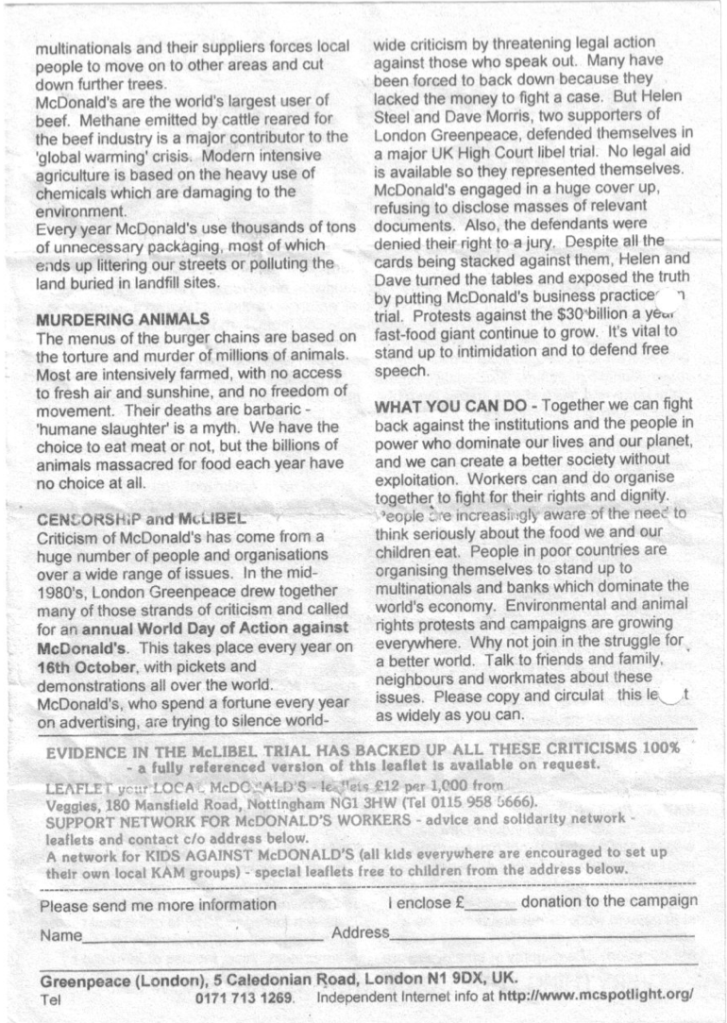
In conclusion, every line of attack is united by the common theme of ‘duplicity’. Whether describing the food as unnatural, exploitation, or severe impacts on the environment, the text spares no effort to show how the company misuses its considerable power to ‘greenwash’ its public image and draw a veil over its unethical practices. Even when legal action is taken, the text exposes how censorship strategies and legal advantages can be bought with money. Nonetheless, the authors make a point of cherry-picking a case against McDonalds that, against all the odds, was won by ordinary people. In the penultimate paragraph, we learn that Helen Steel and Dave Morris ‘represented themselves in a major UK high court libel trial’. Knowing about Dave and Helen’s success is an important part of persuading the reader that action against McDonalds can be successful and the 30-billion-dollar company is not undefeatable. Phrases such as ‘huge number of people’, and ‘together we can fight’ combine to create the impression that Greenpeace is the hub for likeminded individuals to join up in this common cause. The text all but demands of the reader not to be an exception, and the final ‘call-to-action’ is to spread the message and expose the truth behind the McDonalds mask.
Categories:Paper 1 Analysis
 IB Language and Literature 3.0
Thank you! 🙂
LikeLike
This leaflet really exposes the dark side of McDonald’s menu price that most people never think about. It’s shocking how they present a friendly, green image but hide unethical practices behind it — from unhealthy food and chemical additives to worker exploitation and environmental harm. The clown mask metaphor hits hard, and the examples make it feel personal. I’ll definitely think twice before supporting them again. Respect to Greenpeace for standing up. 👏
LikeLike
Really thoughtful analysis. I like how you highlighted the leaflet’s use of imagery, diction, and the theme of duplicity to persuade readers. The way you explained the emotional and logical strategies made the whole breakdown clear and engaging.
LikeLike
Great analysis on how McDonald’s prioritises profit and image over ethics you could also touch on how its recent marketing stunts reflect that disconnect between brand and customer expectations, as seen in surprising moments like the McNuggets and caviar promo that sold out in minutes and sparked widespread frustration online: https://people.com/mcdonalds-mcnuggets-caviar-kits-sold-out-11905520
LikeLike