Unseen Text: Arcadia
Text Type: Advertisement
Guiding Question: How does the text try to engage the reader’s interest in ‘Arcadia’?
While Paper 1 is not a formal essay ( you only have 1 hour and 15 minutes to compose your answer), you are still required to organise your response. In fact, 25% of your marks are gained through the way you structure and focus on the ideas you want to write about. You should probably spend the first 15 minutes working with the text, annotating the formal and stylistic features and collecting your ideas. You then have an hour to write your response. Make sure you demonstrate your paragraph skills when writing your answer; while not explicitly required, paragraphs are the basic building blocks of written organisation, and learning to write in manageable ‘chunks’ will help you both focus your ideas and cover a reasonable range of points. This response has been written to demonstrate that, if you are struggling with organisation, some texts lend themselves to sequential analysis: look how the response follows the layout of the advert. Of course, this is just one possible way of structuring an answer – alternative methods can be equally valid:
Sample Response:
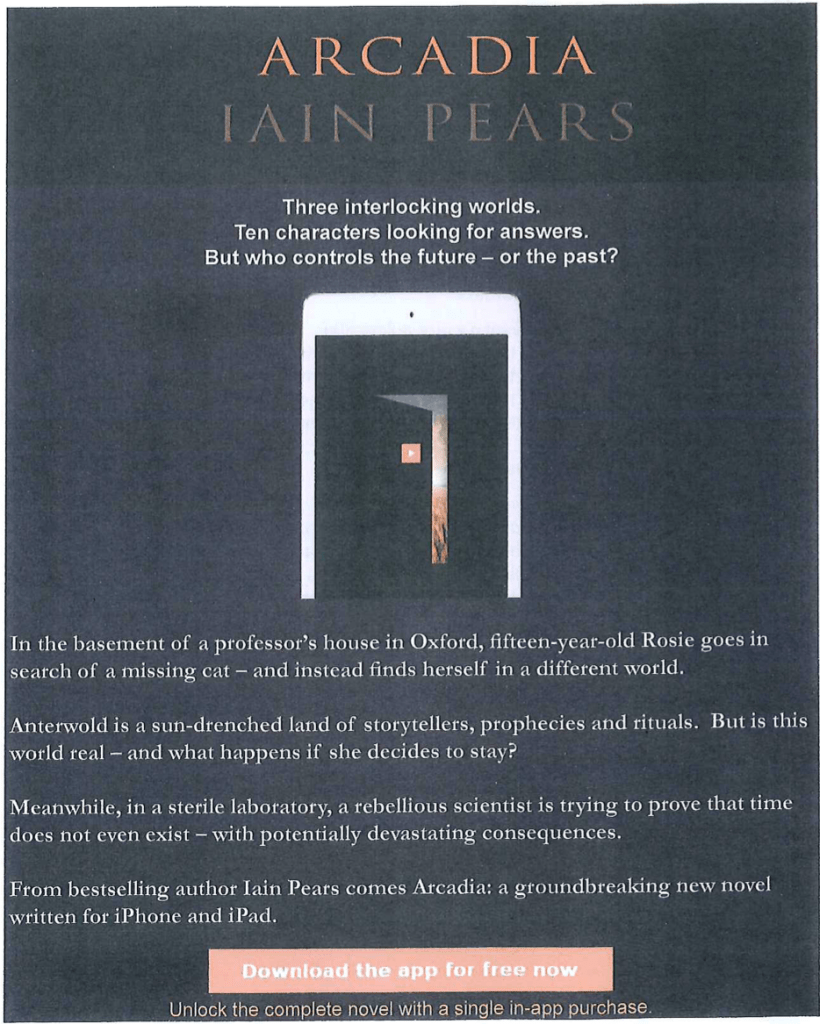
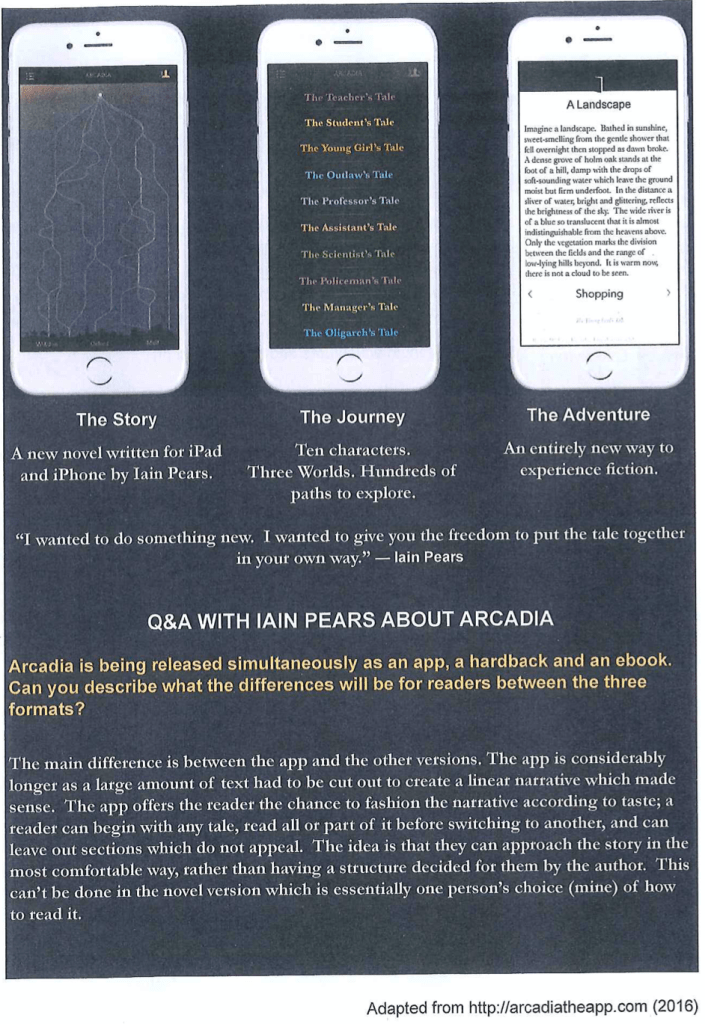
The given text is an online advertisement for a new-concept novel, Arcadia, written by Iain Pears. Where most novels are linear, with the reader following the story from beginning to end, Arcadia is different: the reader can choose to have a new reading experience should they decide to ‘download the app’ by mixing up the order in which they read the different chapters of the story, and even miss out parts of the story that ‘do not appeal.’ The advert foregrounds the mystery of the novel, and attracts readers through promising an escapist adventure into an imaginary world while at the same time appealing to the need for autonomy through giving them control over their reading experience.
Firstly, the advert uses a bold heading and subheading to attract readers by creating a sense of drama and mystery. The title is dramatic: a single word, ‘Arcadia’, which sounds mysterious. Perhaps it’s the name of one of the ‘three interlocking worlds’ introduced in the subheadings? The idea of exploring new, imaginary worlds would especially appeal to fans of fantasy and science fiction who read for escapism. The subheadings offer the promise of drama and mystery (‘looking for the answer’) and perhaps even time travel: ‘but who controls the future – or the past?’ The subheadings have been written to tease and hook, but not to give away too much information: the final line is written in the form of a question, and the answer can only be discovered by reading the book. The title is presented in large, bold type, and in orange lettering so it stands out against the dark background, guaranteed to attract attention and stimulate these thoughts in the reader. Therefore, the advert uses bold headings to invite people into an escapist adventure where answers to an enticing mystery can be found.
Secondly, the advert uses visual imagery to tease the sense of mystery and enhance the feeling of escapism that reading Arcadia will provide. The primary visual symbol is a partially opened door. Through the door is a glimpse of a landscape, probably one of the ‘worlds’ the reader will be able to visit. Sunlight flashes through the door in a dramatic way, contrasting with the dark background to catch attention and heighten drama. The door attracts readers by symbolising a hidden mystery waiting to be discovered. By reading the novel, readers will metaphorically step through the door and into the world of Arcadia. This implies that reading is a ‘journey of discovery’ that involves total immersion in an imaginary world, further enticing readers through the appeal to escapism. Moreover, the door is framed by the borders of an I-phone, linking back to the app’s central feature which is the interactivity that reading on a device can bring, teasing the appeal to autonomy that develops later in the advert. Therefore, the complexity of the visual imagery works to attract readers in different ways: unlocking a mystery, immersing oneself in a fantasy landscape, or taking control of one’s reading journey, all through the same image.
The appeal to escapism is heightened through the teasing of the novel’s main character, an archetype symbolising an adventurous version of readers themselves. The ad’s blurb introduces the character of Rosie, a ‘fifteen years old’ teenage protagonist; as a YA novel, the character reflects the likely target readership. The idea of journeying to a different world, enhanced through the descriptive imagery of a ‘sun-drenched land’, keys into the appeal to escapism that young readers might desire; through Rosie they can live out this fantasy. Furthermore, secondary characters are introduced in a way that teases drama and conflict. A ‘rebellious scientist’ dealing with ‘potentially devastating consequences’ is an exemplar of this. The language ‘devastating consequences’ is dramatic enough to engage interest but vague enough not to give away too much about the novel’s plot. Therefore, through introducing characters that the reader may identify with, and teasing conflict and drama, the advert increases the escapist appeal for readers.
Finally, the advert uses testimonial to highlight the control that readers can take over their reading experience, appealing to the need for autonomy in those who download the app. The copy includes an interview with the author who clarifies that: “I wanted to do something new. I wanted to give you the freedom to put the tale together in your own way.” The phrase ‘put the tale together in your own way’ reimagines the process of reading as a puzzle that the reader can approach in their own fashion. A noticeable repetition throughout the testimonial is the word ‘new’: repeated four times in the text and, combined with the word ‘ground-breaking’, suggests the novel is unique in giving readers this amount of autonomy. Furthermore, the use of anaphora (“I wanted… I wanted…”) implies the writer had the reader’s autonomy at the front of his mind when crafting the story for this app. Therefore, the testimonial appeals to the reader’s desire for autonomy by promising them unprecedented control of their reading journey, a process that is supposed to be unique to this app.
In conclusion, the advert combines the appeal for escapism with the reader’s desire for increased autonomy over their reading journey. The advert teases an experimental reading experience that challenges the convention that books must be read in a linear fashion, from beginning to end. The experience will be more like putting together a puzzle than traditional reading. Readers can play with timelines, choose in which order to read the stories, and piece together parts of the mystery for themselves – immersing themselves in an escapist, fantasy world at the same time.
Categories:Paper 1 Analysis
 IB Language and Literature 3.0