Unseen Text: Big Brother Winner
Text Type: Tabloid Interview
Guiding Question: How does this text generate excitement about celebrity culture for readers?
When preparing for Paper 1, you are encouraged to explore as many different text types as possible; nevertheless, it’s impossible to predict what might come up in your exam. The Lang and Lit subject guide states explicitly that you are not meant to try to memorise features of every text type. Instead you should transfer your learning from one part of the course to another where you can. This article is written in the form of an interview, so the response engages with the most obvious features such as the question-answer format, and noticed the theme of ‘participation’ in celebrity culture as well. However, there are other elements of this multimodal text that you could write about if you choose differently, like the photograph of Ben. Remember, this is just one way of analysing the text and an alternative approach can be equally, or more, effective for you:
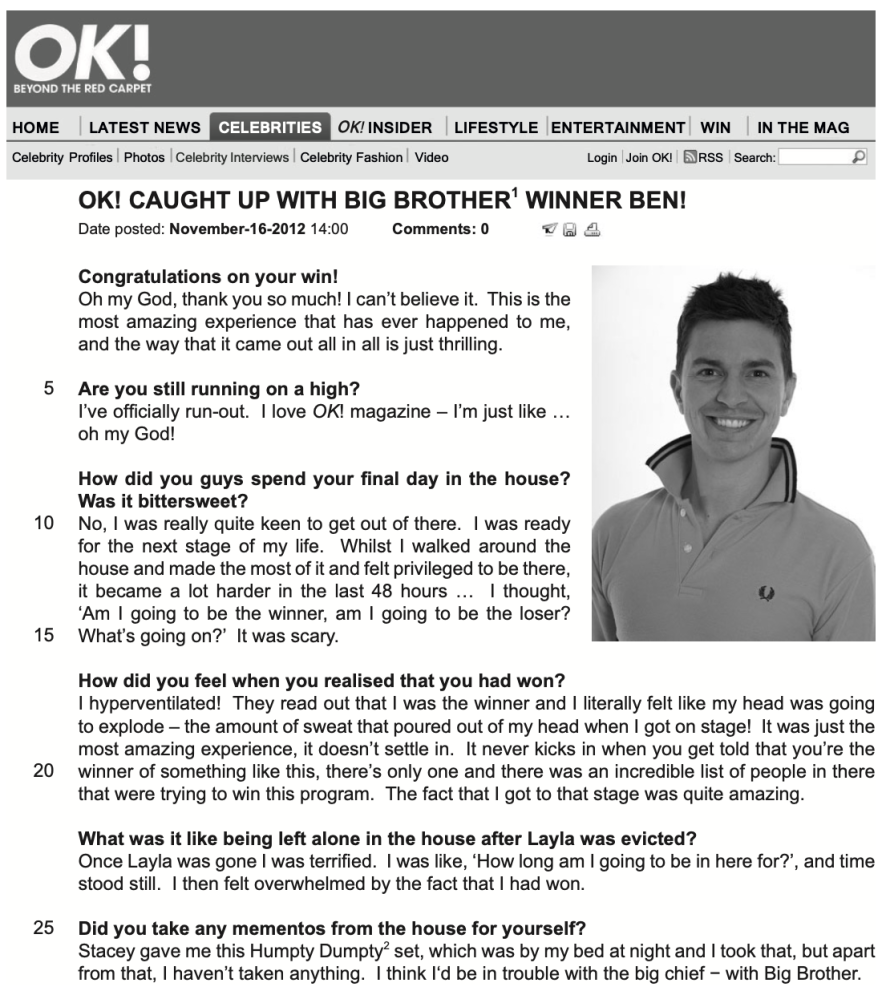
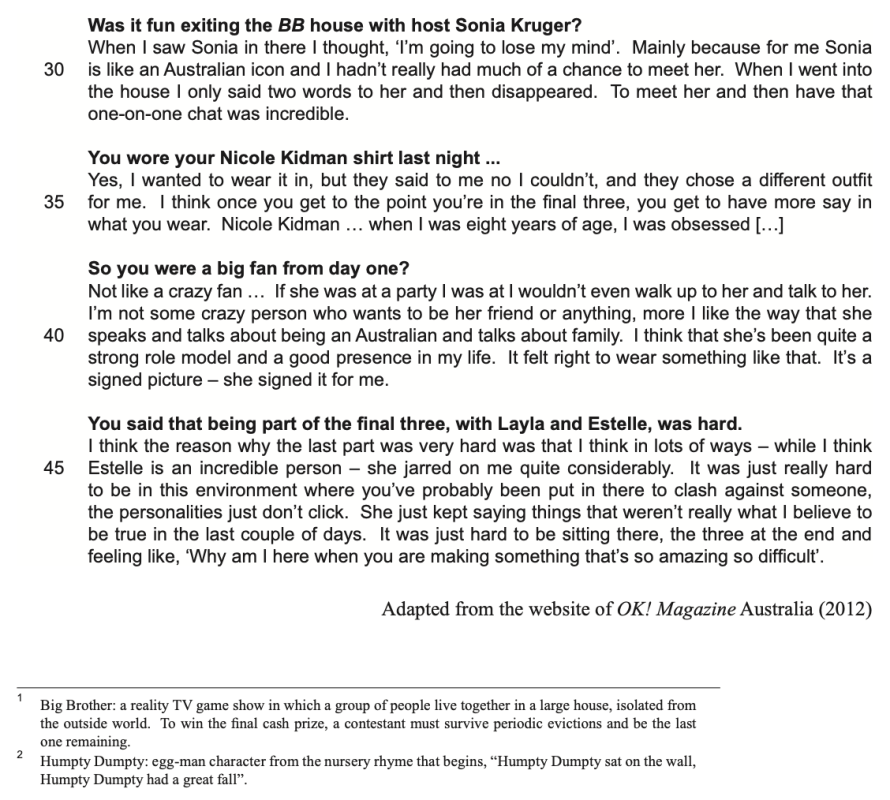
Sample Response:
This text is an interview from the website of OK! Magazine, a publication devoted to ‘celebrity’ news. In this interview, a reality television competitor is asked to share his thoughts and feelings on being the winner of the show Big Brother. As a celebrity magazine, the writers want to generate excitement around celebrity culture to drive engagement from readers, which they do through the question-answer format, as well as suggesting that ordinary people can also participate in celebrity culture, just as Ben has done.
Firstly, the article presents questions that are designed to generate excitement and positivity from the interviewee. The first question directly addresses the excitement of winning the competition through the phrase: ‘congratulations on your win!’. The first question sets the excited tone of the article by being an exclamation, using punctuation to creating an excited agenda for the whole conversation. The second question follows up by asking Ben if he’s ‘still running on a high’. The choice of informal language likens this experience to being in a heightened or altered state, as if being part of celebrity culture creates euphoria like taking drugs. Therefore, the interviewer’s exclamatory tone and use of excited language creates the excited tone of the whole article, in order to suggest how winning Big Brother is a significant event.
Accordingly, Ben’s answers heighten the emotional intensity of participating in celebrity culture. He uses words like ‘thrilling’, ‘scary’ and ‘terrified’ to suggest that the experience was not only exciting but also a bit scary. His answers use hyperbole (‘incredible’) and superlative, both ways of suggesting he’s had a heightened experience, especially when he says: ‘This was the most amazing experience.’ At times Ben seems lost for words, such as when he replies, ‘Oh my god!’ as if he cannot describe the excitement and intensity of winning. At one point he uses figurative language to say: ‘I felt like my head was going to explode’ and ‘time stood still.’ These phrases transform his brush with celebrity culture into something impossible and even magical, outside of the normal realm of human existence. Therefore, the hyperbolic qualities of Ben’s answers combine with the excited tone of the interviewer’s questions to suggest that this is a ‘once in a lifetime’ event that cannot be repeated, and that Ben is lucky to have experienced.
Furthermore, the text generates excitement about celebrity culture by suggesting it is participatory. While only one person – Ben – can win Big Brother, everyone can participate in their own way through, for example, wearing clothes in tribute to favourite celebrities. For this reason, the interviewer asks Ben about his Nicole Kidman t-shirt. Ben’s answers reveal how celebrity culture is an important part of his life, using words like ‘role model’, ‘family’, and ‘good presence’. These words depict celebrities as role models or guiding figures to fans. In fact, the to-and-fro over whether Ben is a ‘big fan’ and ‘not like a crazy fan‘ is revealing about how there can be a right and wrong way to participate. This is reinforced by naming conventions in the article. When Ben speaks about his fellow contestants he uses first names only (e.g. ‘Layla’ and ‘Estelle’). But when he speaks about Nicole Kidman and Sonia Kruger he uses both names. In this way, the text implies celebrity culture is something that ordinary people can be excited about participating in – but only if they don’t take it too far.
In conclusion, this article generates excitement about celebrity culture through featuring emotionally driven questions and excitable, even breathless, answers. It suits the magazine’s purpose to hear Ben’s hyperbolic talk about how ‘amazing’ and ‘incredible’ being part of a TV show can be. Yet at the same time the text is careful to balance against the worst aspects of celebrity worship and overeager fandom, ensuring that excitement is pitched at just the right level for readers to enjoy.
Categories:Paper 1 Analysis
 IB Language and Literature 3.0
Great insights on preparing for Paper 1! It’s so true that trying to memorize every text type isn’t practical. Focusing on transferable skills, like analyzing how language creates divides or uses persuasive techniques, is much more effective. Your example of identifying the ‘them-and-us’ divide through name-calling really illustrates how these skills can be applied across different texts. This approach not only helps with exam prep but also enhances overall critical thinking. Thanks for sharing these tips! Looking forward to exploring more of your content.
LikeLike