Unseen Text: Hausa
Text Type: Encyclopaedia Entry – Informative Text
Guiding Question: How does the way information is presented create impressions of Hausa people for readers of this text?
It is possible that you will be given an informative text to analyse in Paper 1. Information texts can come in all different forms: brochures, prospectuses, leaflets, posters, guidebooks, infographics, recipe books and so on. This text is a little bit unusual: it’s an encyclopaedia entry. Whatever text you may encounter, it’s a good idea to consider the source of the information you have been given: does it come from within the given field of knowledge or from outside? This extract is written from an outside perspective, and from that initial observation, a great deal of insight can be gleaned into not only what information we learn, but how it is phrased – and also lets us consider what is not being said. This type of thinking demonstrates evaluation of the text, something that is explicitly called for in the Paper 1 mark scheme (criteria B). Nevertheless, the response you’ll find below is only one possible way of analysing a text like this. You should feel confident to put forward your own, alternative analysis which is likely to be equally valid should your ideas be rooted in the words and images of the text.


Sample Response:
This text is an extract from the Encyclopaedia Britannica and is intended to provide information about the Hausa people. As tried and trusted stores of information, encyclopaedias are authoritative and reliable. Yet in the case of this text, the writers are outsiders to the Hausa culture and are choosing what aspects of culture to present. Therefore, readers are guided to the impression that the Hausa are an agricultural people, somewhat backward and primitive in comparison to Western readers of encyclopaedias.
The photograph at the top of the page creates the impression that Hausa are a traditional people but, more so, that they are primitive and undeveloped. The photograph depicts two Hausa women sitting on the floor doing needlework. The connection to the ground is a way of suggesting that Hausa people are in touch with nature, but it also carries associations of being simple and undeveloped, lacking civilised mores. The surrounding composition of the image support this through depicting bare and dry ground, and simple wooden boards that associate with rural poverty. The women are dressed in bright clothes and decorated with jewellery and beads; signs of tradition – but also simplicity. Two round gourds symbolise cultural items that further represent the dichotomy of tradition and simplicity. Therefore, the image of women in a traditional setting plays into a preconception of underdevelopment that readers may have about African cultures.
The impressions of tradition and simplicity are supported by keywords in the main body of the copy. The majority of the diction used in the text belongs to a lexical field of ‘rural’ or ‘pastoral’ life. For example, the third paragraph includes words like ‘sorghum’, ‘maize’, ‘millet’ and ‘thatching.’ The word ‘fiefs’ in the second paragraph is outdated, and the words ‘commoners’, ‘chiefs’, ‘slaves’ and ‘noble lineages’ create the impression of an anachronistic society belonging to a past time. Furthermore, words such as ‘market’, ‘traders’, ‘vendors’ and ‘tourist items’ suggest that a good amount of Hausa people’s income comes from traditional crafts, bartering and trading. Similarly, the inclusion of the word ‘subsistence’ reminds us that the Hausa live close to a Western definition of poverty while the phrase ‘utilizing the manure of Fulani cattle’ suggests that farming methods are still primitive or old-fashioned. Therefore, the choice of information presented, combined with the old-fashioned diction, creates the impression that Hausa are not just a traditional people, but a simplistic and primitive culture as well.
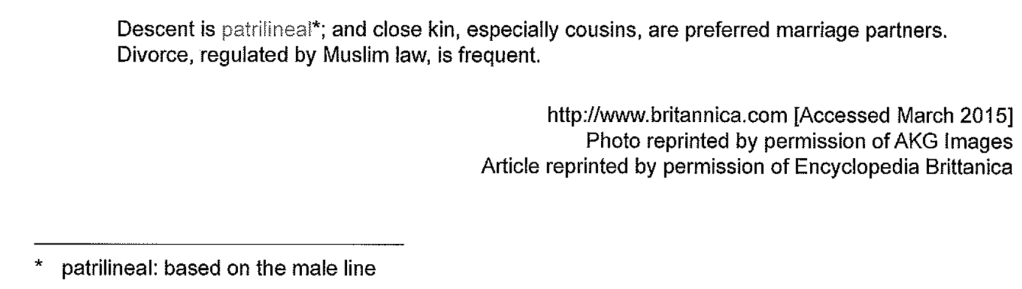
Finally, the overall structure of the text reinforces the impression of simplicity by continually focusing on more traditional aspects of culture. Brief paragraphs are used to give gives geographical, historical, political and economic information. However, the sequence and choice of content reveals a selection bias. In paragraph 5, the text acknowledges that ‘the Hausa have settled in cities,’ suggesting that, like most cultures, Hausa people have multiple identities. But this information comes towards the end of the text, meaning it may not carry as much weight. There are also noticeably no quotations or details provided by Hausa people included in the text. Therefore, through the structure of information, and the choice to exclude contrasting views and Hausa voices, the impression of primitive simplicity is cemented in the reader’s mind.
In conclusion, the text depicts Hausa people as traditional agricultural people, who are also somewhat primitive and uncivilised. The focus on traditional crafts, such as sewing and beadwork, and the details of primitive farming methods lead the impression of the reader towards a narrow view that seems like a tourist’s image. The selection of broad information is likely to confirm preconceptions of African people as simple compared to Western readers of texts such as this.
Categories:Paper 1 Analysis
 IB Language and Literature 3.0
this was awesome💗
LikeLiked by 1 person