Unseen Text: Obsessions: The skinny on Victoria Secret’s fashion show
Text Type: Magazine article – online article – feature article
Guiding Question: How does the writer of this article effectively build anticipation for the show?
Gender stereotypes are a popular component of many Lang and Lit courses and is an issue that sometimes surfaces in Paper 1 unseen texts as well. This CNN article contains many of the stereotypes about women that you may have encountered in your classroom study: idealised appearance; sexualisation; trivialisation; the male gaze. Nevertheless, as a textual analysis, you should focus more on the strategies and methods used by the writer to build anticipation for the catwalk show. The article begins with a challenging pun and the analysis below rests partly on an understanding of the double meaning of the word ‘skinny.’ If you didn’t know the connotations of this word, don’t worry; as ever this is just one possible way to analyse this text. Alternative approaches, different analysis points and your own well-argued evaluations are all equally valid.



Sample Response:
This text is a feature article profiling an annual fashion show organised by Victoria’s Secret, a well-known women’s clothing brand. The purpose of the article is to build excitement and anticipation for the televised show through leaning heavily on the good looks and beauty of the models on stage, promising an ‘out-of-this-world’ experience, and hinting at an ‘insider’ view that will divulge secrets of the modelling world.
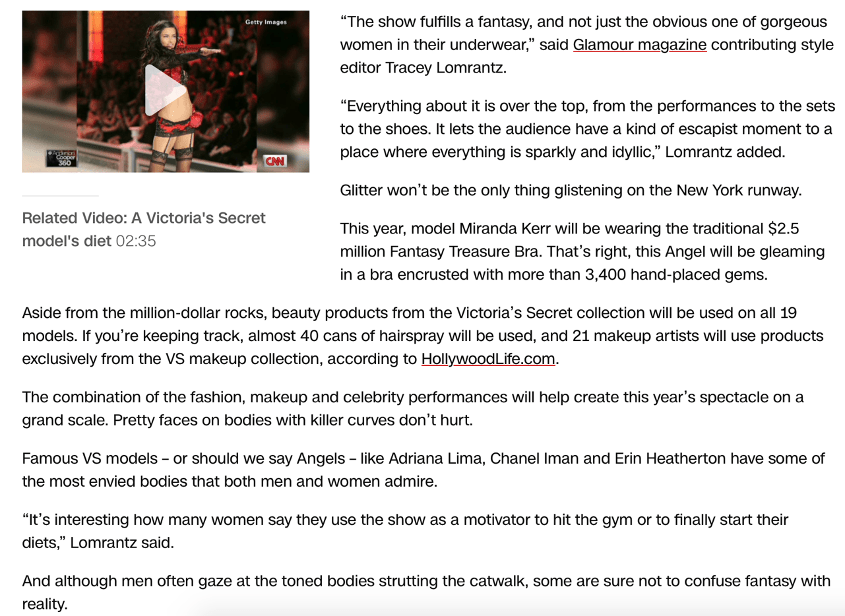
The article uses both image and copy to build anticipation through emphasising the beauty of models participating in the show. For example, the photograph shows a conventionally beautiful model: young, thin, with perfect skin and long hair. The article develops the idea of physical beauty and perfection through diction such as ‘gorgeous’ and ‘sexy’ and amplifies these with words like ‘toned’ and ‘flawless’ which suggest a sculpted, perfected ideal. The models’ beauty is enhanced through costumes and accessories: they wear ‘sky-high heels with elaborate underwear’ and the bra in the picture is ‘encrusted with more than 3,400 hand-placed gems.’ Light imagery such as ‘glitter’ is frequently employed to ‘dazzle’ the reader, enhancing the model’s physical beauty with sensory imagery that is visually overwhelming. All in all, the idea of physical beauty and a near-perfect aesthetic experience is used to tease the reader’s eyes, giving a small visual ‘preview’ that builds anticipation and expectation for the show.
Moreover, not content with a simple depiction of physical beauty, the article further implies that the experience of viewing the show will be ‘out of this world’. Again, the figures of the models are central to building anticipation as they are metaphorically transformed into ‘Angels’, supernatural beings belonging to an elevated, fantastical realm. The photo shows a model wearing angel wings, elevating her into an impossible ideal. This is reinforced by supporting descriptions which promise ‘escapism… to a place where everything is sparkly.’ At the end of the article, a hyperbole promises us that ‘we’re even closer to seeing a real-life heaven on Earth.’ In this way, the text not only transforms the models into angels, but places them in a setting that is beyond real, building anticipation through the expectation of seeing something extraordinary that other shows cannot deliver.
However, the article hints that the impossible beauty on display is no miracle but can be achieved through secrets that will be revealed in the show. The heading contains the word ‘skinny’ – a pun not only on the models’ thin body shapes, but slang for ‘insider information’. The copy includes a comment from an actual insider – model Lima – who reveals that she drinks ‘no liquids at all, so you dry out.’ The imagery of her food – ‘protein shakes made with powdered eggs’ – is an ugly contrast with the fantastical descriptions of beauty on display, and alludes to important issues of weight loss and eating disorders that plague the fashion industry. Lima’s testimony is reinforced by contributions from other industry insiders (for example, ‘Glamour Magazine’s contributing style editor Tracey Lomrantz’). In the fashion world she’s an authority figure and the writer interweaves such interviews with other persuasive features such as a rhetorical question: ‘who would want to see this spectacle?’ Statistics convey the popularity of the show: ‘nine million viewers’ and ‘more than 90 countries’, creating a bandwagon effect making the reader feel like: ‘if everyone is watching, I don’t want to miss out.’ Therefore, the article builds further anticipation by hinting at disclosures from various sources and by implying that you don’t want to be the one to miss out on these secrets.
In conclusion, through a combination of straightforward promises to see beautiful models, combined with the allure of a remarkable spectacle, and the hint that industry secrets will be revealed, the text builds anticipation for the upcoming Victoria Secret fashion show. And if all this isn’t enough, finally the writer uses second person to speak directly to potential viewers: ‘Ladies… whip out your little pink bag, Men, pop the popcorn, call your friends…’ These lines use simple gender stereotypes (women care about appearance, men are social) to get everyone excited about watching the show in their own ways.
Categories:Paper 1 Analysis
 IB Language and Literature 3.0