FRom the pRL / originally written in english / C20TH / europe / england
“What Angela Carter did with fairy tales was take the stories that we all know and turn them inside out. Take the components that were familiar and make them into something that gave women back the power”
Jeanette Winterson
Introduction
Published in 1979, The Bloody Chamber and Other Stories retells classic fairy tales in a disturbing, blood-tinged, explicit way. Angela Carter revises Sleeping Beauty, for example, from an adult, twentieth-century perspective. You might think that fairy tales are the sorts of stories to read to children in bed to lull them to sleep – not these versions! Her renditions are intended not to comfort but to disturb and titillate. The title story re-appropriates the legend of Bluebeard, a mysterious French nobleman who has had many wives. The legend, as recorded by the seventeenth-century author Charles Perrault, begins with the marriage of a girl to an eccentric, wealthy man. Called away on business, the newlywed husband leaves his wife the keys to every room and cabinet in the house. This keyring includes one key that she must not use: the one to the room at the end of the great gallery. Of course, like all fairytale heroines worth their salt, she enters the room forbidden to her – and discovers… well you’ll have to read the story to find out.
Though following the basic structure and plot of many fairy tales with which you’ll be familiar, the stories in The Bloody Chamber flesh out characters and describes settings in a lurid way. Carter’s tales raise issues of sexual awakening and sexual depravity, of the will to live, and of life in hell. Carter flips traditional viewpoints and tells familiar tales in a fresh and modern way.
IB Learner Profile: Knowledgeable
“We develop and use conceptual understanding, exploring knowledge across a range of disciplines. We engage with issues and ideas that have local and global significance.”
A central theme of The Bloody Chamber, especially the title story, is that knowledge can be dangerous… especially for women and girls. The narrator of the first story is protected by her innocence, yet tempted by her curiosity. Her husband uses her desire for knowledge and experience against her, stripping away her protections and manipulating her to fall into his trap. Carter asks us to consider how, throughout legend and yore, curious women have been punished for having the temerity to seek out knowledge: look what happened to Eve and to Pandora (of Pandora’s box fame).
Lang and Lit Concept: Transformation
Transformation in one form or another is concept you’ll come back to time and again when studying this text. You’ll learn about the appropriation and re-telling of Charles Perrault’s stories from Carter’s fresh, feminist perspective; you’ll see how the male gaze transforms the way women look at themselves; and finally you’ll discover the stages in the ‘rites of passage’ by which children are separated from the world they know and love and follow a path that leads to adulthood.
The Bloody Chamber (Part 1): Liminality
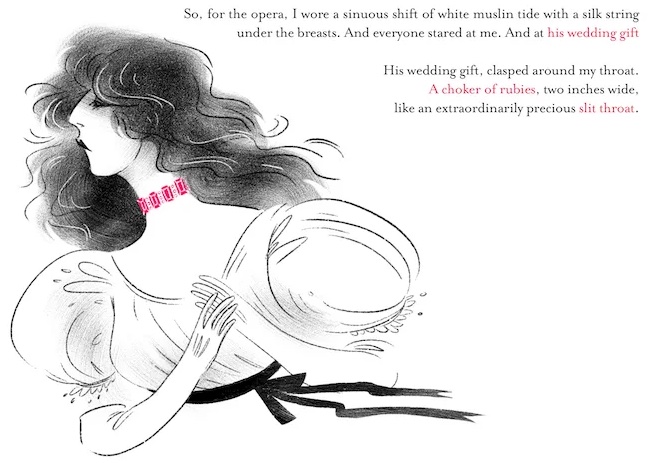
We meet the heroine of the story on a train that is whisking her to the residence of her new husband. Excited by thoughts of making love to her husband for the first time, the young girl can barely sleep. Instead she dreams of what her new life might be like and remembers their eccentric courtship. An older man, her husband is also rich and famous. He seduced her with flamboyant gifts of sumptuous clothing, took her to the opera where she enjoyed being the center of attention, and proposed with an opal ring which was an old family heirloom. On their wedding day, her husband adorned her with another family heirloom: a ruby choker.
Despite her mother’s doubts about this hasty arrangement, and her nurse’s distrust of her husband’s many previous marriages, our heroine thinks nothing of her husband’s quirks and passes the night in breathless contemplation of what awaits at his residence: a magnificent castle, separated from the mainland at high tide, in which she longs to bear him a son and heir to his considerable fortune.
Resources
Wider Reading
Secrets of the Castle
Music is a motif throughout this story. The young narrator is a pianist, and her musical talent represents her core identity. When she is in danger, she turns to music as a protective force. What happens if she loses her ability to play? Keep track of when and where the narrator plays the piano at different parts of the story.
The Bloody Chamber (Part 2): Into the Castle
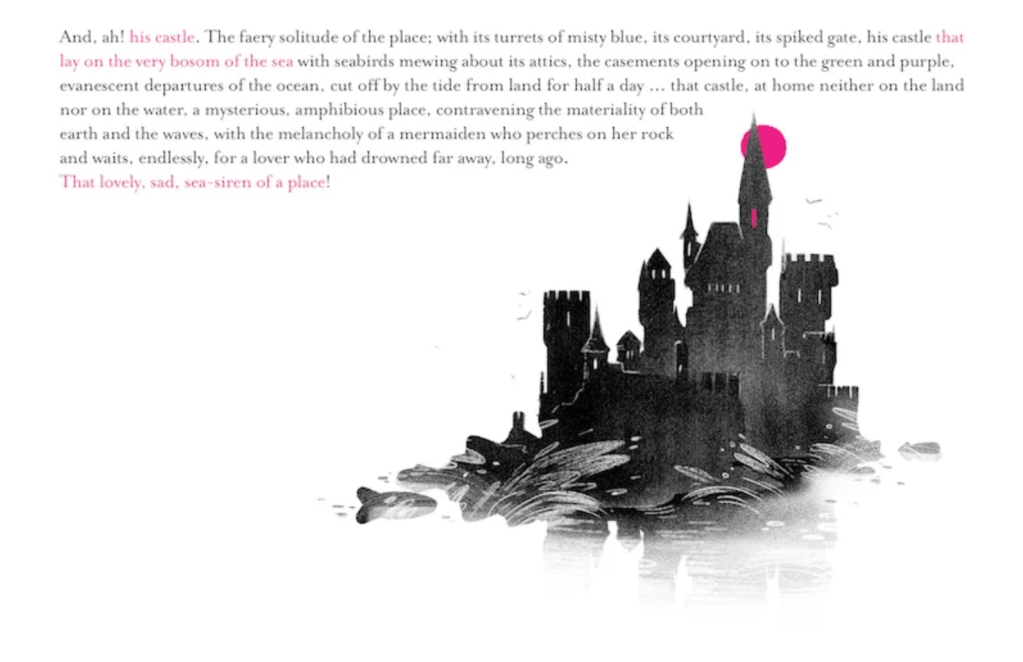
Secrets of the Castle
Is there a connection between the Marquis’ third wife and the titular character of the story Lady of the House of Love that you can read later in the collection? She signs her letter to the Marquis with the letter C, implying she’s Carmilla, a vampire countess from the 19th century gothic novel by Sheridan Le Fanu.
Learner Portfolio: rite of passage
The narrator’s visit to the Bloody Chamber can be seen as the ‘liminal’ stage from the Rites of Passage, or the ‘Ordeal, Death and Rebirth’ moment in Joseph Campbell’s Monomyth. After this moment, the narrator has transitioned from childhood to her adult self.
Create a piece in which you compare and contrast the narrator’s appearance, thoughts, speech, actions and behaviour from before the visit to the chamber with aspects of her character after the visit. What does a close study of these things reveal about the narrator’s ‘new self’? Think about how you would like to present this work: of course you can always write an essay or reflection. But you could also use a venn diagram, create a split-character profile, draw an annotated diagram, even design a map of the narrator’s journey through the castle.
The Bloody Chamber (Part 3): The Ritual Sacrifice
“Any bride brought to this castle should come ready dressed in mourning.”
Resources
Wider Reading
Secrets of the Castle
The Marquis is the only antagonist in the collection who is not literally a beast, although it’s tempting to classify him as a monster representing the worst of humanity. However, Carter takes care to show that he’s only human too. The narrator describes a ‘stench of despair’ emanating from him, normally covered up by his strong perfume, and she can sense his ‘atrocious loneliness’. In this way, his character is given a little more complexity than a classic fairy tale monster.
Learner Portfolio: Looking and Attention
One of the overriding concerns of ‘The Bloody Chamber’ is the damaging ways in which men look at women, and the way, in turn, in which women can come to enjoy being looked at in a certain way by men. Jean-Yves, as a blind man, is physically incapable of the Marquis’s ‘male gaze’, something Carter emphasizes from his first appearance, when the narrator mentions how his ‘grey eyes fixed upon me although they could not see me.’
Research the male gaze by reading articles like these ones by Janice Moreck from Monash University and this by Laura Mulvaney or any others you find independently. Try to find out what are the constituents of the male gaze (for example, objectification)? Create an explainer (such as a Cornell note-taking document, mind-map, or mini-essay) of how The Bloody Chamber shines a light on the phenomenon of the male gaze. Include plenty of quotations and details from the story.
Wolf Trilogy
“Fear and flee the wolf; for, worst of all, the wolf may be more than he seems.”
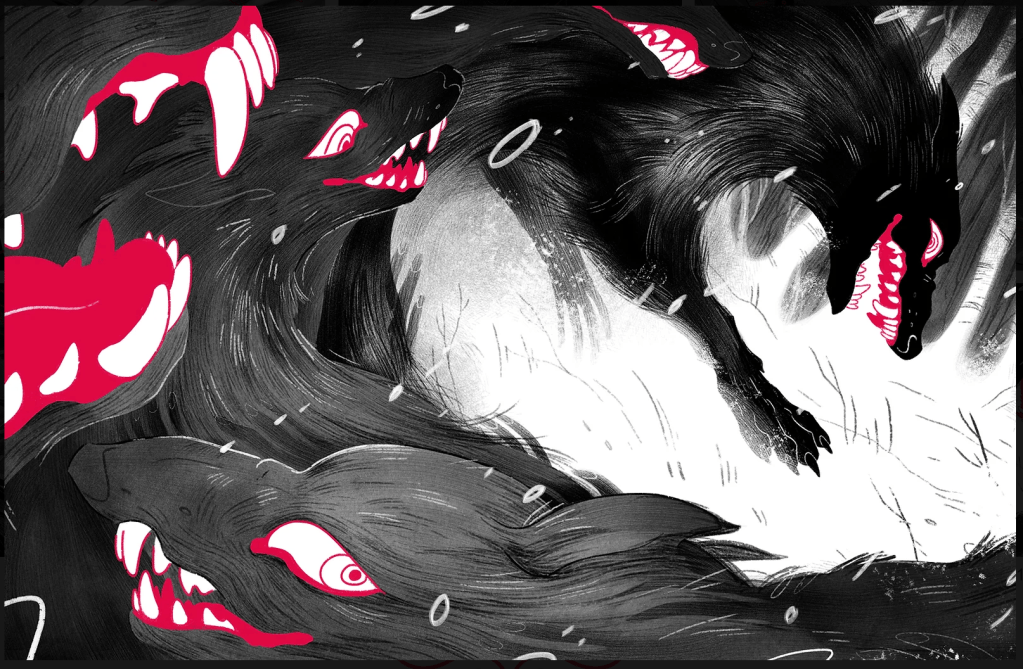
Collectively known as Carter’s ‘Wolf Trilogy’, The Werewolf, The Company of Wolves and Wolf-Alice all draw, to a greater or lesser extent, inspiration from Little Red Riding Hood. But Carter takes us back to the stories’ genesis, when they were wilder, grimmer, more brutal than the story of a sweet girl taking cakes to her grandmother. In far northern lands where superstition is widespread, a trio of young women venture from the safety of hearth and home into the wild, where fearsome wolves – and worse – roam the dark forests, desperate to slake their hungers.
Secrets of the Castle
Learner Portfolio: Practise for Paper 2
Write this Learner Portfolio in the style of a practice Paper 2 response. You can use one of the prompts below, or another prompt given to you by your teacher. Although Paper 2 requires you to write about two literary works, for the sake of this exercise you could focus only on your response to The Bloody Chamber, or you could try to compare your ideas to another literary work you have studied (visit this post for more help with Paper 2 ):
- “Coming of age stories” are ones which present the psychological, moral and social shaping of a character. Discuss how characters develop in works you have studied.
- Animals and images drawn from the world of animals are a rich source of inspiration for writers. Discuss how animals are used to develop central ideas in works of literature you have studied.
- “All that glitters is not gold.” Discuss how appearances are misleading in literary works you have studied.
- Does good always triumph over evil in the literary works you have studied?
Towards Assessment: Individual Oral
Supported by an extract from one non-literary text and one from a literary work (or two literary works if you are following the Literature-only course) students will offer a prepared response of 10 minutes, followed by 5 minutes of questions by the teacher, to the following prompt: Examine the ways in which the global issue of your choice is presented through the content and form of two of the texts that you have studied. (40 marks)
The Bloody Chamber would be a good text to talk about in this oral assessment. Once you have finished studying the collection of stories, spend a lesson working with the IB Fields of Inquiry: mind-map the novel, come up with ideas for Global Issues, make connections with other Literary Works or Body of Works that you have studied on your course and see if you can make a proposal you might use to write your Individual Oral. Here are one or two suggestions to get you started, but consider your own programme of study before you make any firm decisions about your personal Global Issue. Whatever you choose, remember a Global Issue must have local relevance, wide impact and be trans-national:
Literary pairing
Body of work Pairing
- Field of Inquiry: Beliefs, Values and Education
- Global Issue: female desire should not be a taboo topic
- Rationale:
In The Bloody Chamber stories Carter challenges the taboo surrounding female sexuality by presenting heroines who embrace desire, curiosity, and bodily autonomy. Her retellings frequently – and sometimes graphically – reclaim female sexual experience from shame and silence. A translated work that similarly demonstrates female desire and argues female bodily autonomy should not be suppressed in society or in literature is The Vegetarian by Han Kang. While Yeong-hye dares to step outside the prescribed limits of a woman’s muted sexuality in part two, the wider novel shows how women’s sexual liberation is met with hostility and, ultimately, by punishment.
- Field of Inquiry: Science, Technology and the Environment
- Global Issue: fear of the wild leads to the destruction of nature
- Rationale:
Throughout this collection, fear of the wild becomes a driving force that fuels attempts to suppress or destroy nature. In the Wolf Trilogy of stories, villagers’ terror of wolves leads to hunts, killings, and the relentless policing of the forest. A body of work that reveals a similar human tendency is George Monbiot’s essays and articles. He writes about a desire to eliminate the uncontrollable wild spaces of the world, and describes environmentally destructive practices fuelled not only by corporate greed, but by fear and ignorance of the wild.
Towards Assessment: Higher Level Essay
Students submit an essay on one non-literary text or a collection of non-literary texts by one same author, or a literary text or work studied during the course. The essay must be 1,200-1,500 words in length. (20 Marks).
Once you’ve finished studying The Bloody Chamber, and if you are an HL student, you might consider using this text to write your HL Essay. Here are one or two examples of lines of inquiry suitable for this text – but remember to follow your own interests and the direction of your own class discussion to generate your own line of inquiry. It is not appropriate for students to submit responses to an essay question that has been assigned:
- How does Angela Carter use setting to express the dangers and discomfort of transformation in the stories of The Bloody Chamber?
- How does Angela Carter rework fairy tale conventions to shape fully formed women’s identities throughout the stories in The Bloody Chamber anthology?
Categories:Prose
 IB Language and Literature 3.0