Unseen Text: If you want to follow your dreams, you have to say no to all the alternatives
Text Type: Blog Post
Guiding Question: How do authorial choices help to create a persuasive message?
Blogs are a really great text type to practice with. Written by different people for a variety of individual purposes, each blog has its own distinct flavour, original uses of language, interesting hooks, and stylistic features for you to consider. The sample you’ll read below was written by Mahir Isic, a Bosnian student preparing for his upcoming Paper 1 exam. I hope you’ll agree he’s done a great job picking out a suitable range of ‘authorial choices’ – some visual, some linguistic – as required by the guiding question. How would you have answered this question? Remember that, while this is an impressive answer, there’s other features of the text that you might have used instead and alternative approaches can be equally valid:
Sample Response
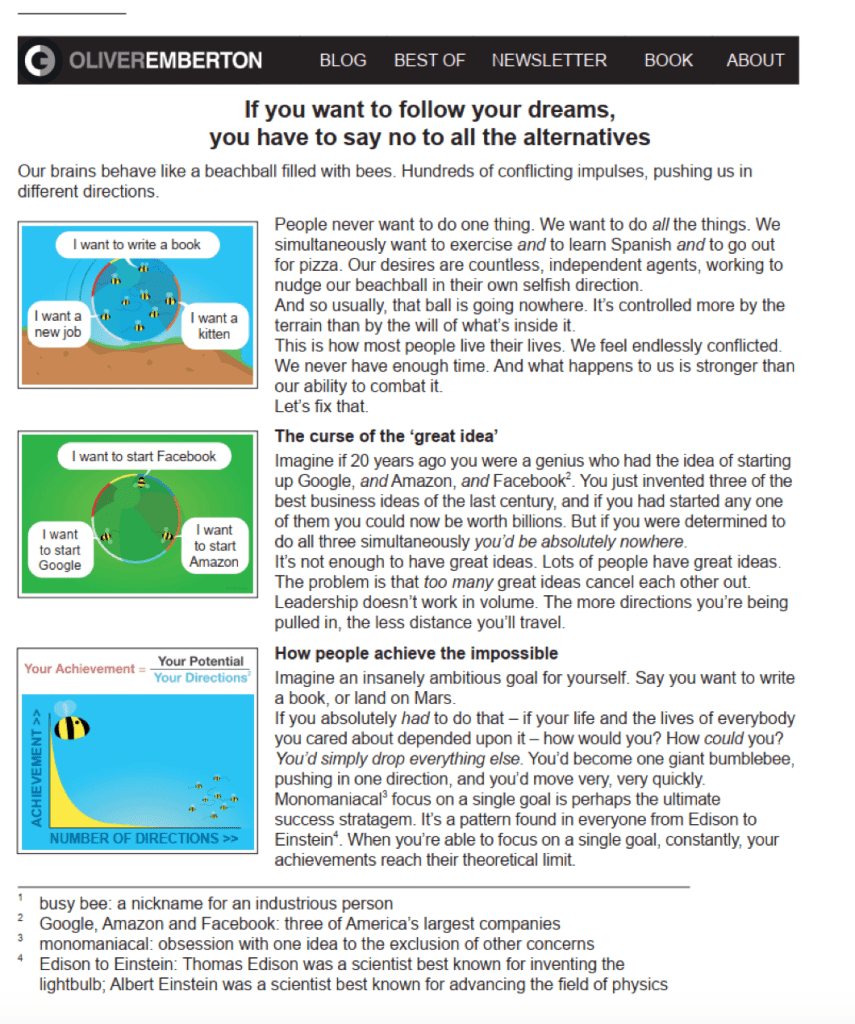
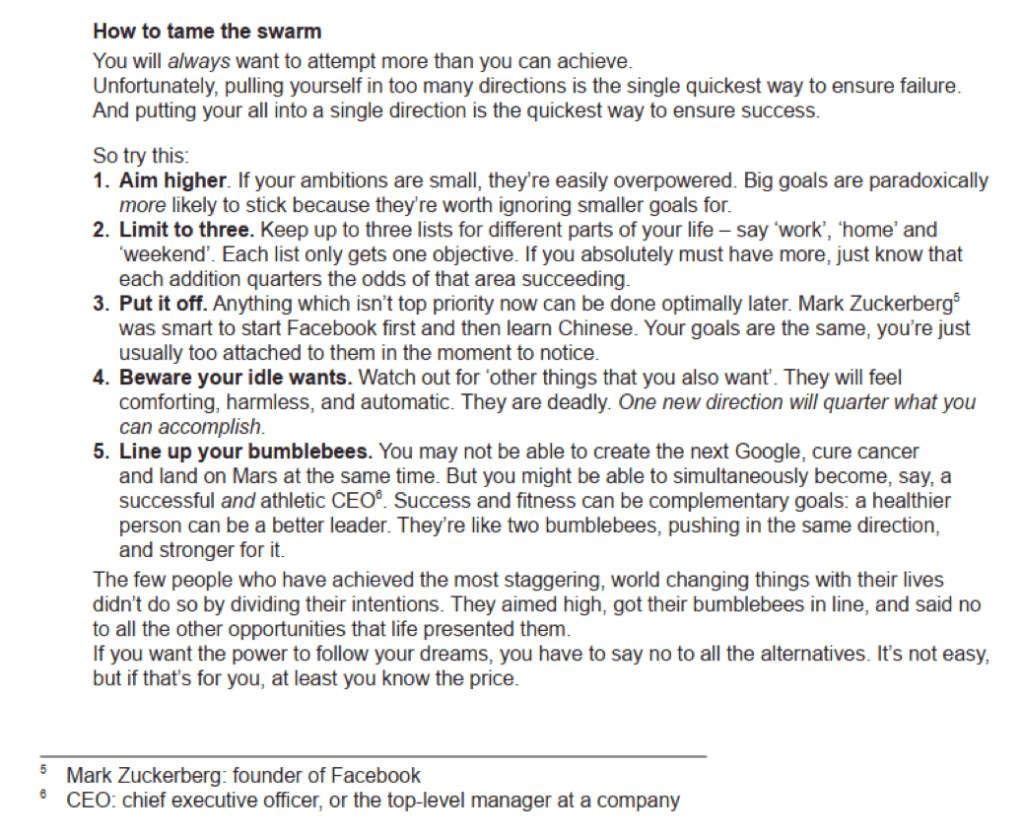
The given text is a blog post by Oliver Emberton, a self-professed ‘busy bee’ meaning he likes to undertake lots of projects at the same time. In this text, Oliver gives advice to the readers of his blog, aiming at a wide range of people who have similar high-achieving aims, but who set themselves too many conflicting targets, so they ultimately don’t achieve anything tangible. In his blog post. Oliver uses the extended metaphor of ‘busy bees,’ accompanied by simple illustrations and reference to well-known successful creators, to persuade his readers to target their efforts at fewer goals and work on ideas one at a time.
Firstly, Oliver uses generalisation to hook his target audience and encourage them to recognise the shared tendency to set conflicting targets that make achievements impossible. He imagines a hypothetical situation where somebody wants to ‘learn Spanish’, ‘exercise’, and ‘go out for pizza’ all at the same time. These activities represent the popular desire to be healthy, productive, and enjoy life: it might be hard to find a person who does not want these things so Oliver says that this is ‘how most people live their lives… endlessly conflicted’. It is not difficult to exercise, learn Spanish, or enjoy oneself, but to do all these things simultaneously is a great challenge, which Oliver emphases using typography by italicising the word ‘and’ as he adds all the activities together. If we live our lives lavishly, then we might feel useless – but time is a resource that cannot be divided. This is the paradox that Oliver illustrates through side panels. In the top panel, he presents an image of many bees clustered together inside a beachball. According to this metaphor, the beachball is a person’s brain and the bees are ideas. Because there are too many conflicting ideas – even nice ones such as ‘I want a kitten’ and ‘I want to write a book’ – the bees are frozen in mid-flight, going nowhere. The image itself is slightly ironic, as bees are usually seen as hard-working and goal-oriented creatures, while in the image they are staring at each other with no coordination or productivity. However, this metaphor is simple and humorous, and supports the generalisation in conveying Oliver’s idea to a wide range of people.
Once he’s hooked his audience, Oliver demonstrates how unproductive it is to have many goals at the same time through an imaginative example using Google, Amazon, and Facebook. These are all global names that many readers will undoubtedly recognise as successful companies, so Oliver states his belief that if the companies had been created by one individual at the same time, they wouldn’t have been nearly as successful. Working hard towards one goal is what Oliver persuades his audience to do, as otherwise ‘you’d be absolutely nowhere.’ This is an example of Oliver using assertion to persuade his readers, who might find it hard to disagree with his strong statement even though his example is imaginary. Furthermore, he matches the alignment of the side panels with his writing; the image accompanying this part of the copy juxtaposes with the first image, showing only three bees going in different directions, staunchly focused on one goal each (as bees usually are), as stand-ins for the heads of Google, et al. He further simplifies his message through a graph; one huge bee going in one direction is high on the achievement axis, while many small bees, representing a number of goals and directions, are low on said axis. While his example is not provable, his assertion that achievement and productivity are proportional to directed effort is highly persuasive. Therefore, by using imaginative examples, but presenting them alongside graphs and symbolic icons, Oliver transmits his core message (that being overcommitted means being unproductive) in different ways for his reader.
The second half of his blogpost presents a shift from theoretical to practical, as he gives readers a simple outline guide to ‘tame the swarm’ of ideas. He extends the ‘bees’ metaphor through the word ‘swarm’, which suggests an uncontrolled, random and chaotic mass of bees/ideas. To help readers control, or ‘tame’, too many creative urges at the same time is the whole purpose of this blog. Therefore, he presents five simple steps such as aiming high, limiting our goals, and putting off anything that could sidetrack us to form the basis of any success plan, while keeping a focused mindset is the fourth step. His last step is perhaps the most important one, as he reassures readers: ‘you may not be able to create the next Google’ but ‘you might be able to become… a successful and athletic CEO.’ This message of shooting for the moon and falling on the stars is emotive, powerful and uplifting for readers, reassuring them that failure is the pathway to success. Everyone dreams of creating the next Google; however, there’s nothing bad about being at the top of a moderately successful company either. Oliver’s five steps are simple on the surface, but deep enough to inspire his readers to expand them into a more detailed plan, representing the ‘one direction’ that Oliver encourages his readers to find which will ‘tame the swarm’ of ideas. Overall, the move from theoretical to practical helps readers understand that the specific problem Oliver outlines has a solution, offering people who find it hard to be productive concrete actions they can take which will help.
In conclusion, Oliver’s blogpost about aiming high is straightforward and carries a simple message in a positive way. He tells us how and why humans are the way they are, and encourages us to improve in one area of setting goals. His copy, while sometimes assertive, is not ambiguous or highly complex, making it easy to understand. The images and comparison with hard-working bees is similarly comprehensible. With this in mind, out of all those who read the blogpost, one or two of Oliver’s ‘busy bees’ might find their way to creating the next Google, Amazon, or Facebook.
Categories:Paper 1 Analysis
 IB Language and Literature 3.0