Unseen Text: Aggressiveness and Readiness Gestures
Text Type: Self-Help Guide
Guiding Question: How does the author of the text reveal his purpose and the values that are important to him?
The ability to be a critical and independent thinker is highly prized by the IBDP. Attributes such as ‘inquirer,’ and ‘thinker’ are boiled in to the IB Learner Profile, providing clues as to how to approach your learning and assessments. In that spirit, here’s a more challenging past paper from a long time ago when the Language and Literature syllabus was very different. While recent texts haven’t had such a dated feel, nevertheless it was an interesting exercise to try to write a sample response thinking about the expected outcomes for Paper 1 as it is set today. Before you read the answer that follows, spend 15 minutes or so thinking how you might answer the question of how the writer conveys values that are important to him, selecting a manageable number of elements from the multimodal extract. Remember, my approach is just one way of responding to the given text; the ideas you come up with can be equally valid:
Sample Response:
The given text is an extract from a self-help guide called Body Language: How to read others’ thoughts by their gestures, written by Alan Pease. The purpose of this extract is to educate readers about the importance of body language in conveying a person’s attitude of aggression which the writer interprets as ‘readiness’. This purpose also exposes a value that is important to the writer: rather than conveying the perception of aggression as abnormal or undesirable, he frames it as a natural human trait that is aroused in situations like sales or sport.
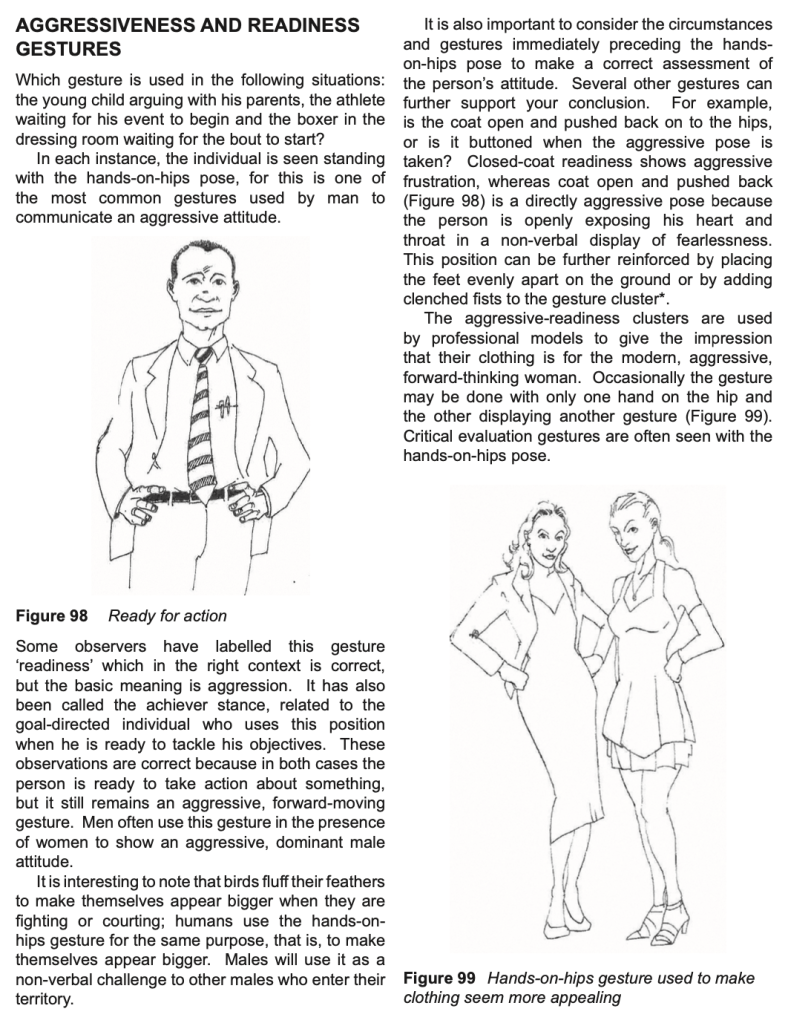
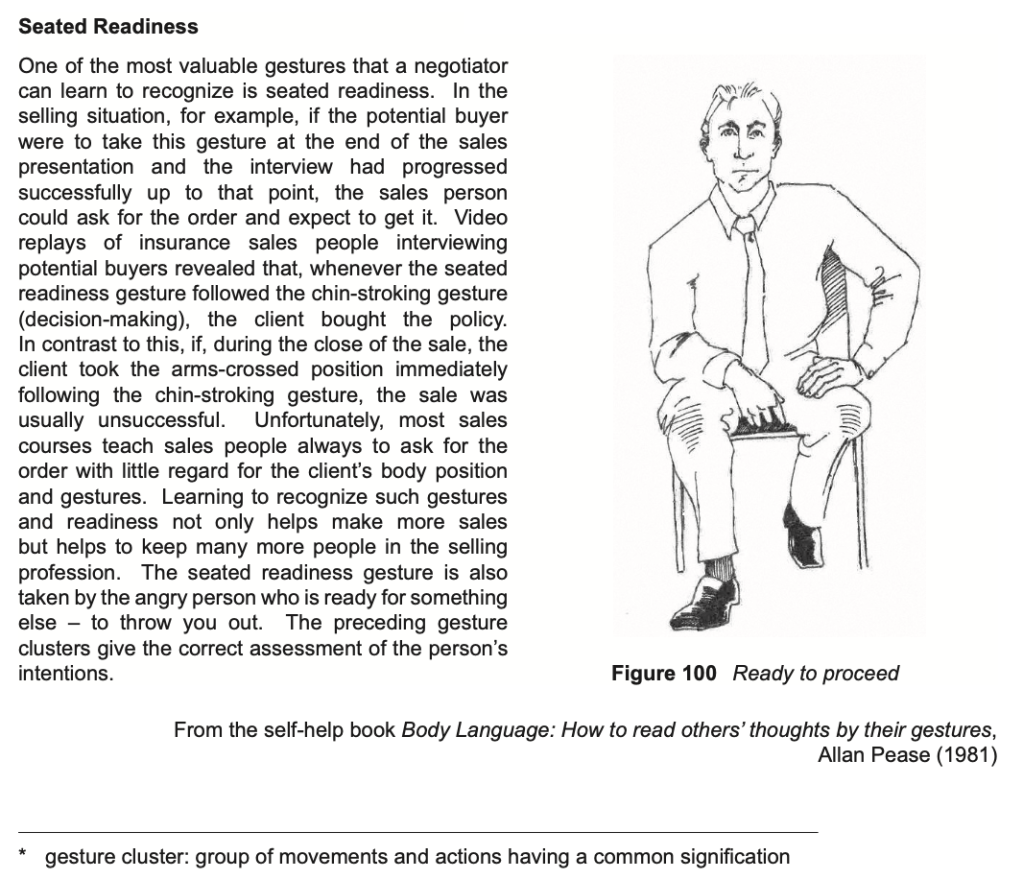
Firstly, the writer uses simple line drawings of men and women in the “hands-on hips pose” as a way of directly teaching readers how to recognise the signs of aggression or ‘readiness’. The most important element of the drawings is body language: men and women are pictured with their hands on hips in a pose that conveys strength and confidence. Accordingly, their facial expressions are neutral, implying they are in control of their emotions, while their gazes look directly at the reader, making eye contact in a strong and challenging way. In both images, the men and women are wearing formal clothes suitable for a business setting or “negotiation.” The man’s tie in particular, as well as the pens within easy reach in his top pocket, symbolise his ‘readiness’ to get the job done. The drawings have captions which interpret the body language for readers in simple terms, repeating the word “ready” so we understand Pease’s belief that aggression is more about ‘readiness’ than merely anger. Therefore, the line drawings of men and women reveal the writer’s purpose of educating people to spot the signs of aggression-readiness, and his belief that aggression is not about violence, but about preparedness or competition.
Furthermore, the writer uses comparisons and analogies to convey his values about aggression meaning ‘readiness’ and his belief that this is natural human behaviour. He compares the way “humans use the hands-on-hips gesture” to how “birds fluff up their feathers to make themselves appear bigger when they are fighting or courting.” Calling attention to similarities between human behaviour and the behaviour of animals in the wild destigmatises aggression and makes it seem like something more natural, and thereby acceptable. Similarly, at the beginning of the article, the writer describes the similarity between “the young child arguing with his parents” and “the boxer in the dressing room waiting for the bout to start.” Calling attention to the common characteristics of children and professional fighters suggests that aggression is something universal amongst all people. Moreover, the article contains a lexical field of aggressive words such as “angry… dominant… fearless… fighting” which helps to convey the idea that violence is an inherent human trait, and especially a masculine one. Therefore, the writer’s use of analogy and comparison, combined with the embedded diction of aggression, helps communicate the value that aggression is not something to fear, but to understand as a natural part of communication amongst people in many contexts.
Finally, the writer uses an authoritative tone and explicatory language to convey his messages about aggression and readiness. Especially towards the end of the text, he repeats the word “learn”, “learning” and “teach” to express the idea that body language and aggression signals can be ‘learned’ as much as any other kind of language. Phrases such as “it is also important to consider…” convey the impression of an authoritative speaker guiding students through a course of study. Pease signals a deep knowledge of his subject by the way he goes into detail: for example, he writes about the use of clothing to subtly alter the meaning of certain aggression signals, such as the difference between “open coat” and “closed coat” readiness poses. This kind of attention to detail signals the writer’s expertise, as does his use of technical language. For example, “readiness gestures” and “gesture clusters” are phrases that carry the weight of formal, academic study. Therefore, the writer combines a use of learned, technical language with an authoritative tone to further express the importance of understanding the subtleties of body language as a means of communication.
In conclusion, the purpose of the text (to educate about the importance of body language in communication) is intertwined with the values that are important to the writer. He believes that, far from being something abnormal or fearful, aggression is a natural form of human ‘readiness,’ used in everyday contexts such as sales, business negotiations, and even modelling. He conveys his meaning clearly through simple line drawings showing men and women projecting confidence and assertiveness in everyday contexts, matching the depiction of ‘readiness’ with the use of confident and assertive language, passing on his own expertise to the reader.
Categories:Paper 1 Analysis
 IB Language and Literature 3.0