Unseen Text: UK Weather
Text Type: News report
Guiding Question: How do the writers dramatise the weather and its effects in this report?
This text is a little unusual as, even though it’s purportedly a news report, it actually warns people about a future event rather than recount something that happened in the recent past. Nevertheless, anyone familiar with a weather report shouldn’t be too thrown by this aspect of the extract. The Guardian has proven to be a particularly fertile source of texts for Paper 1 in the past, possibly because their journalism is of a high and reliable standard, and possibly because the articles in both print and online versions range widely across different topics, themes and events. If you’re familiar at all with the Guardian you might be surprised at how dramatic and sensational this article turns out to be. You shouldn’t worry about that – in fact, this could form the basis of a strong analysis, as you’ll see in the sample response that follows. As always, this response is just one of many possible ways to analyse this text and your own, individual response can be equally valid.
UK weather: snow and ice warnings cause travel disruption
Dozens take shelter in school overnight after becoming stranded on A30 as bitterly cold temperatures return
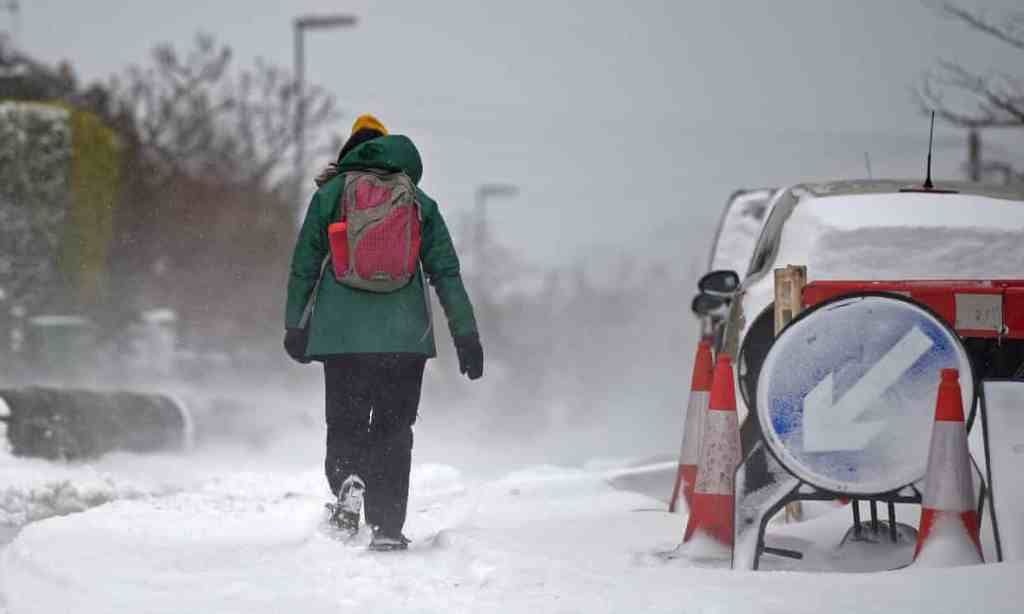
Britain faced further travel disruption on Monday as the “mini beast from the east” brought snow and ice to large areas of the UK overnight.
Parts of Devon and south-west England were expected to bear the brunt of the freeze on Monday, with up to 30cm of snow in some parts of the region compared with up to 10cm for the rest of Britain.
Highways England closed the A30 in both directions between junction 31 of the M5 and the A38 in Bodmin due to what police described as conditions “changing rapidly from passable to impossible”.
Eighty-two people were forced to take shelter in a school after becoming stuck on a 64-mile stretch of the A30. They were moved to a rest centre at Okehampton College at the north side of Dartmoor.
Meanwhile Devon County Council confirmed the closure of dozens of schools on Monday, while train services were also said to be affected.
It comes after hundreds of flights were cancelled and sports events called off as plummeting temperatures cast a blanket of snow across the UK on Sunday, with further “disruptive snowfall” overnight.
Mark Wilson, a Met Office meteorologist, said: “It’s going to be a very, very cold start, with a widespread frost and ice around as well.”

The Highways Agency urged motorists everywhere to drive with caution on Monday and pack snow kits of blankets, food, water and a shovel in areas of heavy snowfall.
In Cornwall, an Asda manager said some stores were running low on bread and milk as customers were panic-buying after the original “beast from the east” saw shelves being cleared of groceries earlier this month.
In Cumbria, mountain rescue teams were called to help 15 people stuck in a cafe near Kirkby Stephen while an ambulance crew struggled to reach patients in Langdale, a valley in the heart of the Lake District national park.
The weather brought traffic to a standstill on some of the country’s busiest roads on Sunday, including the M62 in Yorkshire.

One resident, Stephen Chadwick, described how a cliff gave way. Speaking to BBC News, he said: “I woke up this morning, had a cup of coffee at 7.30 … it was like an earthquake and the cliff just went.”
– Taken from theguardianonline, published by The Guardian Newspaper (2018)
Sample Response:
This article is taken from theguardianonline and seeks to warn readers about the disruption across the country caused by severe weather such as unseasonably cold temperatures and heavy snow. The writers achieve this by using sensational language, presenting an ‘authority-disorder’ narrative, and using embedded interview snippets from a range of sources – all combining to warn people of the dramatic dangers posed by extreme winter weather and to convince them to take extra care to stay safe if they try to travel.
Firstly, the writer sensationalises the dangers of extreme weather through both exaggerated and figurative language. The heading introduces an element of sensationalism through the slammer; a headline in two parts separated by a colon creates a dramatic effect like a movie poster or a major event launch. The word ‘disruption’ in the headline is the precursor to a lexical field that gets progressively more serious: for example, ‘stranded’ suggests weather can cut people off from safety. Often the writer uses modifiers such as ‘very’ and ‘bitterly’ to amplify more neutral words, sensationalising information in a dramatic way. Sensationalism is multiplied when the weather is given its own name: ‘beast from the east.’ The word ‘beast’ figuratively transforms weather into an animal – and a wild or predatory animal at that. The report uses the active voice to personify the weather as an enemy, suggesting it acts with purpose: ‘cast a blanket of snow’ and ‘brought traffic to a standstill’ are examples of the weather acting with agency, making it seem more dangerous. People are represented as victims needing to metaphorically ‘armour’ themselves against the beast by packing ‘snow kits of blankets, food, water and a shovel’. Taken together, the writer combines sensational and figurative language to dramatize the weather as dangerous and even hostile to people who must take extra care to keep themselves safe.
The result of such extreme weather is an ‘order-disorder’ narrative which amplifies the dramatic danger posed until it threatens society itself. The weather is placed in opposition to forces of law and order such as the police, ambulance crews who ‘struggled to reach patients’ and drivers who were brought to a ‘standstill.’ As such, the report creates the sense that the normal order of society is breaking down. Nowhere is this more apparent than in the line describing conditions ‘changing rapidly from passable to impossible.’ The progression from ‘passable to impossible’ reflects the underlying ‘order-disorder’ narrative and is amplified by a catchy half-rhyme. The narrative is illustrated by photos which show disorder: a bus slid off the road is taken at a slanted angle and a woman dressed in heavy clothing navigates through snow. In this way, dramatic images combine with the underlying ‘order-disorder’ narrative to imply the severe disruption of the UK weather in a way that is likely to cut through and command the attention of readers.
Finally, the report embeds snippets of interviews from a range of figures to suggest the weather is so dramatic that all kinds of people must give it their attention too. Sources are a mix of expert (Mark Wilson is a meteorologist), official (the Highways Agency), emergency response (such as a mountain rescue team who had to be deployed), and even ordinary folk who bore the brunt of extreme weather; the sheer range of sources implies the extent of disruption in itself. The sensationalism of the report’s language is exemplified by Stephen Chadwick’s use of a simile to describe how the snowstorm ‘felt like an earthquake’. In this line, what was already a disruptive force is exaggerated even further into a force of destruction. There is undoubtedly a selection bias at work, meaning the writer is only selecting the most dramatic interview snippets for publication. In this way, the range of sources combines with sensational language to further dramatize the weather and the danger it poses, even to the extent of depicting it as a natural disaster.
In conclusion, the report effectively dramatizes the severe UK weather through sensationalism in language, selection of overly dramatic interviews, and through an underlying order-disorder narrative. The cold and snow are given agency and purpose, acting against human society. The intention is to not only report, but to encourage people to take extra precautions and perhaps not to venture out in the snow at all, lest they become a victim to the ‘beast from the east’.
Categories:Paper 1 Analysis
 IB Language and Literature 3.0