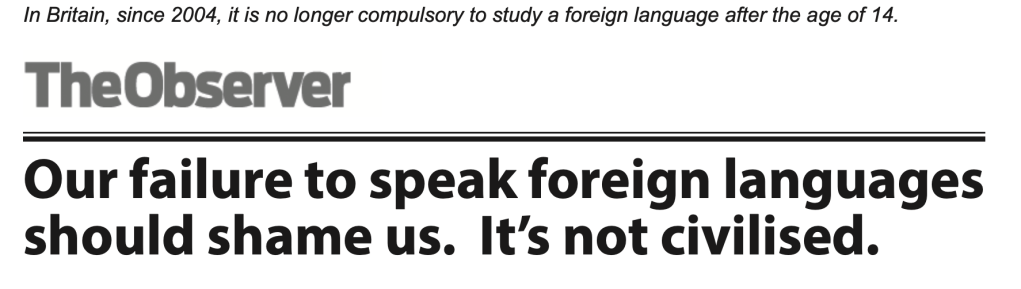
Unseen Text: Our failure to speak foreign languages should shame us.
Text Type: Opinion Column
Guiding Question: How and to what effect is figurative language used to shape the meaning of this text?
Every Paper 1 text comes with a guiding question to help focus your planning and encourage you to write a worthwhile analysis. While it’s not compulsory to use the guiding question, I think it’s highly recommended, especially when the question points you towards a significant choice made in its creation. A while ago, a question was asked about how figurative language shapes the meaning of a text. So this response has been rewritten with that question in mind. Look out for two part questions: both ‘how’ and ‘to what effect’ need dealing with over the course of your answer. As ever, this sample response is but one way of approaching this question and alternative responses can be equally valid:
Sample Response:
This extract is an opinion piece written by Michael Hoffman and published in The Observer, a Sunday newspaper in the UK. His topic is the learning of foreign languages in Britain. Hoffman complains about the way language lessons have been marginalised in schools and criticises the reluctance of English people to learn a foreign language. In order to support his argument, he uses figurative language to deliver his ideas about the fading relevance of foreign languages to British people, to lament the sad state of today’s educational landscape, and to create a compelling argument for the learning of foreign languages at school.
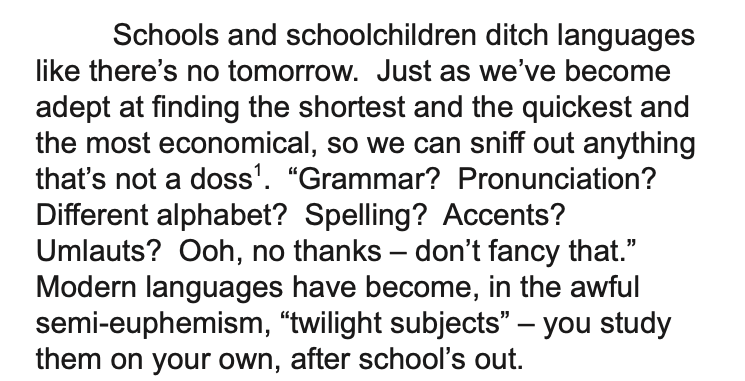
In order to convey his idea that learning foreign languages has lost relevance, Hoffman uses a euphemism to draw attention to how they have been deliberately marginalised in schools. In the lead or bridge paragraph, he reports that they have now become “twilight subjects” and clarifies that this means “you study them on your own, after school.” The label ‘twilight subject’ connotes an in-between time, neither day nor night, conveying the state of foreign language subjects: technically they are still available to learn, but they no longer command the attention of educators and learners. Metaphorically, they have ‘lost their place in the sun’ or are no longer ‘in the spotlight’. The word ‘twilight’ carries additional connotations of fading away or even, in some contexts, of dying out. There’s an irony in the idea of studying a language ‘on your own’ as the whole purpose of speaking any language is to allow one to communicate with and connect with other people. Therefore, not only is the figurative euphemism ‘twilight subject’ a vivid way of conveying the fading relevance of language learning, but it also serves to communicate the counter-effective way that people who do still value foreign languages are forced to learn once languages lose their place on school core curriculums.
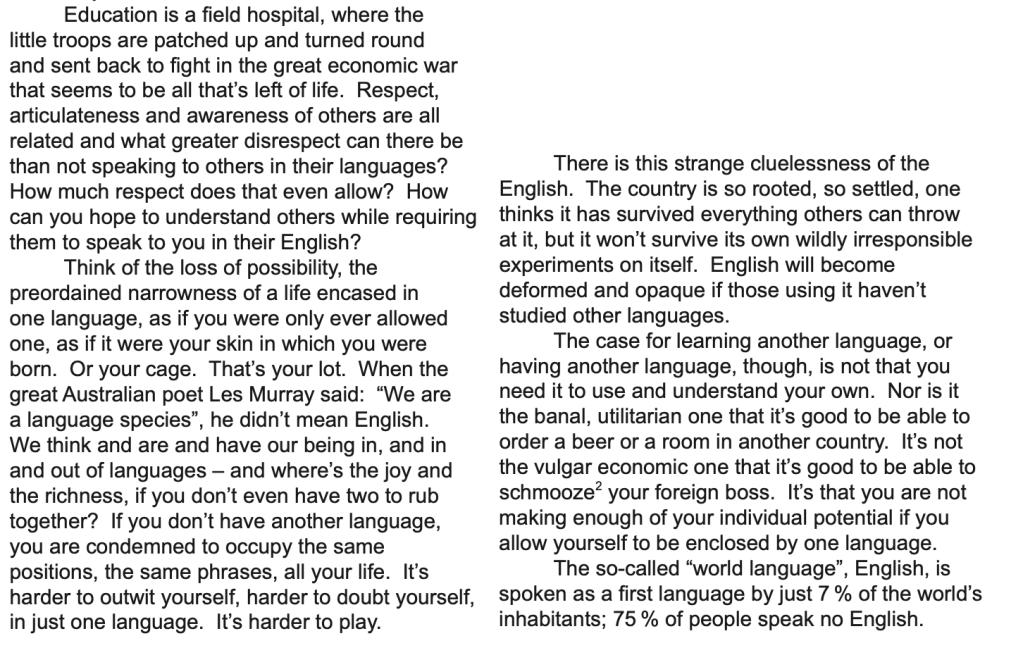
Hoffman extends his lamentations over the state of foreign language education to education in general through using the figurative language of war. He envisages life as a “great economic war” and children are the casualties of this war. The phrase ‘great war’ alludes to World War One, which has connotations of enormous death and destruction, especially for British readers who’s ancestors may have fought in this war. By reframing the whole of life as a ‘great economic war’, Hoffman strongly implies that placing economic value on everything results in a similar ‘no-win’ situation as a war between two countries. The implication is that some parts of life should be lived separate from economic considerations, and he places language learning in that category. Sadly, as language learning is not seen as a direct contributor to the British ‘war effort’ it is deemed of little value. This metaphor is extended through the depiction of education as a “field hospital” where children are cared for – but only insofar as they are patched up and sent back out to fight in this war. In this way, Hoffman indirectly attacks the idea that the purpose of schools is to prepare learners for the world of work. Therefore, he uses the language of war critically and ironically, strongly conveying to readers the opposite meaning – schools should not be places that exist to prepare students for life on an ‘economic battlefield’.
Finally, Hoffman uses figurative imagery not only to lament the current state of foreign language learning, but to argue for the restitution of foreign language classes in schools. He develops the metaphor of “a cage” and the description of life lived inside the cage is “preordained narrowness.” If life is ‘preordained’ it means that people don’t get to choose for themselves what subjects or interests to follow. This connects to the text’s central argument: if foreign language learning is no longer offered in schools, it erodes the ability of people to live life their own way, going back to the image of schoolchildren like soldiers, all lining up in identical rows, being trained for the same things in the same jobs. The metaphor of the cage is extended using diction such as “encased” or “narrowness”, as if speaking only one language is overly restricting. Hoffman directly states his opinion that learning a foreign language is the way out of being trapped in this way. Therefore, the metaphor of the cage becomes an important component of Hoffman’s argument – if we want to have agency and control over something as essential as our own thoughts and minds, we should reinstate foreign language learning in our schools.
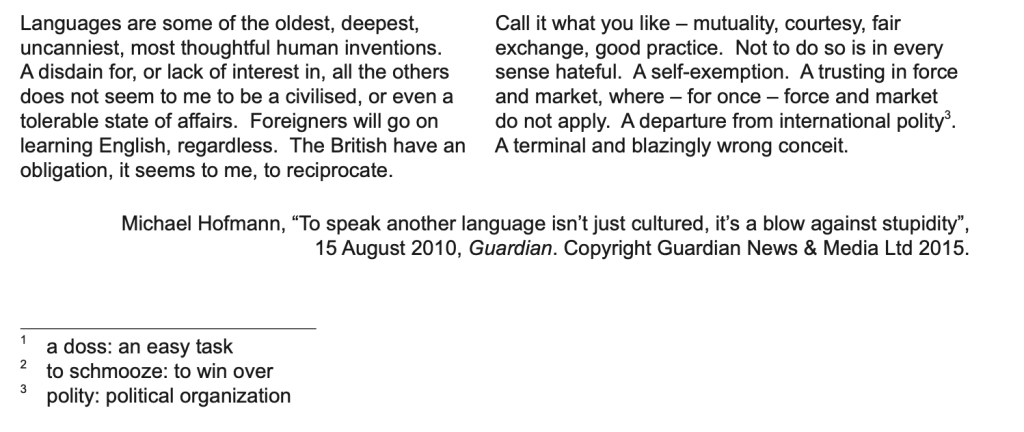
In conclusion, Hoffman uses figurative language to position language learning as a casualty of economic-first educational thinking. He tries to develop an appreciation of language beyond a tool used to “schmooze your foreign boss” or for“international polity.” The true value of languages can be found in ideas such as “respect… mutuality and courtesy.” Indeed, in the text’s heading he suggested that what makes people “civilised” is the willingness to strive for the qualities that learning foreign languages represents. British readers may be put in the uncomfortable position of having a historic national value questioned and challenged.
Categories:Paper 1 Analysis
 IB Language and Literature 3.0